.svg&w=384&q=75 "Naijagoal logo")

Qatar Holds Switzerland to 1-1 Draw: Tactical Survival Analysis
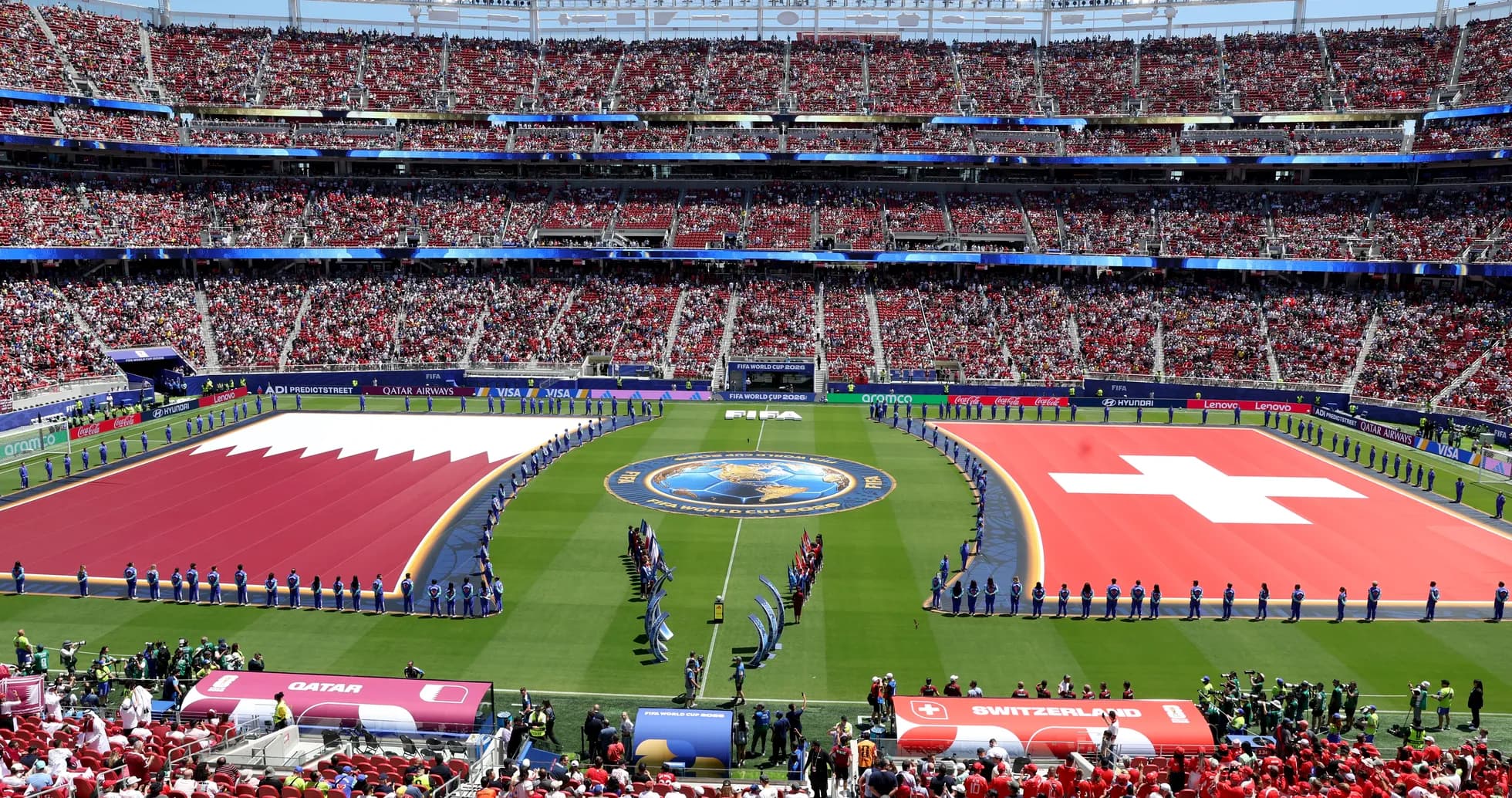
Qatar’s 1-1 draw with Switzerland at Levi's Stadium was a classic case of tactical survival against a territorially dominant opponent. Switzerland, in a 4-3-3 under Murat Yakin, imposed a controlled-possession game, finishing with 68% of the ball, 575 passes and a remarkable 91% accuracy (522 accurate). Qatar, also nominally 4-3-3 under Julen Lopetegui, accepted a low-possession, high-resistance role, managing just 32% possession and 275 passes (196 accurate, 71%), but engineered the game state to keep the contest alive long enough to snatch a point in stoppage time.
Switzerland’s structure was clear: Manuel Akanji and Nico Elvedi stepped high to lock Qatar in, with Ricardo Rodríguez and Denis Zakaria functioning as advanced full-backs in the attacking phase. The midfield trio of Granit Xhaka, Remo Freuler and Michel Aebischer formed a stable passing carousel, allowing frequent recycling and patient shot creation. The shot volume tells the story: 26 total attempts for Switzerland, 18 from inside the box, backed by an xG of 3.24. This was a side consistently able to reach the final third and create penalty-box pressure.
Qatar’s 4-3-3 was, in practice, a compact 4-5-1 for long stretches. The back four of Homam Al-Amin, Boualem Khoukhi, Pedro Miguel and Ayoub Al Oui stayed narrow, with the midfield trio screening central lanes and the wide forwards dropping to form a second line. The concession of an early penalty, confirmed by VAR and converted by Breel Embolo, could have broken their shape, but instead it reinforced Qatar’s conservative approach: protect central zones, accept territorial inferiority, and rely on transitions through Akram Afif and Edmilson Junior.
The defensive execution hinged on concentration and last-line resilience rather than proactive pressing. Qatar committed 12 fouls to disrupt Swiss rhythm, but more telling was the shot profile they allowed. Switzerland managed 7 shots on goal from their 26 attempts, which, combined with an xG of 3.24, underlines that the Swiss were not forced into speculative efforts only; they repeatedly accessed dangerous areas. The fact that the score remained 1-0 for so long reflects both Swiss wastefulness and Qatar’s emergency defending in and around the box, including 0 blocked shots recorded for Qatar but a high volume of pressure on the ball in the final third.
In goal, Mahmud Abunad (Qatar) was central to the result. He made 5 goalkeeper saves and, crucially, posted 0.43 goals prevented, exactly matching Switzerland’s figure in that metric. That combination indicates he not only handled routine efforts but also outperformed the average expectation on the quality of chances faced. His early yellow card for time wasting at 16' was an early indicator of Qatar’s game-management mindset: slow the tempo, break Switzerland’s rhythm and keep the game within a single goal.
At the other end, Gregor Kobel (Switzerland) had a quieter but still significant evening. He faced 4 shots on goal and made 3 goalkeeper saves, with Qatar’s xG at just 0.76. Switzerland’s defensive line, supported by an aggressive counter-press from Xhaka and Freuler, restricted Qatar to 7 total shots, 5 from inside the box. The Swiss back four and midfield shield largely kept Qatar’s attacks to sporadic counters and isolated breaks, with only 3 corner kicks conceded and just 11 fouls committed, suggesting control rather than desperation.
The coaching adjustments after the hour mark were decisive for the tactical narrative. Lopetegui’s triple substitution on 60' — Ahmed Alaaeldin (IN) came on for Yusuf Abdurisag (OUT), Karim Boudiaf (IN) came on for Jassem Gaber Abdulsallam (OUT), and Ahmed Fathi (IN) came on for Ayoub Al Oui (OUT) — subtly shifted Qatar’s balance. Boudiaf’s introduction added experience and positional discipline in midfield, allowing Qatar to push a little higher in select phases. Later, Mohamed Naceur Almanai (IN) came on for Assim Madibo (OUT) at 79', and Hassan Al Haydos (IN) came on for Edmilson Junior (OUT) at 88', moves that injected fresh legs and technical security for the final push.
Yakin, for his part, rotated his front line and midfield to maintain intensity rather than change structure. Johan Manzambi (IN) came on for Dan Ndoye (OUT) and Fabian Rieder (IN) came on for Michel Aebischer (OUT) at 65', followed by Zeki Amdouni (IN) for Rubén Vargas (OUT) at 79', and then Miro Muheim (IN) for Ricardo Rodríguez (OUT) plus Ardon Jashari (IN) for Remo Freuler (OUT) at 89'. The pattern remained a 4-3-3 with fresh carriers and pressers, but as the game wore on, Switzerland’s shot quality dipped marginally and their decision-making in the final third became more rushed.
Discipline also shaped the flow. Qatar picked up two yellow cards — Mahmud Abunad for time wasting at 16' and Jassem Gaber Abdulsallam for foul at 23' — while Switzerland’s only booking went to Denis Zakaria for foul at 42'. The imbalance in cards reflects Qatar’s more reactive, interruption-heavy defensive strategy, contrasted with Switzerland’s structured possession and relatively clean pressing.
The late equaliser, scored by Boualem Khoukhi at 90+4' from a Homam Al-Amin assist, was the culmination of Qatar’s patient risk management. With Switzerland still pushing high and having committed numbers forward throughout, the final minutes offered Qatar the transitional window they had been waiting for. The goal, arriving against a backdrop of Swiss territorial control and a lopsided shot count, underlined the tactical trade-off both sides had embraced: Switzerland prioritised sustained pressure and volume, while Qatar gambled on compactness, goalkeeper excellence and the possibility of a single decisive moment.
Statistically, the draw runs counter to the underlying numbers. Switzerland’s 3.24 xG versus Qatar’s 0.76, their 26-7 shot advantage, 10-3 edge in corner kicks and massive passing superiority point to a game they “should” have won. Yet the equal xG-related goals prevented figures (0.43 for each side) and Qatar’s ability to keep the score within reach highlight the effectiveness of Lopetegui’s low-block, game-management plan. From a tactical perspective, Switzerland demonstrated a coherent, ball-dominant model but lacked the clinical edge to translate it into a multi-goal lead, while Qatar maximised defensive organisation and set-piece and transition moments to extract a point that the raw data suggests was improbable but not undeserved given their execution of a clear, pragmatic strategy.