.svg&w=384&q=75 "Naijagoal logo")
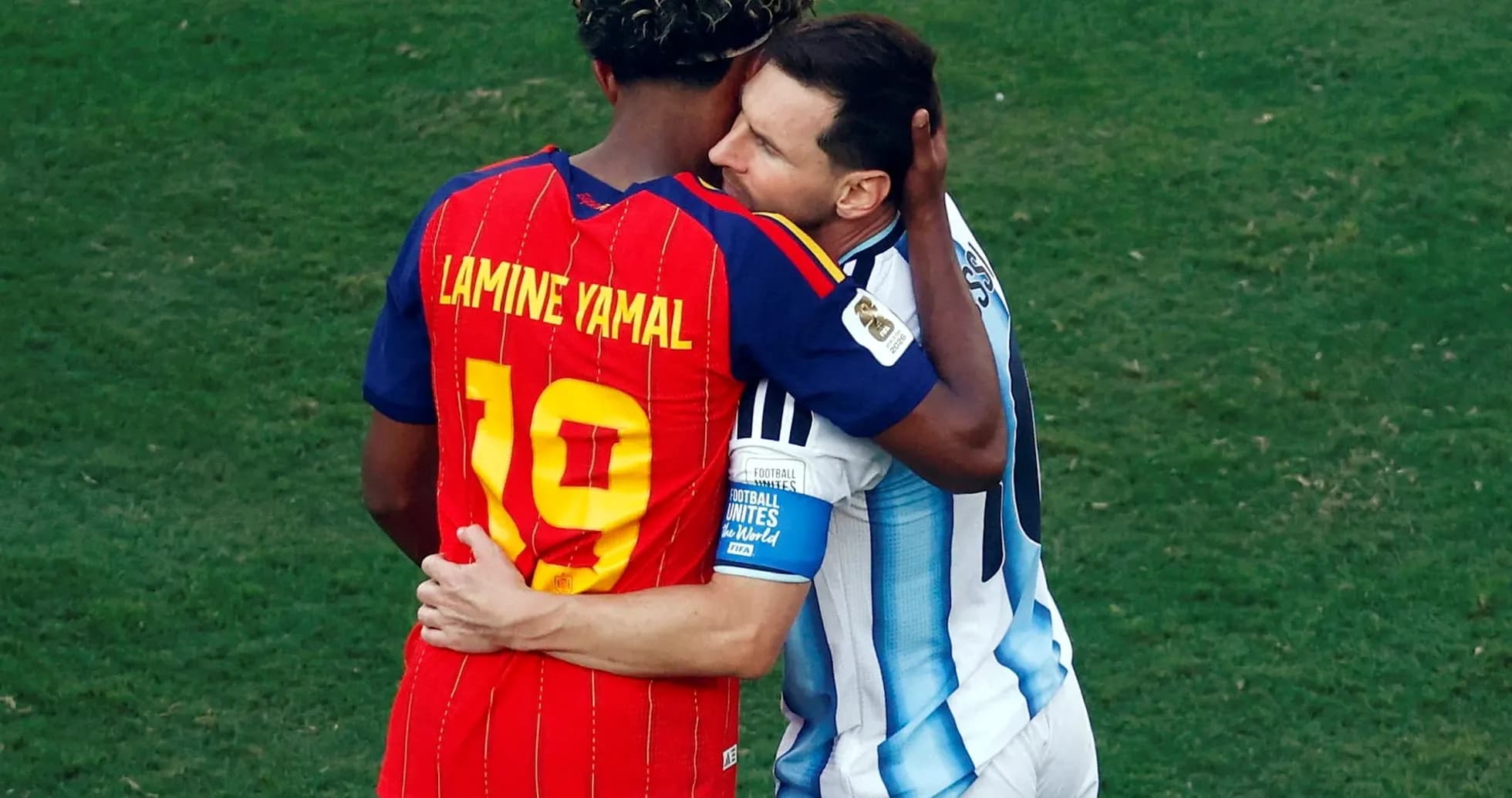

Spain’s Tactical Dominance in World Cup Final Victory Over Argentina
Spain’s 1-0 extra-time win over Argentina in the World Cup Final at MetLife Stadium was a study in territorial domination versus deep defensive resistance. Across 120 minutes, Spain imposed their positional play, Argentina retreated into a compact 4-4-2 block, and the contest ultimately tilted under the cumulative weight of Spanish control, numerical superiority after a sending-off, and a decisive extra-time strike.
Spain's Tactical Setup
From the outset, Spain’s 4-2-3-1 under Luis de la Fuente was built to monopolise the ball and stretch Argentina’s 4-4-2. Rodri and Fabián Ruiz formed the double pivot, with Lamine Yamal and Alex Baena wide, Dani Olmo central and Mikel Oyarzabal as the nominal striker. The passing numbers underline the plan: Spain completed 762 of 852 passes (89%), with 65% possession and 20 total shots, 12 of them on target. The structure allowed Spain to fix Argentina’s front two and consistently find the free man between the lines or in the half-spaces.
Argentina's Defensive Approach
Argentina, in contrast, accepted a reactive role. Lionel Scaloni’s 4-4-2 with Lionel Messi and Julián Alvarez up front, and Rodrigo De Paul–Enzo Fernández–Alexis Mac Allister–Nicolás González across midfield, quickly dropped into a low-to-mid block. With only 35% possession and just 2 total shots (0 on target), Argentina’s threat in open play was almost non-existent; their attacking plan hinged on transitions that rarely materialised and sporadic set-piece moments.
Shot Profile and Expected Goals
Spain’s territorial dominance was visible in their shot profile: 20 attempts, split between 9 from inside the box and 11 from outside. The 3 blocked shots reflect Argentina’s last-ditch interventions, but the expected goals figure of 1.94 shows that Spain consistently generated good-quality chances rather than sterile possession. By contrast, Argentina’s xG of 0.22 captures how thoroughly they were starved of meaningful entries into Spain’s defensive third.
Key Substitutions
The game’s key structural shift came in midfield. As the match wore on, Spain’s substitutions layered fresh technical quality and verticality onto an already dominant platform. Pedri (IN) came on for Fabián Ruiz (OUT) at 62', and Ferran Torres (IN) replaced Mikel Oyarzabal (OUT) at the same minute, sharpening Spain’s capacity to attack depth and receive between lines. Later, Nico Williams (IN) for Alex Baena (OUT) at 75' added direct 1v1 threat on the flank, while Mikel Merino (IN) for Dani Olmo (OUT) at 75' offered extra late-arrivals into the box and aerial presence. In extra time, Martín Zubimendi (IN) for Rodri (OUT) and Eric García (IN) for Aymeric Laporte (OUT) at 99' refreshed the spine to maintain control and defensive security against any late Argentine counters.
Argentina's Substitutions
Argentina’s substitutions were largely reactive and defensive in nature. Nicolás Otamendi (IN) for Lisandro Martínez (OUT) at 44' and Nahuel Molina (IN) for Gonzalo Montiel (OUT) at 58' were like-for-like defensive changes, hinting at physical or tactical issues but not altering the team’s passive posture. Leandro Paredes (IN) for Nicolás González (OUT) at 46' moved Argentina towards a more central, denser midfield four, sacrificing wide ball-carrying for extra protection in front of the back line. Facundo Medina (IN) for Cristian Romero (OUT) and Giuliano Simeone (IN) for Rodrigo De Paul (OUT) at 70' further eroded the original structure; with De Paul off, Argentina lost one of their key shuttlers and pressing triggers, deepening their defensive shell and limiting their ability to break.
Discipline and Tactical Factors
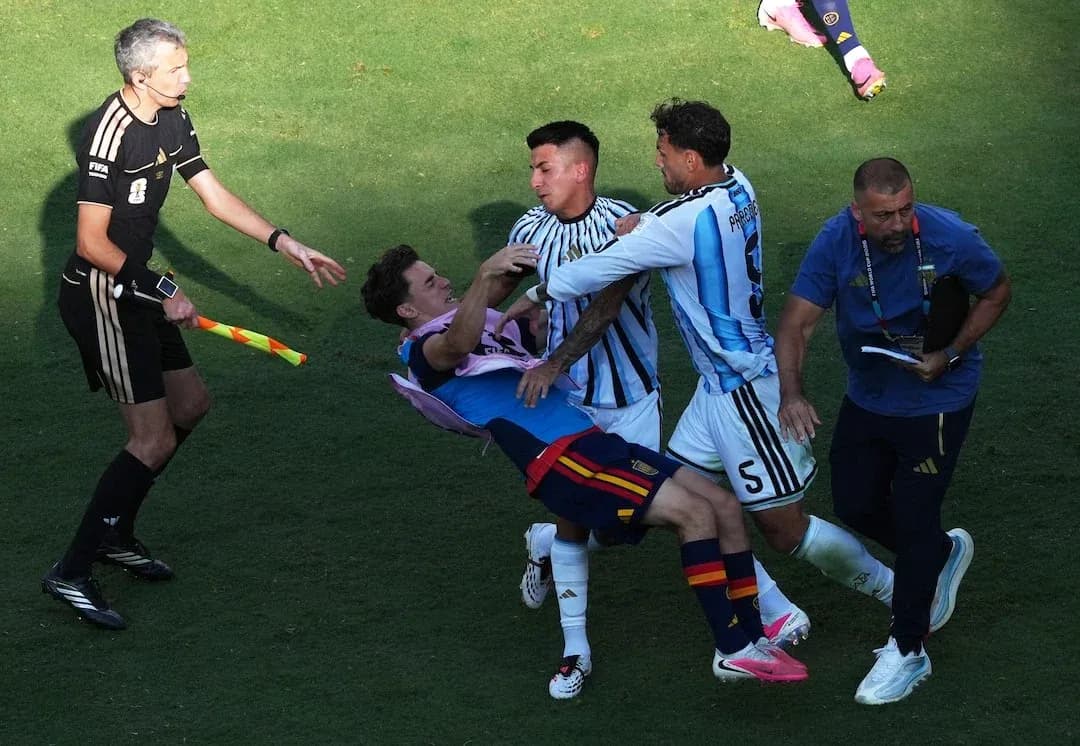
Discipline became a defining tactical factor. Argentina collected 6 yellow cards and 1 red, all on the defensive side of the ball as they tried to disrupt Spain’s rhythm. The dismissal of Enzo Fernández at 90+3' (two yellows for “Argument” at 83' and “Foul” at 90+3', followed immediately by a “Foul” red) left Argentina to navigate extra time with ten men. That numerical inferiority, on top of Spain’s existing dominance of territory and possession, allowed Spain to push their full-backs higher, compress the game around Argentina’s box, and sustain wave after wave of attacks.
The Decisive Goal
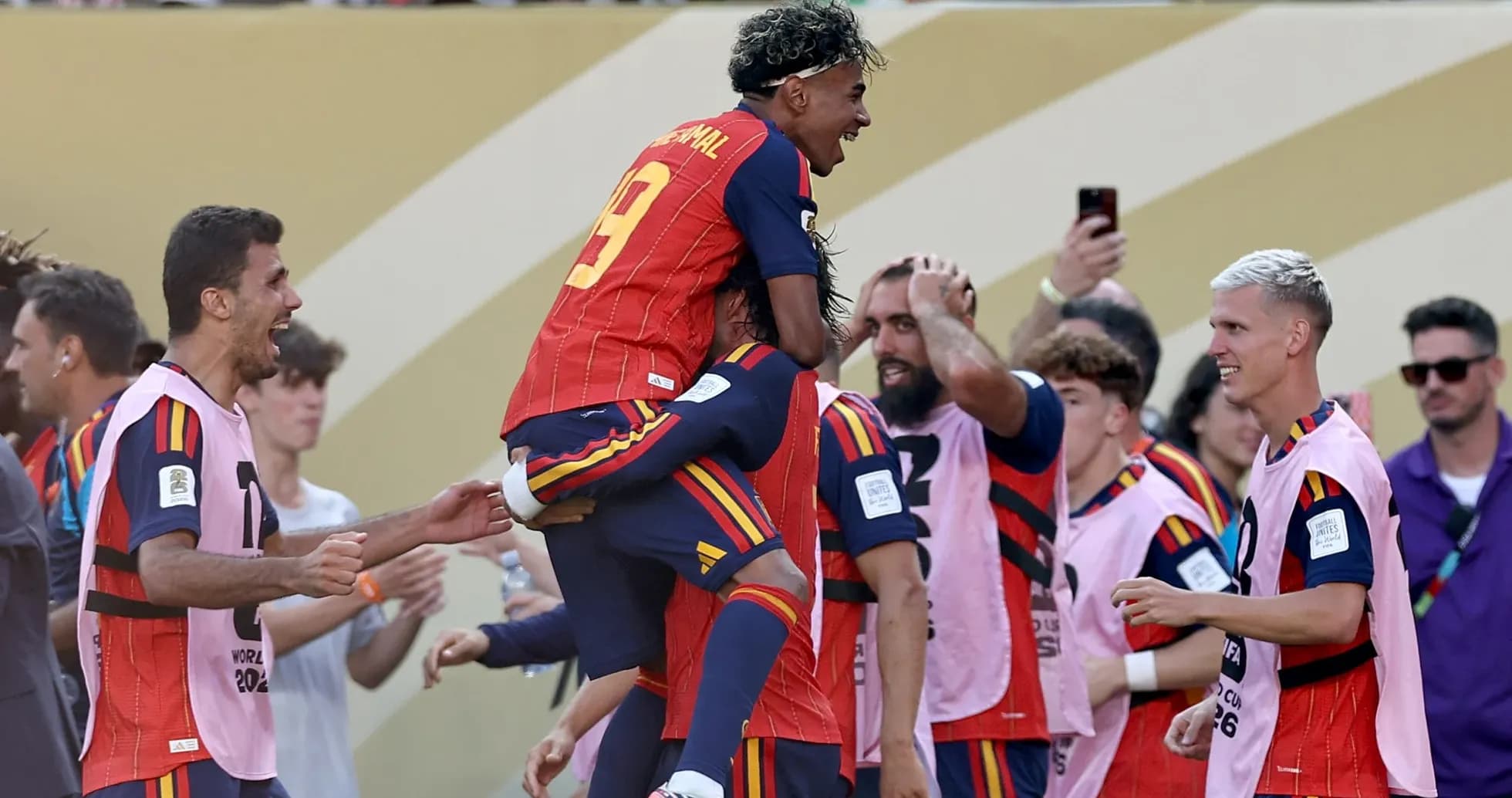
The decisive goal at 106' was the logical outcome of these dynamics. Ferran Torres, who had been introduced to attack depth and spaces between centre-backs and full-backs, provided the finishing edge, while Nico Williams supplied the assist, exactly the kind of direct wide threat his introduction was meant to bring. By then, Spain were camped in Argentina’s half, circulating the ball with patience and precision until a gap appeared. Argentina’s deep 4-4-1 block, already stretched by constant lateral shifts, finally broke.
Goalkeeping Performances
In goal, Unai Simón (Spain) was almost a spectator in shot-stopping terms, with Spain registering 0 goalkeeper saves and Argentina failing to hit the target once. His role was primarily as a first passer in build-up, helping Spain maintain numerical superiority against Argentina’s first line of pressure. Emiliano Martínez (Argentina), by contrast, was under siege: he made 11 saves, a figure that, combined with Spain’s 12 shots on goal and Spain’s xG of 1.94, underlines how central he was to keeping Argentina alive deep into extra time. Both goalkeepers are credited with 1.81 goals prevented, an extraordinary quirk that highlights how Spain’s defensive control and Argentina’s goalkeeping heroics each played different but decisive roles.
Statistical Superiority
Statistically, Spain’s superiority was comprehensive. They out-shot Argentina 20–2, led 12–0 in shots on target, and earned more corners (9–4), reflecting sustained attacking pressure. Their passing structure was cleaner and more reliable: 852 total passes to Argentina’s 463, with a higher completion rate (89% vs 77%). Spain’s 4 offsides versus Argentina’s 1 further illustrate how aggressively they tried to attack the last line, constantly probing behind a retreating defence.
Argentina’s 25 fouls versus Spain’s 21, coupled with their card count, show a side increasingly reliant on disruption rather than structured pressing. Reduced to ten men and unable to relieve pressure through possession or transitions, they were eventually overwhelmed. Spain’s tactical coherence, bench impact, and superior control of space and ball translated their statistical dominance into the only number that mattered: 1-0 after extra time, and a World Cup lifted on the back of a near-perfect territorial performance.