.svg&w=384&q=75 "Naijagoal logo")

France vs England: World Cup 3rd Place Final Highlights
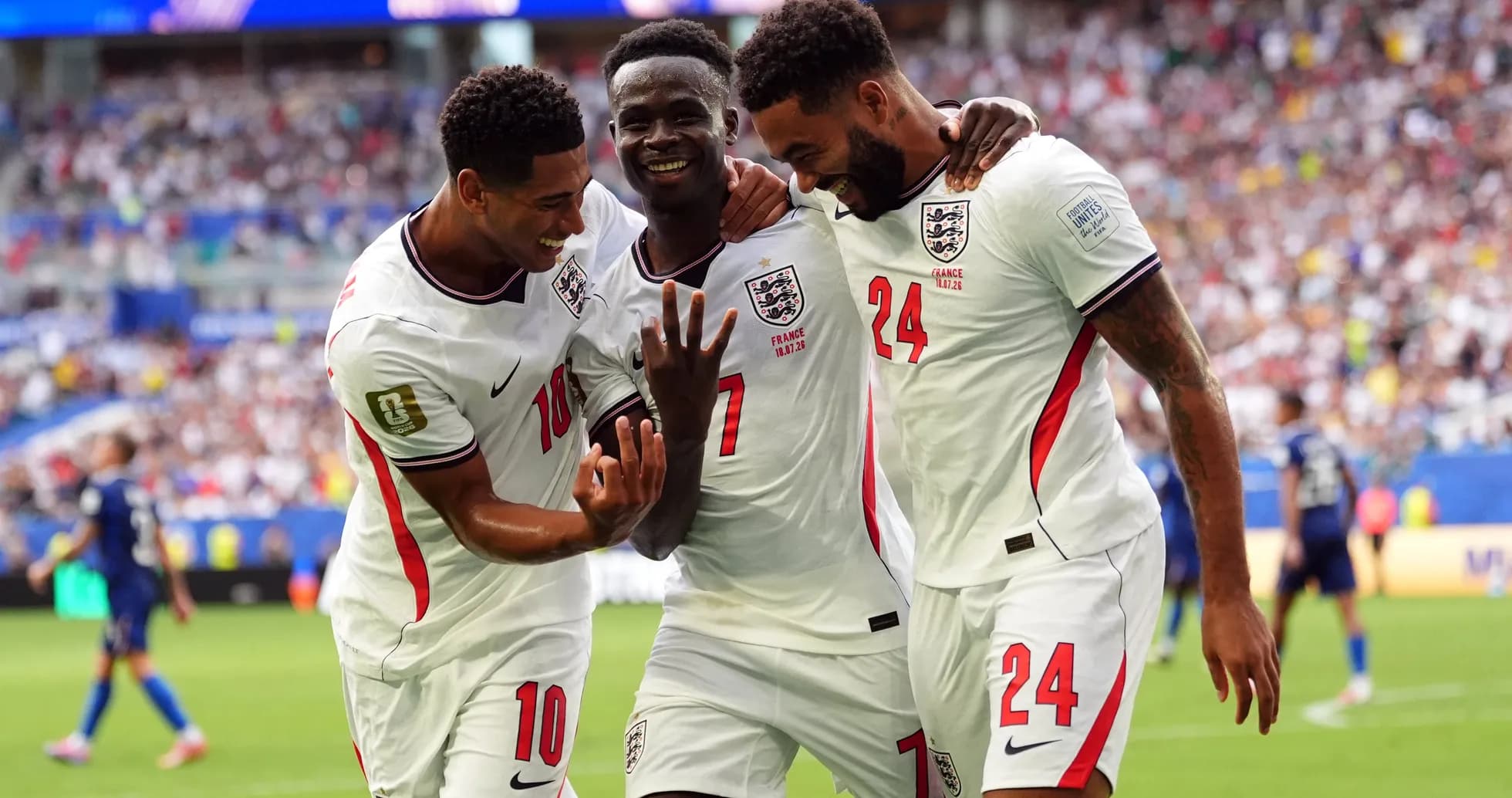
Under the Miami lights at Hard Rock Stadium, France and England met in a World Cup 3rd Place Final that felt more like a fever dream than a consolation tie. The scoreboard told its own chaos: England 6, France 4, after a first half in which England raced into a 4–0 lead and a second half where France clawed back four of their own.
Heading into this game, both sides had been among the tournament’s most ruthless attacks. Overall this campaign, France had scored 20 goals in 8 matches, split evenly between home and away contexts: 15 “at home” and 5 “on their travels”, averaging 2.5 goals per match in total. England matched that total output with 20 goals overall from 8 games as well, but with a different profile: 7 at home and 13 away, for an overall average of 2.5 goals per game, powered by a devastating 3.3 goals per match on their travels.
Defensively, there was a clear divergence. France had conceded 10 goals in total (9 at home, 1 away), an overall average of 1.3 per match, with their home figure at 1.5. England had allowed 12 overall (5 at home, 7 away), conceding 1.5 per match, with a slightly looser 1.8 on their travels. The numbers foreshadowed an open game; the 10‑goal thriller simply stretched those tendencies to their breaking point.
In the group stage standings, both had dominated their sections. France topped Group I with 9 points from 3 matches, scoring 10 and conceding 2 for a group‑stage goal difference of +8. England led Group L with 7 points from 3, scoring 6 and conceding 2 for a goal difference of +4. This was a meeting of two group winners whose seasonal DNA was defined by front‑foot football and high‑end individual quality.
Tactical Voids – Absences, Risk Lines, and Emotional Edges
The team sheets confirmed that neither coach had the luxury of a full deck. For France, W. Saliba was listed as a “Missing Fixture” with a back bruise. Even though he appeared among the substitutes, the medical designation underlined that Didier Deschamps could not plan on him as a reliable 90‑minute pillar. That mattered: Saliba’s profile as a calm, aerially dominant centre‑back would have been an ideal counter to England’s direct threat through I. Toney and the late‑game option of H. Kane.
For England, K. Mainoo’s absence through a wound subtly reshaped Thomas Tuchel’s midfield geometry. Without him, the responsibility to both screen and progress fell even more heavily on D. Rice, who already arrived at this match as one of the tournament’s most complete midfielders: 331 passes at 92% accuracy, 11 tackles, 4 blocks, and 5 interceptions across 7 appearances.
Disciplinary trends added another tactical layer. France’s yellow cards had clustered late in games: 33.33% of their cautions came between 76–90 minutes, with further bookings spread across 0–15, 16–30, 61–75 and even 91–105. That pattern suggested a side that often chased games or defended aggressively as fatigue and urgency rose. England’s bookings were more evenly distributed, but with spikes at 31–45 and 61–75 minutes (25.00% each), hinting at intensity surges around both halves’ closing phases.
Crucially, France’s penalty record this tournament was fragile. Overall they had won 2 penalties, but scored only 1, with 1 missed – a 50.00% conversion rate that had already cost them in key moments. England, by contrast, were perfect from the spot: 3 penalties taken, 3 scored, a 100.00% record. In a high‑variance game like a 3rd Place Final, that disparity in dead‑ball ruthlessness loomed large.
Key Matchups – Hunter vs Shield, and the Engine Room Battle
The attacking headliners were unmissable. For France, Kylian Mbappé arrived as the tournament’s most lethal finisher: 10 goals and 4 assists in 8 appearances, from 36 shots with 23 on target. His 8.21 average rating, 18 key passes, and 36 attempted dribbles (13 successful) painted the picture of a forward who not only finished moves but also created them.
Behind him, O. Dembélé’s blend of incision and work rate (6 goals, 2 assists, 293 passes, 18 key passes, 3 tackles) and M. Olise’s creative command (7 assists, 411 passes at 86% accuracy, 17 key passes) gave France a three‑headed creative core. Add B. Barcola’s impact profile – 3 goals, 1 assist, 13 successful dribbles from 22 attempts, and even 5 tackles plus 1 blocked shot – and Deschamps had a front line that could stretch and destabilise any back four.
On this night, that attack was arranged in a 4‑2‑3‑1: K. Mbappe spearheading, supported by M. Olise, R. Cherki and D. Doue, with W. Zaire‑Emery and A. Rabiot as the double pivot. The back four of T. Hernandez, M. Lacroix, I. Konate and M. Gusto sat in front of M. Maignan. Structurally, it was the same formation France had leaned on all tournament, having used 4‑2‑3‑1 in all 8 matches.
Opposite them, England’s “shield” was built around D. Rice at the base of a 4‑1‑4‑1. Ahead of him, a line of four – B. Saka, M. Rogers, E. Eze, M. Rashford – supported I. Toney as the lone striker. At the back, J. Quansah, E. Konsa, M. Guehi and D. Spence protected D. Henderson.
Rice’s duel with France’s attacking midfield triangle was the central tactical hinge. His tournament numbers – 17 key passes, 2 assists, 4 blocks, 5 interceptions – showed a player who both started England’s attacks and snuffed out the opposition’s. His discipline, though, was a double‑edged sword: 2 yellow cards already this World Cup, and England as a whole had seen a red card from J. Quansah earlier in the tournament. Quansah’s own profile, with 1 yellow and 1 red in just 3 appearances, underscored the risk of leaving him repeatedly exposed against Mbappé’s pace.
Further forward, England’s “hunters” were more distributed. J. Bellingham’s 7 goals and 1 assist from midfield, with 92 duels and 50 won, made him a late‑arriving threat between the lines – even if he started this particular match on the bench. B. Saka (3 goals, 3 assists, 51 duels with 30 won) and A. Gordon (1 goal, 3 assists, 25 dribble attempts) gave Tuchel wide outlets who could both carry and combine. H. Kane, even as a substitute option, brought 6 goals, 1 assist, and 2 scored penalties, plus 3 blocked shots and 1 interception, underlining his work rate in the press and in his own box.
The most volatile matchup, though, lay on England’s right defensive side. J. Quansah, with his previous red card and a relatively small sample of 200 minutes, had to manage Mbappé’s diagonal runs and D. Doue’s underlaps. Any mistimed challenge risked tilting the game, especially given France’s tendency to surge late and England’s card spikes around the end of each half.
Statistical Prognosis – Chaos Confirmed
From a probabilistic lens, this fixture always leaned toward goals. France’s overall scoring rate of 2.5 per match combined with England’s 2.5, against defences conceding 1.3 and 1.5 respectively, pointed toward a multi‑goal contest. France’s home‑context concession of 1.5 per game and England’s away‑context scoring at 3.3 per match made an England‑tilted shootout entirely plausible.
France’s main statistical red flag was their penalty record: 2 taken, only 1 scored, 1 missed. In a match where margins could be defined by set‑pieces, that 50.00% conversion rate contrasted starkly with England’s perfect 3‑from‑3. Meanwhile, England’s disciplinary profile – yellow cards concentrated around 31–45 and 61–75, plus Quansah’s earlier red – hinted at possible instability, but France’s own late‑game bookings and higher home‑context goals against suggested they were just as likely to crack under sustained pressure.
In the end, the 6–4 scoreline was less an anomaly than an extreme expression of both teams’ seasonal identities. France’s 4‑2‑3‑1, powered by Mbappé, Dembélé, Olise and Barcola, guaranteed chances but left a defence already conceding 1.5 at home exposed. England’s 4‑1‑4‑1, anchored by Rice and turbo‑charged by wide runners and elite penalty reliability, leaned into transition and verticality.
Following this result, the numbers will only exaggerate: France’s “home” goals against will spike further, and England’s away scoring rate will look even more outrageous. But tactically, the lesson is clear. When two of the tournament’s most aggressive attacks meet, with one side carrying a fragile penalty record and the other a perfect one, and with both midfields built to run rather than to rest, the statistical prognosis is not balance. It is chaos – and Miami got it in full.