.svg&w=384&q=75 "Naijagoal logo")

Netherlands vs Japan: Tactical Insights from World Cup 2026 Draw
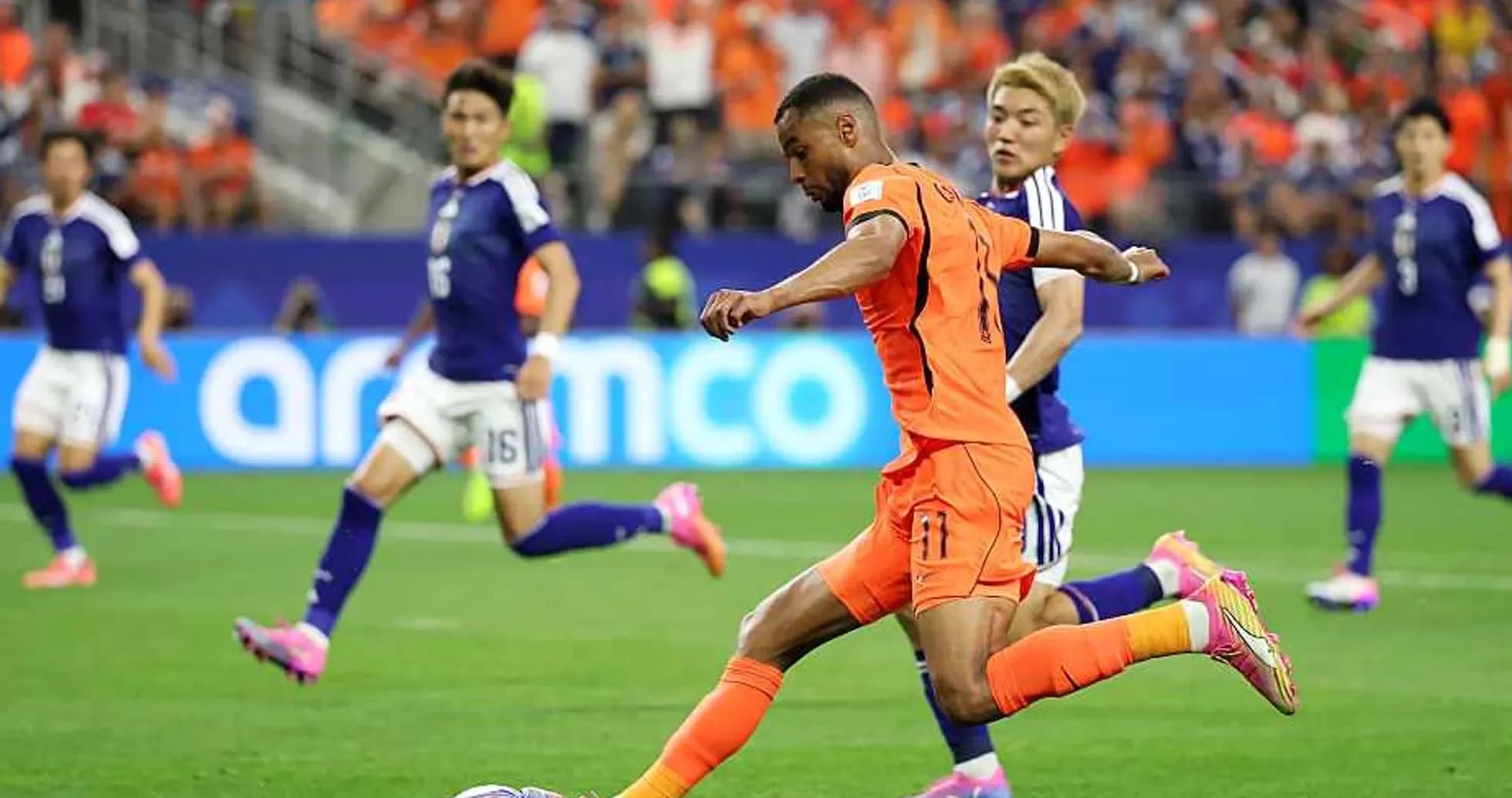
Netherlands and Japan opened their World Cup 2026 campaigns at AT&T Stadium with a tactically rich 2-2 draw that showcased contrasting structures and game plans. Ronald Koeman’s Netherlands imposed themselves for long stretches through a 4-3-3 possession framework, while Hajime Moriyasu’s Japan operated from a 3-4-2-1 that was clearly designed to absorb pressure and spring forward with sharp, vertical attacks. The final scoreline reflected not chaos but a finely balanced duel between territorial control and transition efficiency.
Final Score: Netherlands 2 - 2 Japan
Netherlands’ 60% possession, 525 passes and an 88% completion rate framed the match: Koeman’s side aimed to dominate the ball and space. The 4-3-3 was built on a high, aggressive back line of Micky van de Ven, Virgil van Dijk, Jan Paul van Hecke and Denzel Dumfries, with Frenkie de Jong as the central organiser. De Jong’s positioning between the centre-backs in build-up created a back three in possession, allowing both full-backs, particularly Dumfries on the right, to advance and pin Japan’s wing-backs.
Ahead of him, Ryan Gravenberch and Tijjani Reijnders functioned as dual No.8s, constantly rotating into the half-spaces. Their movement was crucial to Netherlands’ shot profile: all 10 of their attempts came from inside the box, underlining how the structure was geared towards breaking Japan down close to goal rather than relying on speculative efforts from distance. The xG of 0.79 confirms that, while they reached good zones, the final shot quality remained only moderate – more volume and territory than truly clear-cut chances.
The front three of Cody Gakpo, Donyell Malen and Crysencio Summerville provided complementary threats. Gakpo operated as a left-sided forward who could roll inside to combine, Malen looked to run in behind the last line, and Summerville stayed high and wide on the right to stretch Japan’s back three laterally. This width forced Japan’s outside centre-backs, especially Hiroki Itō and Tsuyoshi Watanabe, into wide defensive channels, opening central pockets for late runs from midfield.
Japan’s Structure
Japan’s 3-4-2-1, by contrast, was unapologetically pragmatic. With 40% possession and 342 passes at 84% accuracy, Moriyasu’s side accepted long spells without the ball but remained structurally compact. The back three of Itō, Shogo Taniguchi and Watanabe held a narrow line, protected by a double pivot of Kaishu Sano and Daichi Kamada. Wing-backs Ritsu Doan and Keito Nakamura had dual roles: track Dutch full-backs deep, then explode forward in transition. The front line of Takefusa Kubo, Daizen Maeda and Ayase Ueda (before his late substitution) was tasked with triggering the press selectively, usually when Netherlands tried to play through the middle rather than wide.
In terms of chance creation, Japan’s plan was highly efficient. With 10 total shots (matching Netherlands) split between 6 inside the box and 4 from outside, and an xG of 0.54, they maximised transitions and quick combinations rather than sustained pressure. The fact that they produced 3 shots on goal from significantly less possession underlines how dangerous they were whenever they broke the Dutch structure.
Substitutions
The substitutions from both coaches were clearly tactical levers rather than simple like-for-like changes. For Netherlands, the triple change on 70 minutes – Teun Koopmeiners (IN) came on for Tijjani Reijnders (OUT), Quinten Timber (IN) came on for Crysencio Summerville (OUT), Memphis Depay (IN) came on for Donyell Malen (OUT) – signalled a shift towards greater control and a more centralised attacking threat. Koopmeiners offered a calmer passing presence and deeper playmaking, while Depay’s tendency to drop between the lines created overloads in central zones. Timber’s introduction on the right was about ball retention and pressing rather than pure wing isolation.
Later, Nathan Aké (IN) came on for Ryan Gravenberch (OUT) at 81 minutes, subtly reshaping the back line and adding left-footed build-up security, with a side benefit of more defensive insurance against Japan’s counters. Brian Brobbey (IN) came on for Cody Gakpo (OUT) at 85 minutes to provide a more direct reference point up front, giving Netherlands a target for crosses and second balls as the game stretched.
Moriyasu’s changes were equally strategic. Junya Ito (IN) came on for Daizen Maeda (OUT) at 66 minutes, adding fresh pace on the flank and a more direct dribbling threat. At 75 minutes, Koki Ogawa (IN) came on for Takefusa Kubo (OUT), and Takehiro Tomiyasu (IN) came on for Ritsu Doan (OUT), while Yukinari Sugawara (IN) came on for Tsuyoshi Watanabe (OUT). This triple change reconfigured Japan’s shape: Tomiyasu’s presence stabilised the back line, Sugawara offered energy and crossing from wide, and Ogawa provided a more traditional penalty-box presence. Finally, Kento Shiogai (IN) came on for Ayase Ueda (OUT) at 84 minutes, keeping the front line fresh for late transitions and pressing actions.
Discipline
Discipline played a subtle but real tactical role. Netherlands accumulated three yellow cards, all tightly linked to game dynamics. At 61 minutes, Crysencio Summerville (Netherlands) — Foul, reflecting the intensity of his defensive work from the front. At 83 minutes, Memphis Depay (Netherlands) — Foul, a sign of his involvement in counter-pressing after losing possession. At 90+1 minutes, Micky van de Ven (Netherlands) — Professional foul, a classic tactical intervention to halt a dangerous late Japanese transition. Japan, by contrast, finished without a single booking, underlining their controlled approach in duels despite matching Netherlands with 7 fouls each.
Statistical Verdict
The statistical verdict underlines how finely poised the contest was. Netherlands’ 6 shots on goal to Japan’s 3, and 4 goalkeeper saves for Zion Suzuki (Japan) against 1 for Bart Verbruggen (Netherlands), show that the European side generated more direct tests of the opposition keeper. Both goalkeepers recorded 0.62 goals prevented, pointing to similar shot quality faced and comparable shot-stopping impact, even if the volume differed. The blocked shots were level at 1-1, indicating that neither side relied heavily on last-ditch defending; instead, most defensive work was done through structure and positioning higher up the pitch.
With 5 corner kicks to Japan’s 4 and a narrow xG edge of 0.79 to 0.54, Netherlands can argue they edged the underlying numbers, especially in territorial terms. Yet Japan’s ability to turn limited possession into meaningful, well-constructed attacks justified the 2-2 outcome. Tactically, this was less about one side failing and more about two distinct game models executing effectively enough to cancel each other out over 90 minutes in Arlington.