.svg&w=384&q=75 "Naijagoal logo")

Ivory Coast Secures 1-0 Victory Over Ecuador in World Cup Opener
Ivory Coast’s 1-0 win over Ecuador at Lincoln Financial Field was a classic example of how a clear structural plan and in-game adjustments can tilt a finely balanced World Cup group match. Both sides lined up in a 4-4-2, but Emerse Fae’s Ivory Coast used the shape more aggressively and ultimately translated territorial pressure into a late, decisive strike, while Sebastian Beccacece’s Ecuador controlled marginally more of the ball without converting that into sustained threat.
First Half
In the first half, Ivory Coast’s 4-4-2 was built on a strong central platform. Franck Kessié and Seko Fofana operated as a double pivot with complementary roles: Kessié anchoring and screening, Fofana stepping higher to press Ecuador’s first line and support the forwards. With 48% possession and 470 passes (397 accurate, 84%), Ivory Coast were not dominant on the ball but were efficient, progressing quickly once they recovered it. The wide midfielders, Yan Diomande on the right and Bazoumana Touré on the left, held relatively high starting positions, pinning Ecuador’s full-backs and giving early outlets for direct switches from the back four.
Ecuador’s 4-4-2 was more circulation-oriented. Moisés Caicedo and Pedro Vite tried to dictate the tempo from central midfield, and the team ended with 52% possession and 492 passes (419 accurate, 85%). However, their possession was often in front of Ivory Coast’s compact block. Enner Valencia and Gonzalo Plata were forced to drop into pockets rather than threaten the last line consistently, which limited the volume of penalty-box actions: Ecuador finished with 12 total shots, only 5 inside the box and just 1 on goal.
Defensively, Ivory Coast’s structure was clear: the front two, Nicolas Pépé and Elye Wahi, screened passes into Caicedo and Vite, while Kessié and Fofana stepped out aggressively when the ball entered central zones. The three first-half yellow cards illustrate the intensity of that approach. At 28', Seko Fofana (Ivory Coast) was booked for “Roughing”, a consequence of his proactive ball-winning role. Ten minutes later, at 38', Kessié received a yellow for “Tripping”, followed at 40' by Guéla Doué’s caution for “Tripping” on the right side of the back four. These incidents underline how Ivory Coast were willing to accept disciplinary risk to break Ecuador’s rhythm between the lines.
Ecuador’s back four initially coped well with Ivory Coast’s directness, but their own attacking balance was off. John Yeboah and Alan Minda, nominally wide midfielders, were often drawn deep to help progression, leaving large distances to Valencia and Plata. The result was fragmented attacking phases: they produced 12 shots and 5 corners, but the shot quality was modest, reflected in an xG of 1.01. Ivory Coast, by contrast, generated 15 shots, 8 from inside the box, and an xG of 1.52, indicating more consistent penetration.
Second Half
The second half hinged on a series of substitutions that altered the dynamics of both teams. At 56', Ecuador replaced Alan Minda (OUT) with Nilson Angulo (IN), looking for more vertical running from the left. Simultaneously, Fae made two attacking-tilted changes: Elye Wahi (OUT) made way for Ange-Yoan Bonny (IN), and Bazoumana Touré (OUT) was replaced by Amad Diallo (IN). These moves re-energised Ivory Coast’s front line. Bonny provided a more physical presence up top, allowing Pépé to find more freedom between the lines, while Diallo’s introduction from the left added ball-carrying and 1v1 threat against Ecuador’s right side.
At 62', Beccacece sought to stabilise and add aerial power by introducing Ángelo Preciado (IN) for John Yeboah (OUT) and Jackson Porozo (IN) for Alan Franco (OUT). This shifted Ecuador’s right flank towards a more defensive profile, but it also reduced their capacity to combine in advanced wide areas. Porozo’s later yellow card at 73' for “Holding” encapsulated Ecuador’s growing difficulty in dealing with Ivory Coast’s more direct and aggressive attacking waves.
The 77' minute brought another decisive wave of changes. Ivory Coast withdrew Nicolas Pépé (OUT) for Christ Inao Oulaï (IN), and Seko Fofana (OUT) for Ibrahim Sangaré (IN). These substitutions subtly rebalanced the side: Sangaré’s presence added extra defensive control and ball-winning in midfield, allowing Kessié to manage the tempo and protect the yellow-card-heavy spine. Oulaï offered fresh legs and energy in advanced areas. For Ecuador, Enner Valencia (OUT) was replaced by Kevin Rodriguez (IN), a move that maintained a central reference point but did not significantly change their pattern of chance creation.
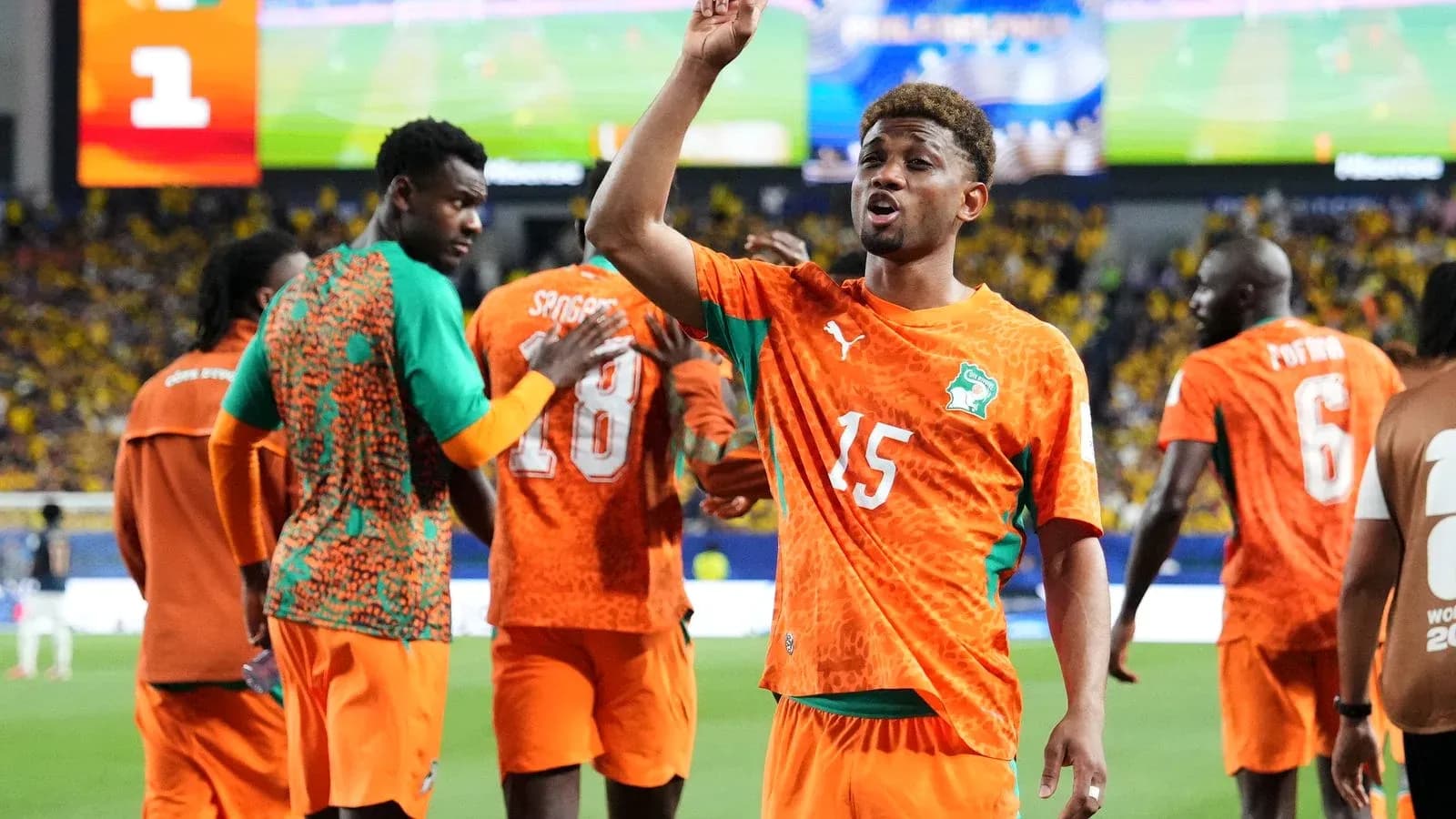
Late on, at 89', Ivory Coast made a final defensive adjustment, with Guéla Doué (OUT) replaced by Odilon Kossounou (IN), reinforcing the right side as the game moved into its decisive phase. The winning moment came at 90': Amad Diallo (Ivory Coast) scored a “Normal Goal”, assisted by Wilfried Singo. The pattern of the match suggests this goal was the culmination of Ivory Coast’s growing territorial control and their ability to get runners into advanced half-spaces and wide channels, with Singo stepping from the back line to deliver the final pass.
In goal, Yahia Fofana (Ivory Coast) was largely protected by the structure in front of him, facing only 1 shot on target and making 1 save. The defensive line of Doué, Singo, Emmanuel Agbadou and Ghislain Konan, shielded by Kessié and Fofana/Sangaré, limited Ecuador to low-yield shooting positions. The team’s defensive performance is also reflected in the goals prevented metric: Ivory Coast’s figure of 0.22 indicates competent goalkeeping and shot-stopping in the few moments of danger.
At the other end, Hernán Galíndez (Ecuador) made 3 saves, and Ecuador’s defensive unit blocked 3 shots, matching Ivory Coast’s 3 blocked attempts. The goals prevented value of 0.22 for Ecuador suggests Galíndez did his part to keep the scoreline narrow, but the volume and quality of Ivory Coast’s chances eventually broke through.
From a statistical verdict, the match was close in possession and passing accuracy but tilted in chance quality and attacking sharpness. Ecuador’s 52% possession and slightly higher pass completion did not translate into superior xG or shots on goal. Ivory Coast, with 48% possession, 15 total shots (4 on goal) and a higher xG of 1.52, crafted the more dangerous opportunities and managed the game’s key moments better.
Discipline-wise, Ivory Coast finished with 3 yellow cards, all in the first half, while Ecuador collected 1. The card distribution and reasons — “Roughing”, “Tripping”, “Tripping” for Ivory Coast and “Holding” for Ecuador — underline a match where Ivory Coast’s aggression was front-loaded, then tactically managed through substitutions and structural tweaks. Ecuador’s single caution, arriving as they chased the game, reflected their increasing defensive strain rather than sustained physical dominance.
Overall, Ivory Coast’s 4-4-2 proved more adaptable and vertically effective than Ecuador’s version of the same shape. Through targeted in-game adjustments and a clear commitment to compressing space centrally, Fae’s side earned a narrow but tactically deserved 1-0 win in this World Cup group opener.