.svg&w=384&q=75 "Naijagoal logo")

Iran and New Zealand Share Points in Thrilling 2-2 Draw
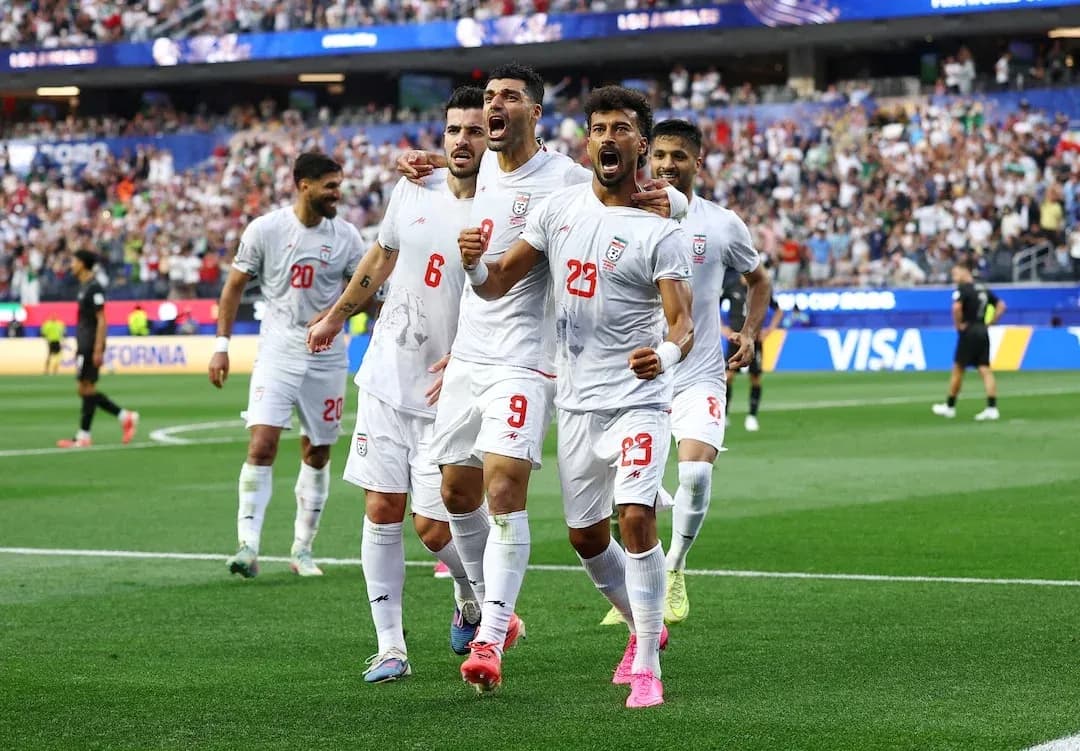
Iran 2-2 New Zealand at SoFi Stadium opened Group G with a high-tempo draw that leaves both sides on two points, locked on goals scored and conceded after back-to-back 2-2 results. New Zealand stay top of the group on rank 1, Iran remain rank 2, but with identical new tallies of 2 points, 4 goals for and 4 against, the section is finely poised heading into the second round of fixtures.
Match Report
The game exploded into life early. In the 7th minute New Zealand struck first: 7' New Zealand goal — E. Just (assisted by C. Wood). Wood pulled into the right channel and squared low for Just, who timed his run into the box to steer a composed finish past Alireza Beiranvand, rewarding New Zealand’s positive start.
Iran responded by pushing their full-backs higher and gradually pinning New Zealand deeper. The pressure told on 32 minutes: 32' Iran goal — R. Rezaeian (unassisted). The right-back drove inside from the flank, combined via a second ball and, with no passing lane open, unleashed a driven effort from the edge of the box that deflected slightly and beat Max Crocombe at his near post to level at 1-1.
At half-time, Amir Ghalenoei moved aggressively to tilt the midfield. On 46 minutes Iran made the first change: 46' M. Ghaedi replaced A. Yousefi (Iran), adding a more direct dribbling threat on the flank. Seven minutes later, he freshened the front line: 53' A. Alipour replaced S. Moghanlou (Iran), looking for more depth in behind New Zealand’s centre-backs.
Almost immediately after that second Iranian change, New Zealand reasserted themselves with a near carbon copy of their opener. 54' New Zealand goal — E. Just (assisted by C. Wood). Again Wood pulled wide right, again he delivered low into the area, and Just arrived unmarked between the lines to side-foot home, restoring New Zealand’s lead at 1-2 from Iran’s perspective.
Iran refused to fold and continued to funnel attacks down the right, where Rezaeian combined overlaps with early crosses. The equaliser came on 64 minutes: 64' Iran goal — M. Mohebi (assisted by R. Rezaeian). Rezaeian advanced into space on the flank and whipped in a teasing ball that cleared the first line; Mohebi, ghosting in from midfield, met it with a controlled finish to make it 2-2.
Ghalenoei then looked to stabilise the left side and add set-piece quality: 65' E. Hajsafi replaced S. Ghoddos (Iran), shifting the balance of the midfield and giving Iran a left-footed outlet in build-up.
New Zealand answered with a triple change on 68 minutes to inject fresh energy and protect their full-backs. First, 68' B. Old replaced L. Cacace (New Zealand), introducing more attacking thrust down the left. Simultaneously, 68' R. Thomas replaced C. McCowatt (New Zealand), adding control and experience in the central band.
As the game entered its final quarter, Darren Bazeley (by selection) continued to refresh his back line: 78' C. Elliot replaced T. Payne (New Zealand), a like-for-like switch at right-back aimed at dealing with Iran’s persistent pressure down that side.
Iran’s last attacking roll of the dice came on 80 minutes, withdrawing their star centre-forward: 80' A. Hosseinzadeh replaced M. Taremi (Iran), a move that pushed Iran towards more fluid interchanging in the final third rather than a fixed target man.
The only card of the match arrived late: 89' E. Hajsafi (Iran) — yellow card (Tripping). The substitute was booked for halting a New Zealand transition with a cynical foul near the halfway line.
In stoppage time New Zealand made two further substitutions to see out the draw and manage legs for the rest of the group stage. 90+2' J. Randall replaced S. Singh (New Zealand), adding fresh pressing from the attacking midfield line, and 90+2' T. Bindon replaced M. Stamenic (New Zealand), a defensive-minded change to secure central spaces as Iran pushed for a late winner. Neither side could find a decisive goal, and the match closed at 2-2.
Fixture Statistics & Tactical Audit
- xG: Iran 1.5 vs 1.24 New Zealand
- Possession: Iran 48% vs 52% New Zealand
- Shots on Target: Iran 4 vs 8 New Zealand
- Goalkeeper Saves: Iran 6 vs 2 New Zealand
- Blocked Shots: Iran 5 vs 2 New Zealand
The underlying numbers suggest a finely balanced contest with contrasting offensive profiles. Iran generated slightly higher xG (1.5 vs 1.24), largely through sustained pressure and volume of attempts (17 total shots vs 14) and a strong presence in and around the box (10 shots inside the area). Their attack was more cumulative than explosive, building through repeated entries down the right and benefiting from Rezaeian’s delivery and Mohebi’s late runs.
New Zealand, by contrast, were more vertically efficient. They produced twice as many shots on target (8 vs 4), forcing Beiranvand into six saves and indicating that when they did reach the final third, their chances tended to be cleaner. The Wood–Just combination was particularly effective at attacking the space behind Iran’s full-backs, explaining how New Zealand could record lower xG but still threaten repeatedly.
Possession tilted marginally towards New Zealand (52% vs 48%) and they were notably more secure on the ball, completing passes at 85% compared to Iran’s 77%. That technical control allowed them to reset under pressure and pick moments to spring Wood into the channels. Iran’s five blocked shots underline how often New Zealand’s defensive block recovered into shape around their box, even when stretched.
Overall, the 2-2 scoreline aligns closely with the underlying data: Iran edged shot quality and volume, New Zealand edged on-target attempts and territorial control. Neither side did enough to claim they were clearly superior; both had defensive vulnerabilities exposed by the opponent’s main attacking pattern.
Standings Update & Seasonal Impact
Both teams entered the match having drawn their opening group game 2-2, each on 1 point with a goal difference of 0 (2 scored, 2 conceded). This second successive draw moves Iran to 2 points with 4 goals scored and 4 conceded, maintaining a goal difference of 0. New Zealand also advance to 2 points, likewise on 4 goals for and 4 against.
New Zealand remain ranked 1st in Group G, Iran stay 2nd, with the pair still occupying the Round of 32 qualification places. The symmetry of their records keeps the group wide open: the margin for error in the final group match is minimal, as a single win or defeat could swing both progression and seeding given the identical points and goal differences.
Lineups & Personnel
Iran Starting XI
- GK: Alireza Beiranvand
- DF: Ramin Rezaeian, Shoja Khalilzadeh, Ali Nemati, Milad Mohammadi
- MF: Mohammad Mohebi, Saman Ghoddos, Saeid Ezatolahi, Aria Yousefi
- FW: Shahriar Moghanlou, Mehdi Taremi
New Zealand Starting XI
- GK: Max Crocombe
- DF: Tim Payne, Finn Surman, Michael Boxall, Liberato Cacace
- MF: Joe Bell, Marko Stamenic, Callum McCowatt, Sarpreet Singh, Elijah Just
- FW: Chris Wood
Post-Match Verdict
This was an attacking showcase built on clear, repeatable patterns rather than chaos. Iran were methodical and occasionally clinical in wide overloads (1.5 xG from 10 shots inside the box), but their defensive line struggled to handle direct runs off Wood, conceding 8 shots on target and relying on Beiranvand’s six saves to avoid defeat. New Zealand were efficient in transition and ruthlessly exploited the right half-space (two goals from the Wood–Just axis), yet allowed too many shooting opportunities around their own box (17 shots faced, 5 blocked), pointing to structural gaps between midfield and defence.
For Iran, the attacking contribution of full-back Rezaeian and late-arriving midfielder Mohebi is a clear positive, but the team’s inability to protect the channels behind their advanced full-backs remains a concern. For New Zealand, the front pairing of Wood and Just looks tournament-ready, but if they are to convert draws into wins, they must reduce the volume of opposition entries into the final third and lower the shot count they concede. On balance, a draw was a fair reflection of two sides whose strengths and weaknesses almost perfectly cancelled each other out.