.svg&w=384&q=75 "Naijagoal logo")

Germany’s Tactical Masterclass in 7-1 Win Over Curaçao
Germany’s 7-1 dismantling of Curaçao at NRG Stadium was a structural as much as a technical mismatch. Julian Nagelsmann’s 4-2-3-1 dominated every phase, using a high-possession, positionally fluid attack to pin Dick Advocaat’s 4-3-1-2 deep and repeatedly isolate its full-backs. With 65% of the ball, 27 total shots and 22 of those from inside the box, Germany converted territorial control into relentless penalty-area occupation, while Curaçao’s compact central block never found a stable way to protect either half-space or the wide channels.
Out of possession, Germany’s first pressing line was built around Kai Havertz screening Curaçao’s centre-backs and pivot, with Jamal Musiala, Florian Wirtz and Leroy Sané staggering their positions to close passing lanes into Leandro Bacuna and Juninho Bacuna. The double pivot of Felix Nmecha and Aleksandar Pavlović held an aggressive height, often stepping beyond the centre circle to compress space behind Germany’s front four. This prevented Curaçao from building through the middle; their 336 passes (276 accurate, 82%) came mostly in their own half or from forced longer balls into Jürgen Locadia and Sontje Hansen, who were generally outnumbered by Jonathan Tah and Nico Schlotterbeck.
In possession, Germany’s 4-2-3-1 frequently morphed into a 3-2-5. Joshua Kimmich pushed high and narrow from right-back to join the midfield line, while Nathaniel Brown advanced on the left to provide width and overlapping runs. Pavlović dropped between the centre-backs to start build-up, allowing Schlotterbeck to step forward and link play. The attacking line of Sané (right), Wirtz (left), Musiala (central) and Havertz constantly rotated: Musiala drifted into the left half-space, Wirtz came inside to overload zone 14, and Havertz alternated between dropping to create a 4v3 in midfield and running beyond the last line. This movement was reflected in Germany’s 633 passes, 550 accurate (87%), with sustained circulation around Curaçao’s box generating 12 shots on goal and 8 blocked shots.
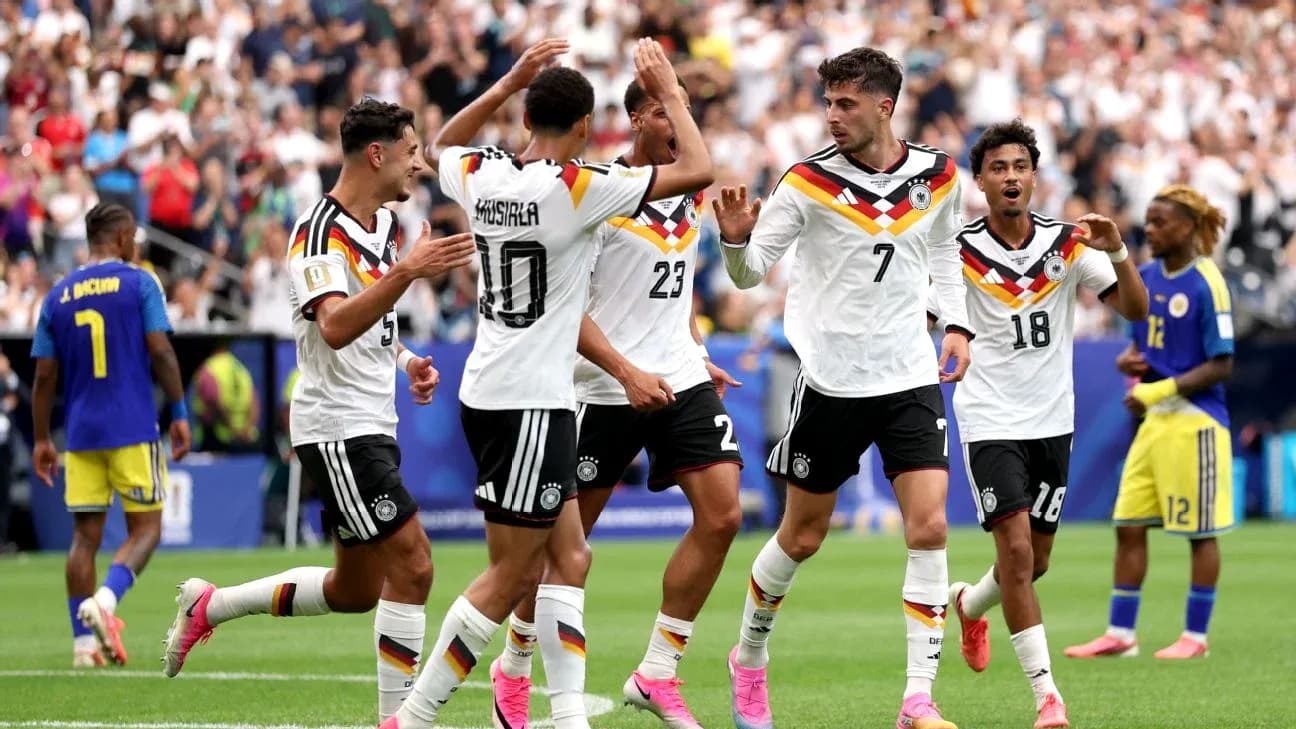
The opening goal at 6 minutes encapsulated Germany’s structure: Nmecha arrived from deep, exploiting the gap created by Havertz’s movement, and finished a move assisted by Wirtz. Curaçao’s midfield three were repeatedly dragged out by the rotation of Musiala and Wirtz, leaving the space in front of the back four exposed. Even when Curaçao equalised through Livano Comenencia, it came more from a rare transition than sustained control; their xG of 0.4 against Germany’s 3.91 underlined how little they created from open play.
Germany’s left side became the primary pressure point. Brown’s constant overlaps and underlaps, combined with Wirtz’s inward drifting, overloaded Sherel Constancio Floranus and the right side of Curaçao’s defence. Brown’s assist for Schlotterbeck at 38 minutes and his own goal at 68 minutes, assisted by Deniz Undav, both came from this dynamic. Curaçao’s 4-3-1-2 struggled to shift laterally with enough intensity; the narrow front two could not press Germany’s back line effectively, and the midfield three were pulled side to side, opening lanes for Kimmich and Pavlović to play through.
Kimmich’s role was particularly decisive. From right-back, he acted as an auxiliary playmaker, repeatedly stepping into the half-space to deliver final balls and crosses. His assist for Musiala at 47 minutes and later for Undav at 78 minutes came from exactly these advanced positions. By the time Kimmich was replaced by Waldemar Anton at 83 minutes, Germany had already broken Curaçao’s defensive structure repeatedly, with the right side now as dangerous as the left.
Substitutions for Germany were tactical refinements rather than corrections. Undav (IN) came on for Musiala (OUT) at 64 minutes, adding a second penalty-box presence and allowing Havertz to roam more freely between lines. David Raum (IN) for Brown (OUT) at 73 minutes maintained left-sided width with fresher legs, while Antonio Rüdiger (IN) for Tah (OUT) and Leon Goretzka (IN) for Nmecha (OUT) at the same minute preserved intensity and physicality in the spine. These changes sustained the press and ensured that, even with a large lead, Germany continued to create high-quality chances, culminating in Havertz’s late normal goal at 88 minutes, assisted by Undav.
Curaçao’s adjustments were more reactive. Jeremy Antonisse (IN) for Hansen (OUT) at 46 minutes aimed to inject pace in transition, and Jearl Margaritha (IN) for Locadia (OUT) at 64 minutes freshened the forward line. Gervane Kastaneer (IN) for Tahith Chong (OUT) at 83 minutes added another direct runner, but with only 8 total shots and 2 on goal, these changes never altered the fundamental dynamic: Curaçao were pinned back, forced to defend deep with minimal counter-attacking threat.
Goalkeeper performance underlined the imbalance. Manuel Neuer (Germany) faced only 2 shots on goal and made 1 save, largely acting as a sweeper behind an aggressive defensive line rather than a traditional shot-stopper. Eloy Room (Curaçao), by contrast, made 4 saves but was repeatedly exposed by the volume and quality of Germany’s chances; Curaçao’s goals prevented figure of -2.47 illustrates how the underlying chance quality far exceeded what the score alone suggests, with Room unable to compensate for the structural gaps in front of him.
Statistically, Germany’s 65% possession and 8 corner kicks compared to Curaçao’s 35% and 1 corner tell the territorial story. The discrepancy in total shots (27 vs 8) and shots inside the box (22 vs 4) reflects how consistently Germany arrived in optimal finishing zones, while Curaçao were kept to lower-quality efforts. Germany’s foul count of 18 against Curaçao’s 11 was a by-product of their aggressive counter-press and high defensive line, occasionally needing tactical interventions to stop transitions. With xG at 3.91 for Germany and 0.4 for Curaçao, the 7-1 scoreline actually flatters the underdogs slightly in terms of underlying performance: Nagelsmann’s side not only dominated the ball and territory but systematically engineered high-value opportunities, turning a structurally superior game plan into a statement victory in this World Cup group opener.