.svg&w=384&q=75 "Naijagoal logo")
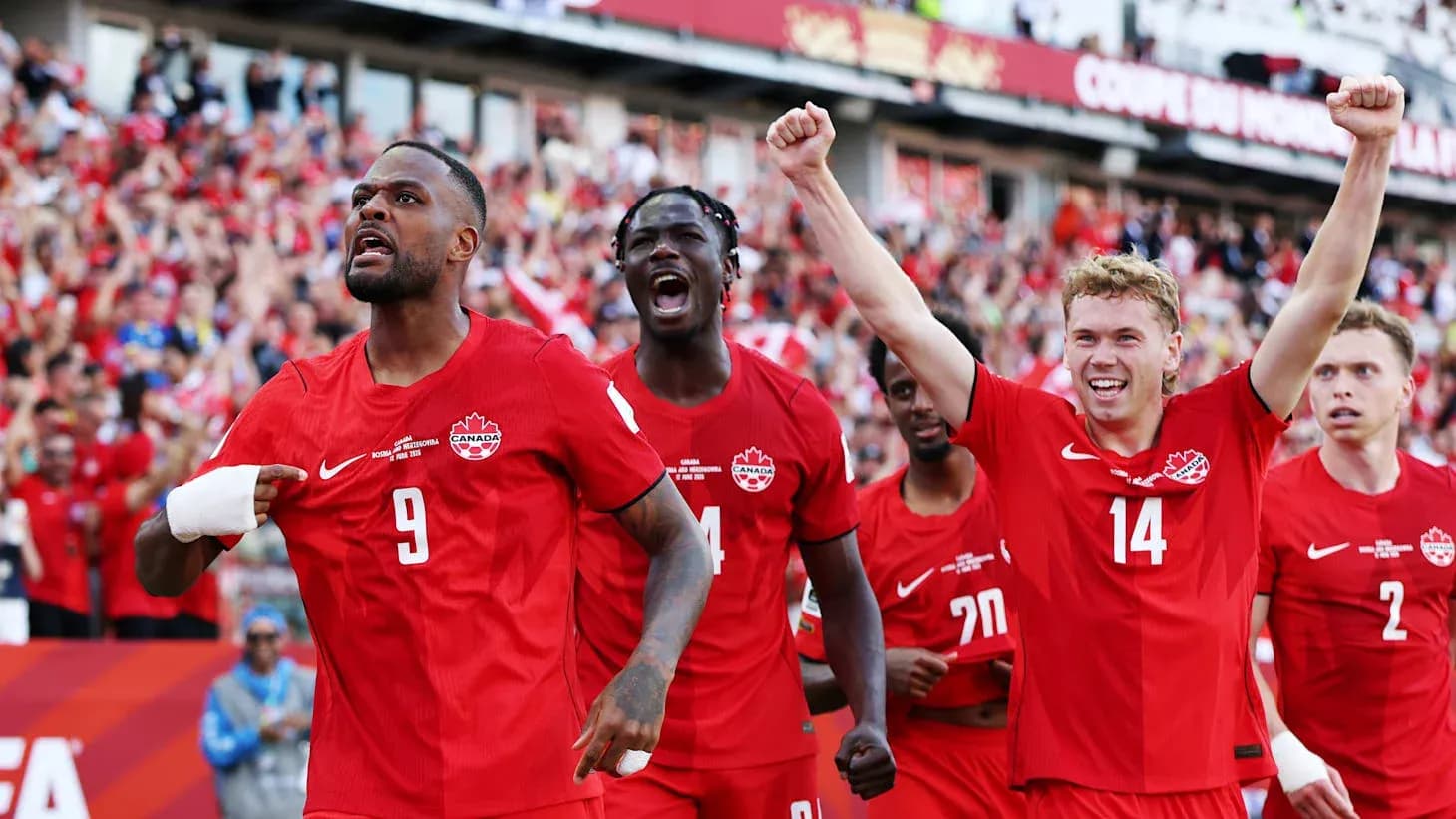

Canada and Bosnia & Herzegovina Draw in World Cup Group B Clash
Under the Toronto lights at BMO Field, the World Cup’s Group B narrative began with a stalemate that felt anything but static. Canada and Bosnia & Herzegovina shared a 1–1 draw, but beneath the symmetry of the scoreline lay two very different squad stories and a tactical contest that will echo through the rest of the group.
I. The Big Picture – Structure, Stakes, and Early Identity
Following this result, Canada sit 2nd in Group B with 1 point, Bosnia & Herzegovina 4th, also on 1. Both carry a goal difference of 0, each having scored 1 and conceded 1 overall. The symmetry extends into their early statistical profile: in total this campaign, both sides average 1.0 goal for and 1.0 goal against per match.
Yet how they arrive at those numbers could hardly be more distinct.
Canada’s 4-4-2 under Jesse Marsch is aggressively vertical. At home in this tournament so far, they have played 1, drawn 1, and crucially have not failed to score. The double act of Jonathan David and Tani Oluwaseyi up front is supported by wide runners Tajon Buchanan and Liam Millar, with Ismael Kone and Stephen Eustaquio as the central hinge. It is a structure designed to stretch the pitch, trusting the back four to defend large spaces.
Bosnia & Herzegovina mirror the 4-4-2 on paper, but Sergej Barbarez’s version is more measured and defensively grounded. On their travels in this tournament they have also drawn their only match, with a compact back line anchored by Nikola Katic and Sead Kolasinac, and a front pair of Ermedin Demirovic and Jovo Lukic who combine graft with penalty-box presence.
II. Tactical Voids and Discipline – Where the Edges Fray
Neither side has listed absentees, so the “voids” here are structural rather than personnel-driven.
For Canada, the main vulnerability is the space behind their adventurous full-backs. Alistair Johnston and Richie Laryea both push high to create overloads, leaving Luc De Fougerolles and Derek Cornelius exposed to direct counters. De Fougerolles’ profile underlines the burden: in his 90 minutes he engaged in 22 duels, winning 10, and drew 4 fouls while committing 2. His yellow card places him already in the disciplinary spotlight, as does Johnston’s caution; Canada’s card distribution shows 2 yellow cards in total, split evenly between 0–15 minutes and 46–60 minutes, a sign of early aggression and post-interval intensity.
Bosnia’s discipline tells a different tale: three yellow cards, spread across 31–45 minutes (33.33%), 46–60 minutes (33.33%), and 91–105 minutes (33.33%). Jovo Lukic, Katic, and Demirovic all sit on a booking, which subtly reshapes the way Barbarez can use his spine in future high-stakes moments. The late yellow window (91–105 minutes) hints at a side willing to foul to protect a result deep into added time.
III. Key Matchups – Hunter vs Shield, Engine Room vs Enforcer
Hunter vs Shield
For Canada, the pure “hunter” is Cyle Larin. He did not start, but his impact from the bench was unmistakable: in 14 minutes he scored 1 goal from his only shot, which was on target, and earned a 7.7 rating. Heading into the rest of the group, Larin stands as Canada’s leading scorer in total, with a ruthlessly efficient shot profile and the physical presence to unsettle any centre-back pairing.
Opposite him, Bosnia’s shield is Katic. Across his 90 minutes, he won 15 of 24 duels, made 5 tackles, and blocked 2 shots, all while taking a yellow card without letting it blunt his aggression. His 8.2 rating reflects a defender comfortable both in the air and on the ground, and his timing in contact zones will be critical if he is to keep Larin and David from exploiting crosses and second balls.
On Bosnia’s side, the hunter is Lukic. In total this campaign he has 1 goal, 3 shots (2 on target), and 10 duels won from 13 contested. His yellow card underscores his combative edge. The shield tasked with handling him is De Fougerolles, whose 50 completed passes at 80% accuracy show composure in build-up but whose 22 duels reveal how often he is dragged into direct confrontation. That duel – Lukic’s physical, back-to-goal game against a young centre-back learning international tempo – will shape Bosnia’s attacking ceiling.
The Engine Room
In Canada’s midfield, Eustaquio is the metronome, while Kone provides vertical thrust. But the creative spotlight has already shifted to Promise David. From the bench he logged 29 minutes, 1 assist, 3 passes with 1 key pass, and 1 shot, emerging as the joint-top assister in the competition so far. His presence as a late-arriving forward-creator complicates defensive assignments between the lines.
Bosnia’s enforcer axis runs through Benjamin Tahirovic and the dual-role of Kolasinac. Tahirovic’s positioning screens the back four, while Kolasinac, nominally a left-back, functions as both destroyer and playmaker. He has already delivered 1 assist, completed 21 passes with 71% accuracy, and created 1 key pass. Defensively, he has 3 tackles and 2 blocked shots in the top scorers data set, and 2 tackles plus 2 blocked shots in the assists data set – either way, the message is clear: Kolasinac blocked 2 shots and remains Bosnia’s most complete two-way outlet.
The duel between Kolasinac and Buchanan on Canada’s right flank is a pure stylistic clash: Buchanan wants to isolate and run, Kolasinac wants to step in, win contact, and immediately spring transitions.
IV. Statistical Prognosis – What This Draw Really Says
Following this result, both teams share an identical statistical skeleton: 1 match, 0 wins, 1 draw, 0 losses, 1 goal for, 1 against, and no clean sheets. Penalties have not featured yet; both sides have taken 0 in total, with 0 scored and 0 missed, so there is no evidence either way from the spot.
Without explicit xG data, the prognosis leans on patterns. Canada’s tendency to sustain pressure, coupled with the introduction of Larin and Promise David as high-impact substitutes, suggests a side whose attacking xG profile will likely climb as matches wear on. Their willingness to commit full-backs forward points to a team confident in creating volume rather than relying on isolated moments.
Bosnia & Herzegovina, by contrast, project as a side whose defensive solidity may keep their xG against in check. With Katic dominating duels and Kolasinac both blocking shots and supplying assists, they have the personnel to absorb pressure and strike selectively through Lukic and Demirovic.
In tactical terms, this 1–1 does not feel like equilibrium; it feels like two blueprints emerging. Canada’s path forward is to lean into their attacking depth, sharpen their final-third combinations, and manage the risk zones behind their full-backs. Bosnia’s is to keep their back line intact, control their card accumulation in key minutes, and ensure that Lukic’s penalty-box instincts are regularly serviced by Kolasinac and the wide midfielders.
The squads have shown their hand. The next fixtures in Group B will decide whose model scales better under knockout-level pressure.