.svg&w=384&q=75 "Naijagoal logo")

Brazil and Morocco Draw in World Cup 2026 Opener
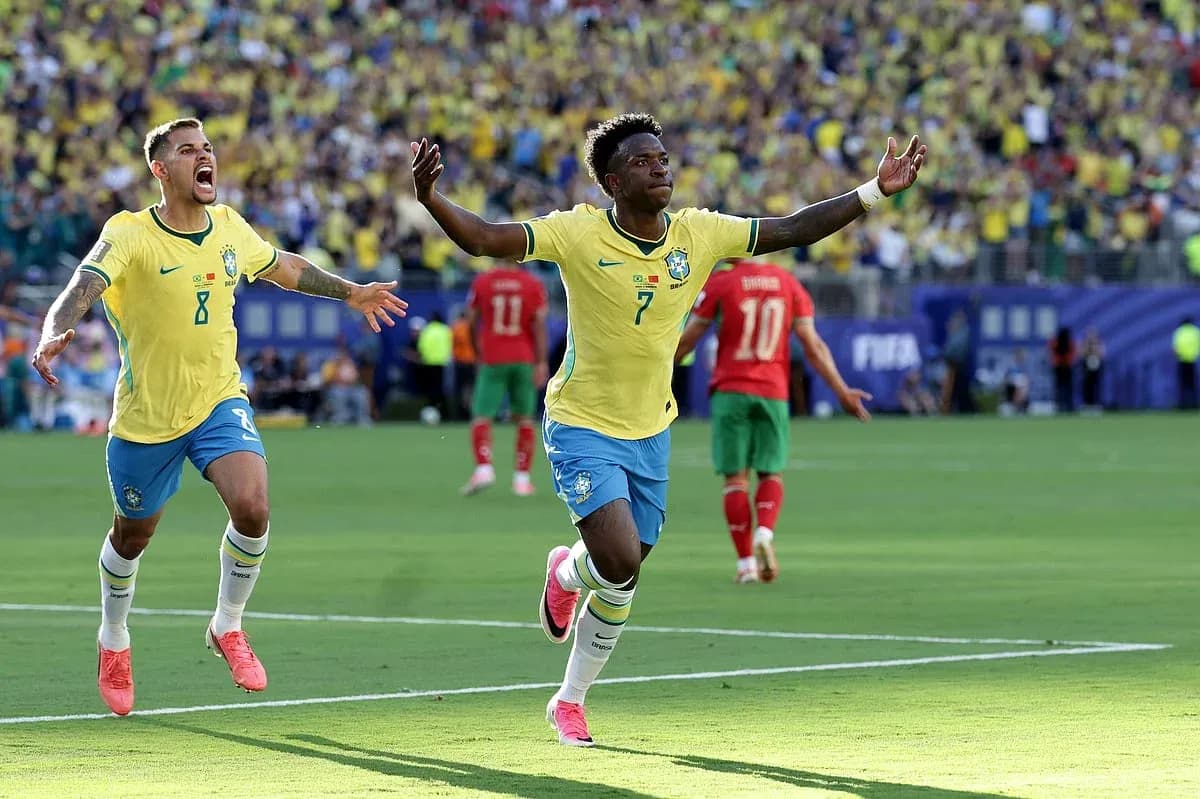
Under the New Jersey lights of MetLife Stadium, Brazil and Morocco opened their World Cup 2026 campaigns with a 1–1 draw that felt less like a settling of accounts and more like the prologue to a longer duel. Following this result, both sides sit on 1 point with a goal difference of 0 in Group C, Brazil officially listed in 3rd in their group snapshot and Morocco in 2nd, each shaped by a single, tightly contested fixture: 1 goal scored, 1 conceded, no clean sheets, and no wins yet on the board.
I. The Big Picture – Two 4-2-3-1s, Two Identities
Both coaches arrived at the same formation on paper – 4-2-3-1 – but used it to tell very different stories.
Carlo Ancelotti’s Brazil leaned into a fluid attacking band. With Alisson behind a back four of Douglas Santos, Gabriel, Marquinhos and Ibanez, the double pivot of Casemiro and Bruno Guimarães was tasked with both security and distribution. Ahead of them, Lucas Paquetá, Raphinha and Vinícius Júnior floated behind I. Thiago, forming a line of creators rather than rigid wingers.
Morocco’s Mohamed Ouahbi mirrored the shape but with a different emphasis. Bono anchored a back four of N. Mazraoui, C. Riad, I. Diop and A. Hakimi. In front, N. El Aynaoui and A. Bouaddi formed a young, industrious shield, allowing a technically gifted trio – B. El Khannouss, A. Ounahi and Brahim Díaz – to orbit around the central reference point, I. Saibari.
Heading into this game, both teams’ season profiles were blank slates; following it, they are near-mirror images statistically. Brazil, playing at home in this fixture, have played 1 home match in total this campaign, drawing it, scoring 1.0 home goals on average and conceding 1.0 at home. Morocco, on their travels, have also played 1 away game in total, drawing it, with 1.0 away goals for and 1.0 away goals against. The symmetry underlines how evenly matched this opener was.
II. Tactical Voids and Discipline – Brazil’s Edge of Risk
There were no listed absentees, so both coaches had full decks to play from, and the squads were deep. Brazil’s bench was stacked with options like Endrick, G. Martinelli, M. Cunha and Luiz Henrique, while Morocco’s included A. El Kaabi, S. Amrabat and S. Rahimi among others. Yet the real void that emerged was not about who was missing, but who was walking the disciplinary tightrope.
Brazil’s season card profile is already stark. All of their yellow cards so far – 2 in total – came in the 31-45 minute window, a 100.00% concentration of bookings right before half-time. That aggression has names attached: Ibanez and Casemiro. Ibanez’s World Cup has opened with 1 yellow card in 45 minutes, while Casemiro also collected 1 yellow in his 45-minute shift. Both sit simultaneously atop the yellow and red-card statistical tables for Brazil, a quirk of early-tournament sample size but an accurate reflection of the edge they play on.
This matters tactically. With Casemiro as the primary breaker and Ibanez part of the last line, Brazil’s entire defensive spine can be one mistimed challenge away from a red-card crisis in future group games. Ancelotti will need to decide whether to rotate, to protect them, or to double down on their physicality as part of Brazil’s identity.
Morocco, by contrast, emerge from the opener with a clean disciplinary slate: no yellow, no red across any time window. That calmness, combined with their compact 4-2-3-1, hints at a side comfortable suffering without losing control.
III. Key Matchups – Hunter vs Shield, Engine Room vs Engine Room
Hunter vs Shield
The goalscoring mantle for Brazil has already been seized by Vinícius Júnior. Heading into the next match, he stands with 1 total goal from 1 appearance, backed by 30 total passes at 86% accuracy and 2 key passes. He is less a traditional finisher and more a destabiliser who finishes – 8 dribble attempts in his first outing underline how much of Brazil’s attacking chaos flows through him.
For Morocco, the “hunter” is I. Saibari. He also has 1 total goal in 1 appearance, with 1 shot on target and 24 passes at 91% accuracy. Where Vinícius Júnior operates from the flank, Saibari is a central reference point, pinning centre-backs, linking play and finishing moves. His 7 duels with 3 won show he is not just a poacher but a physical presence in the front line.
Both hunters face defences that have so far conceded exactly 1 goal in total this campaign, with average goals against of 1.0 for both Brazil and Morocco. There is no fortress yet, only systems still bedding in. The next chapter of this duel will be about which back four learns faster.
Engine Room – Playmaker vs Enforcer
In midfield, the narratives are already forming. For Brazil, Bruno Guimarães is the metronome. He has 38 total passes at 89% accuracy, 1 key pass, 2 tackles and 1 blocked shot. He is the conduit that turns ball recovery into structured possession, and his ability to combine with Lucas Paquetá between the lines is central to Ancelotti’s design.
Morocco’s creative axis is Brahim Díaz. With 1 total assist, 2 key passes and a 100% passing accuracy from 19 total passes, he has already etched his name into the tournament’s assist charts. His 3 dribble attempts, 1 successful, and 3 fouls drawn mark him out as the player who bends defensive structures, especially in the right half-space.
The duel is subtle but decisive: Bruno Guimarães orchestrating Brazil’s tempo versus Brahim Díaz threading Morocco’s transitions. Whoever imposes their rhythm will tilt the field for their hunter – Vinícius Júnior or I. Saibari.
IV. Statistical Prognosis – Margins, xG Feel, and the Road Ahead
We do not have explicit xG numbers, but the early statistical fingerprints point to a finely balanced contest going forward. Both teams have:
- Played 1 match in total this campaign.
- Drawn that match (Brazil at home, Morocco away).
- Scored 1 total goal and conceded 1 total goal.
- Failed to keep a clean sheet even once.
- Taken no penalties, with 0 total penalties scored and 0 total penalties missed for each.
This suggests two sides capable of creating enough to score once, but not yet structured enough to shut games down. Brazil’s attacking ceiling feels higher, powered by Vinícius Júnior’s individualism and Bruno Guimarães’ orchestration, while their disciplinary profile – 2 yellows clustered before half-time – hints at volatility.
Morocco’s prognosis is one of control and clarity. Their back four of Hakimi, Diop, Riad and Mazraoui has conceded only 1 total goal on their travels, and their midfield line is technically secure. With Brahim Díaz already on the assist charts and I. Saibari among the top scorers, they have a clear route to goal: quick, vertical combinations through the central lanes.
Following this result, the statistical balance says these sides are level. The tactical nuance says Brazil may live more dangerously, with higher upside and higher risk, while Morocco may edge the tournament’s long game through discipline and structure. The next time they step onto the World Cup stage, expect the story to be decided not by volume of chances, but by who better aligns their hunter with their shield – and who can keep their enforcers on the pitch when the clock ticks past 31 minutes and the bookings usually begin to fall.