.svg&w=384&q=75 "Naijagoal logo")
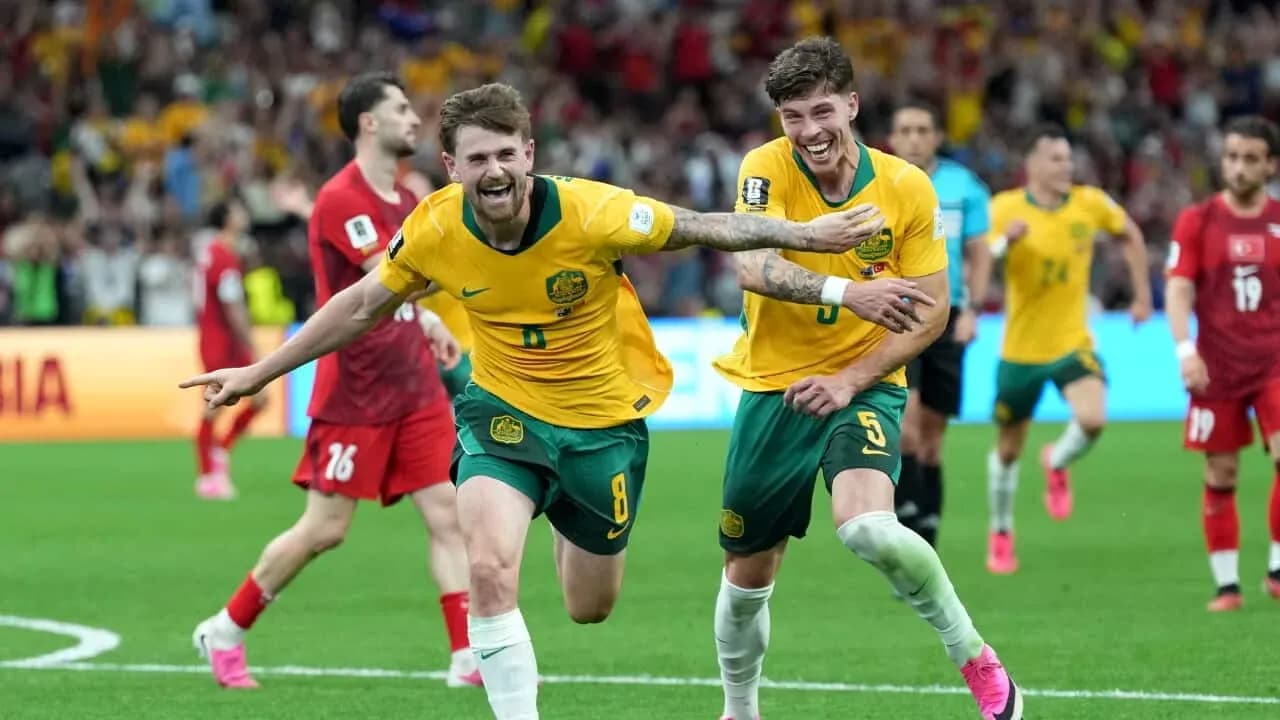

Australia's World Cup Victory: A Tactical Breakdown of the 2-0 Win Over Türkiye
Under the closed roof of BC Place in Vancouver, this World Cup Group D opener became a statement of intent from Australia and a sobering tactical lesson for Türkiye. The 2-0 scoreline in regular time did more than settle an opening fixture; it crystallised two contrasting identities at the very start of a campaign.
Following this result, Australia sit 2nd in Group D with 3 points, a goal difference of +2 (2 goals for, 0 against) and a perfect early record: 1 win from 1. Their World Cup season statistics mirror the night in Vancouver: in total this campaign they have played 1 match, won 1, drawn 0, lost 0, scoring 2.0 goals on average at home and conceding 0.0. Türkiye, by contrast, leave the same pitch 3rd in the group, with 0 points and a goal difference of -2 (0 goals for, 2 against). On their travels this season they have played 1, lost 1, failed to score, and conceded an average of 2.0 goals.
I. The Big Picture: Structural Clarity vs Fragile Ambition
Tony Popovic set Australia up in a 5-4-1 that was anything but conservative. The back five of Jacob Italiano, Alessandro Circati, Harry Souttar, Cameron Burgess and Jordan Bos formed a wide, flexible shell, allowing the Socceroos to compress space horizontally while still springing forward. Ahead of them, the midfield line of Connor Metcalfe, Aiden O’Neill, Paul Okon-Engstler and Nestory Irankunda gave Popovic a blend of work rate, control and direct threat, with Mohamed Touré leading the line as a lone forward.
The structure fit perfectly with Australia’s early World Cup DNA: compact without the ball, ruthless when chances appear. Their season data already tells a clear story: in total this campaign they have kept 1 clean sheet from 1, failed to score in 0 matches, and their biggest win so far is this very 2-0 at home.
Vincenzo Montella’s Türkiye mirrored a more modern attacking posture on paper: a 4-2-3-1 with Uğurcan Çakır behind a back four of Zeki Çelik, Merih Demiral, Abdülkerim Bardakcı and Ferdi Kadıoğlu. In front, İsmail Yüksek and Hakan Çalhanoğlu formed the double pivot, with Arda Güler, Orkun Kökçü and Barış Alper Yılmaz supporting Kerem Aktürkoğlu as the nominal striker.
Yet the numbers and the outcome reveal the fissures. In total this campaign, Türkiye have played 1 match and lost it 2-0 away, have 0 clean sheets and have failed to score in their only outing. The attacking promise of their 4-2-3-1 never truly translated into incision against Australia’s disciplined block.
II. Tactical Voids and Discipline: Where the Game Tilted
There is no recorded list of absentees for either side, so the tactical voids came not from missing names but from structural imbalances.
For Australia, the absence of yellow or red card data in their season profile hints at a clean disciplinary slate so far. They managed to impose aggression without crossing lines, an important detail in tournament football where accumulation quickly becomes a storyline. The five-man defence stayed intact, the midfield rotated fouls intelligently, and no one drifted into dangerous disciplinary territory.
Türkiye’s season card profile, however, already carries a warning sign. In total this campaign, their only yellow card came in the 76-90 minute window, accounting for 100.00% of their bookings. That late-game surge in indiscipline dovetails with the frustration of chasing a match that was slipping away. The top yellow-carded player, Yunus Akgün, embodies that tension: 1 appearance, 35 minutes, 1 yellow card, 1 foul committed. He came [IN] as a substitute and brought energy, but his caution underlines how Türkiye’s attacking push in the latter stages risked unraveling into impatience.
Crucially, neither side has taken a penalty in total this campaign. Australia’s penalty record stands at 0 taken, 0 scored, 0 missed; Türkiye mirror that exactly. There was no spot-kick safety net for either attack—everything had to be crafted in open play.
III. Key Matchups: Hunter vs Shield, Engine Room vs Enforcer
The “Hunter vs Shield” duel was defined by Nestory Irankunda and an Australian back line that refused to give Türkiye a way back into the game.
Irankunda, already on the World Cup top scorers list with 1 goal in 1 appearance, played 61 minutes as a right-sided midfielder but functioned like a wide forward. He took 2 shots, both on target, scored once, completed 1 dribble from 1 attempt and drew 1 foul. His 7.5 rating and sharpness in the final third turned Australia’s 5-4-1 into a 3-4-3 in transition, with Italiano and Bos able to push higher when he pinned Türkiye’s left side back.
Behind him, the “Shield” of Souttar, Circati and Burgess was impenetrable. Australia’s season numbers—0.0 goals conceded at home and in total—are a direct reflection of that trio’s command of the box and aerial dominance. Türkiye’s forwards, including Aktürkoğlu and the advanced midfield line, found no route through. In total this campaign, Türkiye’s goalsFor record is stark: 0 across home, away and overall.
In the “Engine Room” battle, Paul Okon-Engstler emerged as the quiet conductor. On the top assists list with 1 assist from 1 appearance, he played 84 minutes, completing 32 passes with 81% accuracy and delivering 2 key passes. He also contributed 3 tackles, 2 successful blocks and 3 interceptions, a two-way performance that allowed O’Neill and Metcalfe to share the load while he linked defence to attack. Every time Türkiye tried to build through Kökçü or Çalhanoğlu, Okon-Engstler stepped into passing lanes or forced play wide.
On the other side, İsmail Yüksek was tasked with shielding Türkiye’s back four, but he was too often isolated. With full-backs Ferdi Kadıoğlu and Zeki Çelik pushed high to provide width, the double pivot had to cover enormous horizontal spaces. Australia’s 5-4-1 exploited this by dragging one of the pivots wide, then playing quickly into Touré’s feet or Irankunda’s channel runs.
IV. Statistical Prognosis: What This Result Tells Us Going Forward
Even without explicit xG figures, the statistical contours are clear. Australia’s profile after this match is that of a side that maximises chances and minimises risk: 2.0 goals scored on average at home, 0.0 conceded, 1 clean sheet from 1, and no penalties required to build their lead. Their biggest home win is already 2-0, and their only formation used—5-4-1—has delivered both control and incision.
Türkiye’s prognosis is more fragile. On their travels they concede 2.0 goals on average, have yet to score, and their only defeat so far is a 2-0 away loss. The late yellow card concentration between 76-90 minutes suggests a team that loses composure when chasing the game. Yunus Akgün’s profile—1 yellow in 35 minutes—reinforces the risk that their most aggressive attacking substitutions may come with a disciplinary cost.
Tactically, Australia look built for tournament football: a stable back five, a creative and industrious midfield anchored by Okon-Engstler, and a genuine cutting edge in Irankunda, whose early goal return and efficiency in front of goal make him a central figure in any “Hunter vs Shield” narrative going forward.
For Türkiye, Montella must tighten the distances between his lines and find a way to convert the technical quality of Güler, Kökçü and Çalhanoğlu into tangible end product. Until their goalsFor column shifts from 0, every match will be played under the shadow of that opening 2-0 defeat and the statistical reality it has created.