.svg&w=384&q=75 "Naijagoal logo")

Spain Dominates but Draws with Cape Verde Islands: Tactical Analysis
Spain’s 0-0 draw with Cape Verde Islands at Mercedes-Benz Stadium was a tactical siege in which one side monopolised territory and the ball, while the other executed a disciplined low block and survived through structure and goalkeeping. Spain’s control was almost absolute in classic Luis de la Fuente fashion: 74% possession, 801 passes at 92% accuracy, and 27 total shots. Yet they could not convert 2.29 xG into a breakthrough. Cape Verde Islands, with just 26% of the ball and 6 shots (1 on target), leaned into compactness, time-on-task in their own half, and selective counters, doing just enough to protect a 0-0 that their 0.3 xG underlines as a defensive success.
Spain's Formation
Structurally, Spain’s nominal formation is not listed, but the personnel profile suggests a 4-3-3 morphing into a 2-3-5 in possession. Marcos Llorente and Marc Cucurella operated as advanced full-backs, with Pau Cubarsí and Aymeric Laporte left to manage rest defence against rare Cape Verde transitions. Rodri anchored midfield with Fabián Ruiz and Pedri ahead, while a fluid front three of Ferran Torres, Mikel Oyarzabal and Pablo Gavi rotated between half-spaces and wide channels.
Passing Metrics
The passing metrics show Spain’s positional play functioning as designed. With 801 total passes and 734 accurate (92%), Spain circulated relentlessly to shift Cape Verde’s block. The volume of shots inside the box (16) versus outside (11) indicates that this was not sterile possession; they did manage to penetrate central zones. However, 8 blocked shots out of 27 total highlights Cape Verde’s density in and around the area, with defenders consistently getting bodies in front of efforts before they truly tested Vozinha.
Cape Verde's Setup
Cape Verde Islands, under Pedro Leitao Brito, set up with a back four of Steven Moreira, Pico, Diney Borges and Sidny Lopes Cabral, screened by a hard-working midfield of Kevin Lenini, Ryan Mendes, Laros Duarte and Jamiro Monteiro, with Jovane Cabral and Dailon Rocha Livramento providing outlets. Their 279 passes at 73% accuracy reflect a pragmatic approach: clearances and long passes when under pressure, with occasional attempts to link through midfield when Spain’s press left a lane open.
Event Timeline
The event timeline reinforces the tactical narrative. The first key disciplinary moment came at 16', when Sidny Lopes Cabral (Cape Verde Islands) received a yellow card — Foul. This early booking for a defender in a team under siege forced Cape Verde’s back line to manage duels more cautiously, increasing the importance of collective compactness and cover rather than aggressive front-foot defending.
The triple substitution at 61' was a clear Cape Verde tactical adjustment. Deroy Duarte (IN) came on for Laros Duarte (OUT), Nuno Da Costa (IN) came on for Dailon Rocha Livramento (OUT), and Willy Semedo (IN) came on for Jovane Cabral (OUT). This reconfiguration refreshed legs in midfield and attack, aiming to preserve pressing intensity in the first line and offer counter-attacking pace as Spain pushed higher. It also suggested a shift towards slightly more vertical transitions, with Da Costa and Semedo better suited to attacking space behind Spain’s advanced full-backs.
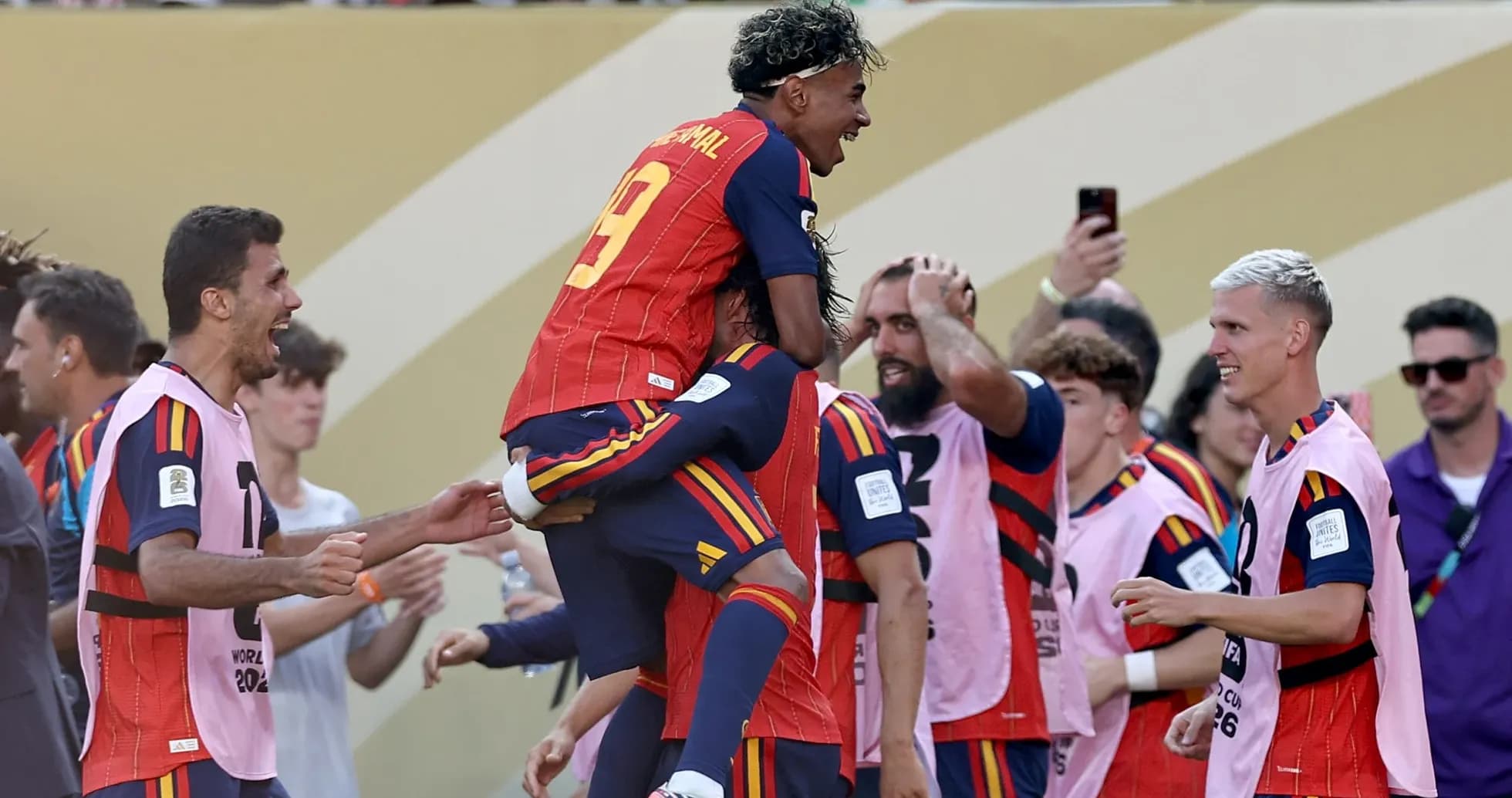
Spain’s response came on 71', with Mikel Merino (IN) coming on for Fabián Ruiz (OUT) and Lamine Yamal (IN) coming on for Pablo Gavi (OUT). De la Fuente sought more late-arrival threat from midfield and 1v1 dynamism on the right. Merino’s profile as a box-arriving midfielder was intended to attack the second line of Cape Verde’s block, while Lamine Yamal’s dribbling was designed to destabilise a tiring left side of the Cape Verde defence.
Cape Verde continued to manage energy through changes: at 76', João Paulo (IN) came on for Sidny Lopes Cabral (OUT), removing a booked defender and adding fresh legs, an explicitly risk-averse but sensible move given the pressure. At 79', Telmo Arcanjo (IN) came on for Jamiro Monteiro (OUT), maintaining midfield work-rate and helping close central lanes as Spain increased tempo.
Spain’s final attacking reshapes came late: at 81', Dani Olmo (IN) came on for Ferran Torres (OUT), adding a more interior, combination-focused profile on the flank; at 87', Nico Williams (IN) came on for Rodri (OUT), an aggressive switch that effectively removed the single pivot to add another winger, turning Spain into an almost full attacking line in the closing minutes. This underlined Spain’s territorial dominance but also increased exposure to counters, which Cape Verde, with just 1 shot on goal and 6 total, rarely exploited.
Goalkeepers' Performance
In goal, Unai Simón (Spain) had a largely observational role, making 1 save. This single save against Cape Verde’s 1 shot on target aligns with the defensive control Spain exerted; their rest defence and counter-press limited Cape Verde to low-quality looks, as reflected in the 0.3 xG. Vozinha (Cape Verde Islands), by contrast, was central to the result. He made 7 saves, and with Cape Verde’s goals prevented figure at 1.46, his shot-stopping materially altered the outcome, turning what xG suggests should have been a Spanish scoring game into a clean sheet.
The final card of the match, at 90+3', saw Pedri (Spain) booked — Foul. This late yellow encapsulated Spain’s frustration as they chased a decisive attack in stoppage time, pressing aggressively to recover the ball after yet another blocked or repelled move.
Statistical Overview
Statistically, Spain’s 2.29 xG versus Cape Verde’s 0.3 underlines the asymmetry in chance creation. Spain’s 11 corner kicks to Cape Verde’s 1, and 10 fouls to Cape Verde’s 1, further reinforce the pattern: Spain constantly on the front foot, Cape Verde defending deep and only occasionally contesting aggressively. Both sides ended with 1 yellow card, but the disciplinary symmetry hides a deeply unbalanced contest in terms of territory and threat.
Broader Tactical Lens
From a broader tactical lens, Spain can interpret this as evidence that their positional framework reliably generates volume and quality of chances, but they lacked efficiency and perhaps variety in the final third against a packed block. Cape Verde Islands, meanwhile, executed a textbook underdog game plan: compact 4-5-1/4-4-2 shapes, high shot-blocking numbers, and elite goalkeeping from Vozinha, fully justifying a point in a match where the raw numbers were stacked against them.