.svg&w=384&q=75 "Naijagoal logo")

Spain Dominates Austria 3-0 in World Cup Round of 32
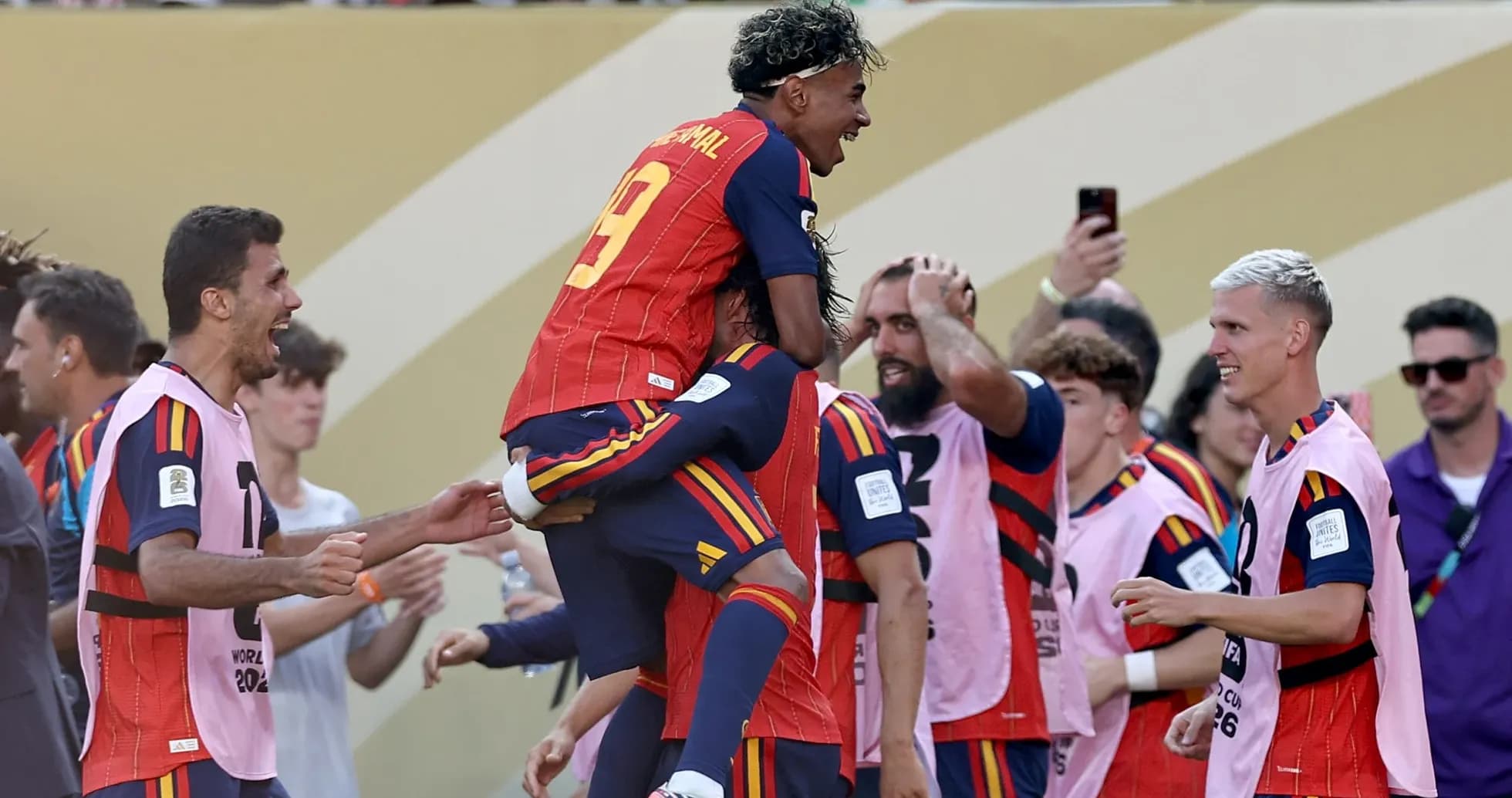
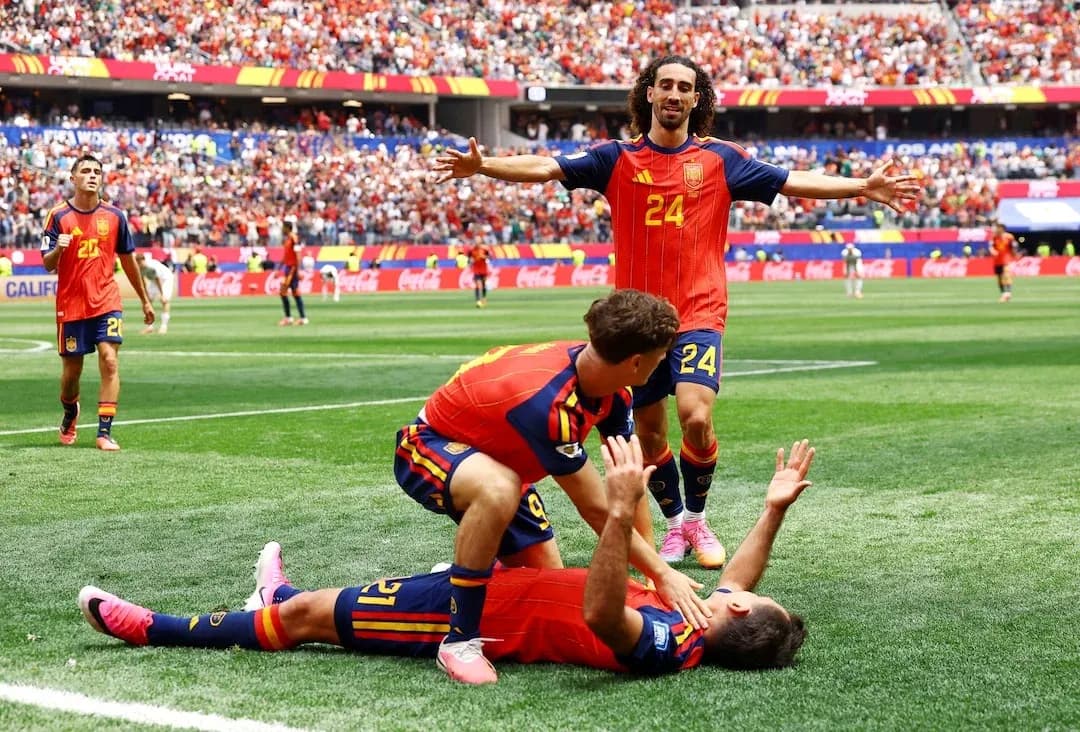
Spain’s 3-0 win over Austria at SoFi Stadium in this World Cup Round of 32 tie was a controlled, territorial dismantling built on structural superiority and relentless ball circulation. The 1-0 half-time lead (Mikel Oyarzabal on 36') only partially reflected their dominance; two second-half goals merely aligned the scoreline with a performance that saw Spain take 23 shots to Austria’s 5 and monopolise 65% possession.
Austria, by contrast, delivered a textbook low-output, reactive game: no shots on goal, no corners, and just 35% of the ball. Their shape and substitutions were clearly geared towards staying in the tie and counter-punching, but they never generated the pressing traps or transition clarity to unsettle Spain’s rhythm.
I. Executive Summary
Spain’s approach was recognisably positional: a back four with Rodri anchoring in front, and a technically gifted band of midfielders and wide playmakers (Lamine Yamal, Dani Olmo, Alex Baena, Mikel Oyarzabal) constantly rotating between lines. With 629 passes at 91% accuracy, they established a stable possession platform high up the pitch, pinning Austria’s midfield and back line deep.
Austria started with a back four featuring David Alaba and Kevin Danso centrally, Stefan Posch and Konrad Laimer as full-backs, and a compact midfield triangle around Nicolas Seiwald and Xaver Schlager. The plan was to compress central zones, delay Spain between the lines, and then break through Marcel Sabitzer and Michael Gregoritsch. But with only 346 passes at 82% and 5 total shots (0 on target), their structure was mostly reactive and failed to translate into meaningful attacking sequences.
II. Scoring Sequence & Disciplinary Log
The first breakthrough came on 36': Mikel Oyarzabal (Spain) finished a move assisted by Marc Cucurella, a pattern that encapsulated Spain’s flank-driven dominance. Cucurella’s advanced role from left-back, combined with interior support, repeatedly overloaded Austria’s right side, and Oyarzabal’s timing into the box punished the first real lapse in Austria’s compactness.
At 1-0, Austria still had theoretical access to the game, which explains Ralf Rangnick’s aggressive double change at 46': Carney Chukwuemeka (IN) came on for Nicolas Seiwald (OUT), and Florian Grillitsch (IN) came on for Xaver Schlager (OUT). The idea was to gain more ball security and progressive passing in midfield, but Spain’s pressing and rest-defence structure choked off any momentum.
On 60', Austria reshaped their attack: Marko Arnautović (IN) came on for Michael Gregoritsch (OUT), and Saša Kalajdžić (IN) came on for Romano Schmid (OUT). This shifted the focus towards a more direct, aerial threat, but with no crosses and no corners, the new forwards were starved of usable service.
Spain’s second goal on 66' effectively killed the contest: Pedro Porro (Spain), pushing high from right-back, scored after a pass from Alex Baena. This underlined Spain’s full-back asymmetry—Porro frequently joining as an extra midfielder or winger, while Rodri dropped to stabilise rest defence. At 2-0, Spain could manage tempo and spacing with minimal risk.
Luis de la Fuente then freshened his midfield at 71': Mikel Merino (IN) came on for Dani Olmo (OUT), and Ferran Torres (IN) came on for Alex Baena (OUT), maintaining intensity between lines and adding depth running in behind a tiring Austrian back line.
The only card of the match arrived on 83':
83' Stefan Posch (Austria) — Foul
This was symptomatic of Austria’s increasing desperation as they struggled to get out and were forced into late challenges to break Spain’s rhythm.
Spain continued to rotate: at 85', Pablo Gavi (IN) came on for Lamine Yamal (OUT), adding fresh pressing legs. Austria responded with Alexander Prass (IN) for Stefan Posch (OUT) at 85', a move that slightly rebalanced their left side but came too late to affect the outcome.
The 3-0 arrived on 89': again Mikel Oyarzabal (Spain), again assisted by Marc Cucurella. The repetition of that combination highlighted a structural mismatch on Austria’s right, where rotations between Cucurella, Oyarzabal and the left-sided interior repeatedly disorganised the defensive line.
Spain’s final adjustments at 90' were about game management: Marc Pubill (IN) came on for Aymeric Laporte (OUT), and Fabián Ruiz (IN) came on for Pedri (OUT), preserving legs and ensuring control through to full time.
III. Tactical Breakdown & Personnel
With no recorded saves for Unai Simón (Spain), the defensive story is one of preventive control rather than last-ditch interventions. Spain’s 7 blocked shots and Austria’s 0 shots on goal show how high the defensive line and midfield screen operated: Pau Cubarsí and Aymeric Laporte could hold aggressive positions with Rodri screening in front, compressing the central lane where Sabitzer typically thrives.
In possession, Spain’s structure resembled a 2-3-5 in settled attacks. Pedro Porro and Marc Cucurella both advanced high, with Rodri anchoring and Pedri plus Alex Baena (later Mikel Merino and Ferran Torres) forming a fluid interior triangle. Lamine Yamal and Dani Olmo provided width and half-space occupation, while Oyarzabal acted as a hybrid nine, dropping to link or attacking the box late. This explains the 15 shots inside the box and 23 total shots—Spain consistently created positional superiority around the Austrian area.
Austria’s defensive plan was initially compact and narrow, but the lack of pressure on the ball-carrier allowed Spain to keep finding switches and cut-backs. Their 15 fouls to Spain’s 8 indicate how often they arrived late into duels after being shifted side to side. The single yellow card for Stefan Posch was the most visible manifestation, but the deeper issue was systemic: their midfield line was repeatedly stretched, leaving the back four exposed to diagonal runs and third-man combinations.
On the ball, Austria’s 0 corners and 5 total shots (only 1 blocked) reflect how rarely they established territory in the final third. With 35% possession and 346 passes, they never built sustained attacks; instead, they relied on long balls and early passes into Gregoritsch and later Arnautović and Kalajdžić. Spain’s rest defence, with Rodri dropping between or beside the centre-backs, neutralised these outlets.
Alexander Schlager (Austria) was heavily involved, making 6 saves. That figure, against 10 shots on goal, underlines both Spain’s volume and the fact that several efforts were either blocked or off target. Austria’s negative goals prevented value suggests the finishing quality of Spain’s chances was slightly above what the goalkeeper could reasonably neutralise.
IV. The Statistical Verdict
The underlying numbers match the eye test. Spain’s xG of 2.84 against Austria’s 0.32 confirms a one-sided chance profile: three goals scored roughly in line with expectation, while Austria never threatened to turn the match into a contest. Spain’s 629 passes, 570 accurate (91%), illustrate a side comfortable circulating under minimal pressure, while Austria’s 346 passes, 284 accurate (82%), show a team often forced into riskier, longer distributions.
Spain’s 9 corners to Austria’s 0 and 7 blocked shots to Austria’s 1 speak to territorial dominance and defensive alertness. Discipline also tilted Austria’s way: 15 fouls and 1 yellow card versus Spain’s 8 fouls and no bookings, consistent with a side chasing and breaking up play.
With no extra-time or penalties, this was a clean, 90-minute demonstration of Spain’s control-oriented game model. They advanced from the Round of 32 not through moments of chaos, but by systematically denying Austria access to both space and time, while repeatedly creating high-quality situations in and around the box.