.svg&w=384&q=75 "Naijagoal logo")

Switzerland Advances to World Cup Round of 16 with 2-0 Victory Over Algeria
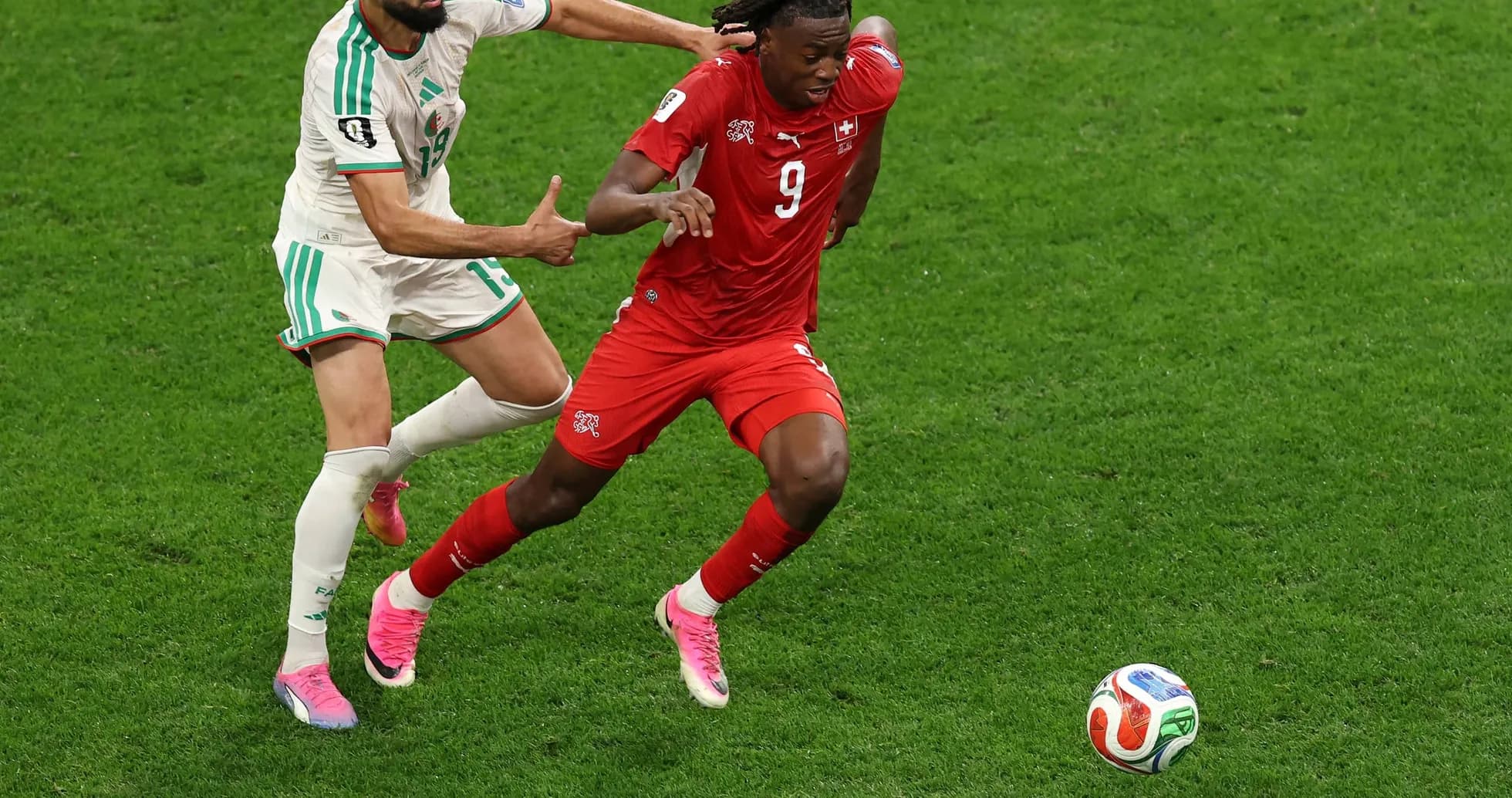
Switzerland 2-0 Algeria at BC Place in Vancouver sends the Group B winners into the World Cup Round of 16 with authority, building on their group-stage momentum. Murat Yakin’s side convert territorial efficiency into a controlled knockout win, moving from 7 to 10 points overall in the tournament phase, while Algeria’s campaign ends after a performance that saw them enjoy more of the ball but create far fewer clear chances.
Match Report
On 10', Switzerland struck first. Switzerland goal — Breel Embolo (assisted by Johan Manzambi) finished a well-constructed move to give the European side an early 1-0 lead, immediately validating their direct, vertical approach.
Algeria’s frustration began to surface before the break. On 36', Farès Chaïbi (Algeria) — yellow card (Tripping) was booked after a late challenge as Switzerland continued to threaten in transition while ceding possession.
Right after half-time, Switzerland doubled their advantage. On 46', Switzerland goal — Dan Ndoye (unassisted) cut through the Algerian back line with a solo effort to make it 2-0, a goal that shifted the tie decisively and allowed Yakin’s team to manage the game from a position of comfort.
Algeria reacted with a double change on 58' to chase the game. Jaouen Hadjam replaced Houssem Aouar (Algeria), adding more thrust from full-back, while Amine Gouiri replaced Ramiz Zerrouki (Algeria) to inject fresh attacking impetus between the lines.
Switzerland responded by refreshing their own attacking midfield on 71'. Fabian Rieder replaced Rubén Vargas (Switzerland), and Noah Okafor replaced Johan Manzambi (Switzerland), maintaining intensity in the press and offering fresh legs to exploit space behind Algeria’s advancing full-backs.
Algeria made their own attacking reshuffle on 71'. Anis Hadj Moussa replaced Riyad Mahrez (Algeria), and Hicham Boudaoui replaced Nabil Bentaleb (Algeria), signalling a shift towards more direct running and energy in central areas.
The increased aggression from Algeria brought another caution. On 72', Hicham Boudaoui (Algeria) — yellow card (Roughing) was booked for a robust challenge as the North Africans tried to disrupt Switzerland’s rhythm without the ball.
Still chasing the game, Algeria used their final change on 82', with Adil Boulbina replacing Rafik Belghali (Algeria) to add fresh legs on the flank against a Switzerland side now largely in game-management mode.
Yakin then closed the game down with late substitutions to protect key players and preserve structure. On 83', Zeki Amdouni replaced Breel Embolo (Switzerland), removing the goalscorer and adding a fresh forward to press Algeria’s build-up. On 87', Silvan Widmer replaced Denis Zakaria (Switzerland), and Michel Aebischer replaced Dan Ndoye (Switzerland), reinforcing the right side and midfield cover to see out a controlled 2-0 victory.
Fixture Statistics & Tactical Audit
- xG: Switzerland 2.56 vs 0.73 Algeria
- Possession: Switzerland 45% vs 55% Algeria
- Shots on Target: Switzerland 5 vs 2 Algeria
- Goalkeeper Saves: Switzerland 2 vs 2 Algeria
- Blocked Shots: Switzerland 2 vs 3 Algeria
The scoreline closely mirrors the underlying numbers: Switzerland’s attack was clinical (2 goals from 2.56 xG and 5 shots on target) and consistently generated high-quality chances inside the box, even without dominating the ball. Algeria’s greater share of possession (55%) translated into only 2 shots on target and 0.73 xG, underlining a structural issue in progressing the ball into dangerous central zones. Switzerland’s compact 4-2-3-1 blocked lanes into the half-spaces, forcing Algeria into lower-value efforts from outside or wide areas, which Switzerland’s back line and Gregor Kobel handled comfortably. Both goalkeepers made 2 saves, but Switzerland’s superior shot quality and efficiency in transition justified the 2-0 margin.
Standings Update & Seasonal Impact
Switzerland, who arrived in the Round of 32 as Group B leaders with 7 points and a +4 goal difference (7 scored, 3 conceded), now move to 10 points in the overall tournament progression with 9 goals for and 3 against, improving their goal difference to +6. That statistical profile — strong attacking output combined with a tightened defence in knockout play — reinforces their status as one of the more balanced sides heading into the Round of 16.
Algeria entered this tie from Group J with 4 points and a -2 goal difference (5 scored, 7 conceded). The 2-0 defeat leaves them on 4 points overall, with 5 goals for and 9 against, worsening their goal difference to -4. The pattern of their tournament holds: competitive in spells, but ultimately undone by defensive looseness and an inability to convert possession into high-quality chances against elite opposition, bringing their World Cup run to an end at the Round of 32 stage.
Lineups & Personnel
Switzerland Starting XI
- GK: Gregor Kobel
- DF: Denis Zakaria, Nico Elvedi, Manuel Akanji, Ricardo Rodríguez
- MF: Remo Freuler, Granit Xhaka, Dan Ndoye, Johan Manzambi, Rubén Vargas
- FW: Breel Embolo
Algeria Starting XI
- GK: Luca Zidane
- DF: Rafik Belghali, Aïssa Mandi, Ramy Bensebaini, Rayan Aït-Nouri
- MF: Ramiz Zerrouki, Nabil Bentaleb, Farès Chaïbi
- FW: Riyad Mahrez, Ibrahim Maza, Houssem Aouar
Post-Match Verdict
Switzerland delivered a controlled and clinical performance (2.56 xG from 11 shots, 5 on target) built on a compact mid-block and rapid vertical transitions. Early and early-second-half goals allowed Yakin’s side to dictate tempo, with the double pivot of Freuler and Xhaka effectively screening central zones and forcing Algeria into low-yield possession. The defensive unit limited Algeria to just 0.73 xG and 2 shots on target despite conceding 55% possession, illustrating a disciplined structure rather than reactive defending.
For Algeria, this was more a case of attacking inefficiency than outright defensive collapse. While they conceded 2 goals from 5 shots on target, their own attacking metrics — 8 total shots, 2 on target, and only 0.73 xG — highlight a lack of penetration and final-third cohesion. The series of second-half substitutions increased energy but did not materially change the shot profile. In knockout football, Switzerland’s balance between risk and control proved decisive, while Algeria’s sterile dominance of the ball underlined the gulf in chance creation at this level.