.svg&w=384&q=75 "Naijagoal logo")

Cristiano Ronaldo Honors Diogo Jota After Portugal's World Cup Victory
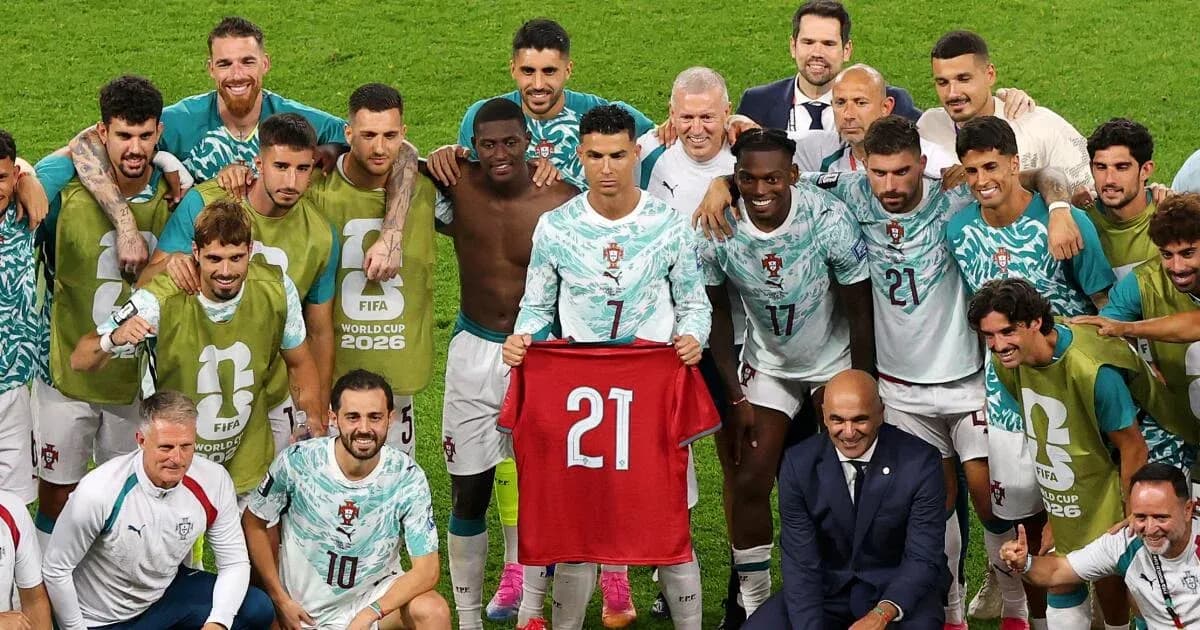
Cristiano Ronaldo stood alone in the glare of the floodlights, a red No. 21 jersey clutched to his chest.
Around him, teammates laughed, shouted, posed for the cameras after a wild 2-1 World Cup knockout win over Croatia at Toronto Stadium. But the captain’s face told a different story. No smile, no roar. Just the weight of a night that was about far more than a place in the next round.
It was about Diogo Jota.
On the eve of the one-year anniversary of Jota’s death, Portugal’s players gathered in the center circle and held up his shirt. Ronaldo took it, raised it, then pulled it over his own. The crowd rose. The noise swelled. He walked slowly, almost carefully, across the pitch, acknowledging the stands as emotion finally broke through the game-face that has carried him through two decades at the top.
“It’s a special day, for our Jota, who is up there illuminating us,” Ronaldo told Portugal’s Sport TV later. “We know he’s present with us and it only made sense to win today to honor him in the best way.”
On X, he posted the team photo with a message that matched the intensity of the night: “We won for ourselves, for Diogo, and for Portugal!!! LET’S GO!!!!”
A game that refused to calm down
Even by World Cup standards, this was a match that crackled.
At 41, Ronaldo still bends games to his will. With Portugal trailing, he stepped up in the 68th minute and buried a penalty to drag his country level at 1-1, another cold, ruthless finish when the pressure bit hardest.
The stadium shook. Portugal surged.
Deep into stoppage time, the pressure finally told. Goncalo Ramos rose to meet a cross and guided a header into the net for the winner, a classic poacher’s goal in a moment that felt scripted for drama. Portugal’s bench exploded, players spilling onto the touchline as Croatia’s defenders stared in disbelief.
The drama didn’t end there. Croatia thought they had found a lifeline with the clock almost out, the ball bundled into the net in a desperate late attack. For a few seconds, their celebrations matched Portugal’s. Then the flag went up. Offside. The goal was disallowed, and with it went Croatia’s World Cup hopes.
When the noise finally eased and the adrenaline faded, Ramos’s thoughts went straight to the teammate who was no longer there.
“We think about him every day,” he told Fox Sports, speaking about Jota. “It’s even more special to win this game in this day. And he gives us strength every day and for every game.”
A nation remembers No. 21
The tribute had started long before the final whistle.
As Portugal’s national anthem rang out before kick-off, Jota’s image appeared on the big screen. Faces in the stands turned upward. Some clapped, some simply watched in silence, the kind that carries more feeling than any chant.
Then came the 21st minute.
In pockets around the stadium, Portugal fans rose to their feet. A banner unfurled, bearing Jota’s image. Balloons floated up, each marked with his No. 21. For a moment, the match felt secondary. This was a collective act of remembrance, a fanbase refusing to let a player they adored fade into the past.
Jota’s story still cuts deep. Just after midnight on July 3, 2025, he and his brother, André Silva, died in a single-car crash near Zamora, Spain. Jota was 28. Silva was 25. Two lives gone in an instant, two careers stopped mid-stride.
For Portugal, Jota had been a clinical finisher, a forward with sharp movement and sharper instincts. He played nearly 50 times for his country, made the 2022 World Cup squad, and then watched the tournament from the sidelines because of injury. It felt then like a delay, not a denial, of his big stage. No one imagined that stage would never truly arrive.
“Forever 20” at Anfield
The sense of loss has never been confined to one nation.
At Liverpool FC, where Jota scored 65 goals in 182 games and carved out a reputation as a relentless, intelligent attacker, the club marked the anniversary this week with a permanent tribute of its own. On Wednesday, at Anfield, Liverpool unveiled a memorial dedicated to “Jota and Silva.”
The monument, created by sculptor Emma Rodgers, carries a title that will echo with every home crowd: “Forever 20,” a nod to Jota’s Liverpool jersey number. It stands as a fixed point in a place built on memory, a reminder that some players leave more than goals behind.
“Today, as every day, we remember Diogo Jota and André Silva, who tragically passed away one year ago,” the club wrote on X on Friday. “Through immeasurable loss and incalculable pain, the impact they made and the legacies they left behind — not only within the footballing world, but in the hearts and minds of so many around the world — has shone through over the last 12 months.
“All of our love, support, thoughts and prayers continue to be with Diogo and André’s families, friends and all those whose lives were touched by them. Forever in our hearts, forever our number 20.”
Playing for more than a result
On nights like this, the layers of modern football strip away. Tactics, statistics, transfer talk — they all take a step back.
Portugal did what they needed to do on the pitch: they survived a knockout test, leaned on their veteran superstar, and found a late winner. But the image that will endure is not Ramos wheeling away in celebration or Ronaldo thundering his penalty home.
It is Ronaldo, 41 years old, wrapped in Jota’s No. 21, walking slowly across a World Cup pitch as a stadium roared for a player who could not be there.
Portugal march on in this tournament. The stakes will rise, the opponents will grow tougher, the scrutiny will intensify. Yet for this squad, and for their captain, every step now carries an extra weight — and an extra source of strength: the feeling that, somewhere above the noise and the chaos, Diogo Jota is still part of the journey.