.svg&w=384&q=75 "Naijagoal logo")

South Korea Triumphs Over Czechia in World Cup 2026 Opener
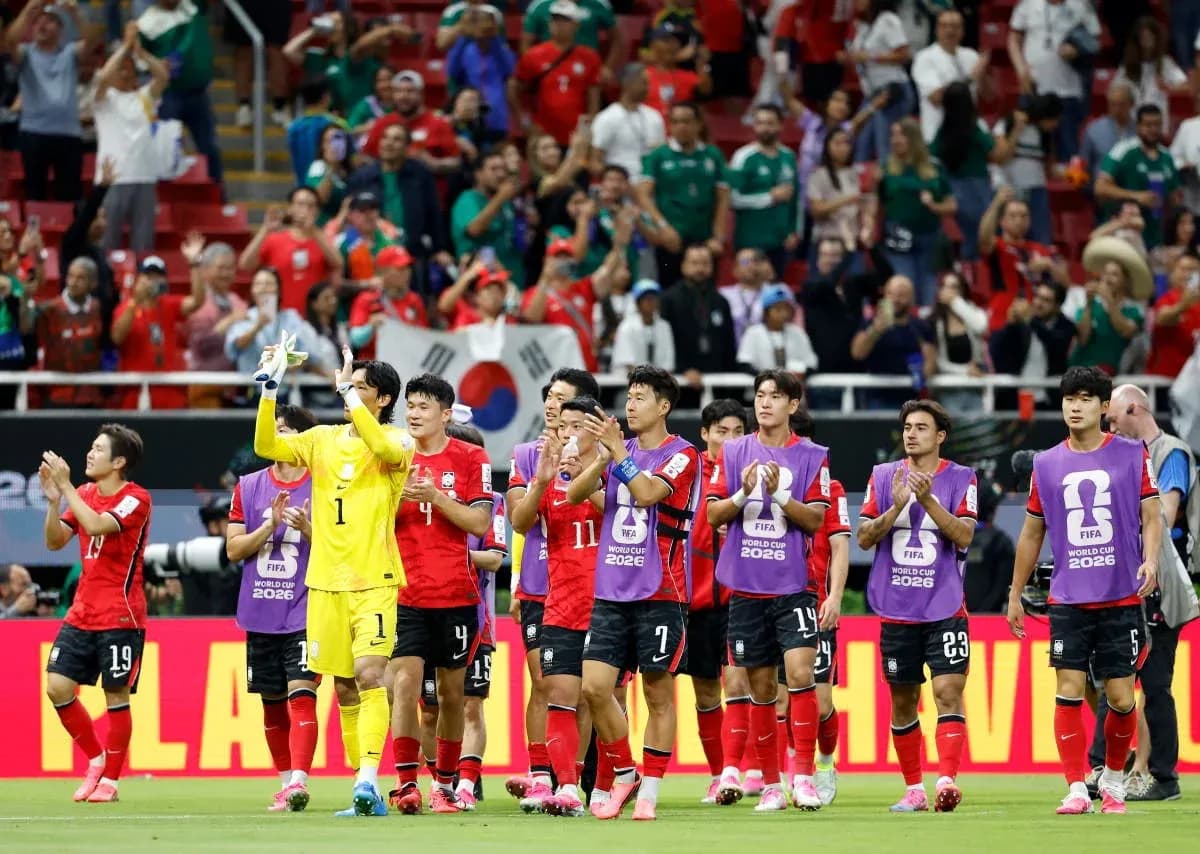
Under the lights of Estadio Akron in Guadalajara, South Korea and Czechia opened their World Cup 2026 journeys with mirrored blueprints but sharply contrasting outcomes. Both coaches – Myung-Bo Hong and Miroslav Koubek – trusted a 3-4-2-1, yet the same structure produced a 2-1 victory for South Korea and a frustrating defeat for Czechia. Following this result, South Korea sit 2nd in Group A on 3 points with a goal difference of +1 (2 scored, 1 conceded), while Czechia are 3rd with 0 points and a goal difference of -1 (1 scored, 2 conceded).
I. The Big Picture – Mirrored Shapes, Different Stories
South Korea’s season profile in this group is embryonic but clear: in total this campaign they have played 1 match, winning it 2-1. At home they have played 1, won 1, with 2.0 goals for and 1.0 against on average. There is no clean sheet yet, but there is control: the same 3-4-2-1 used here is their only lineup so far.
Czechia’s reflection is the inverse. On their travels they have played 1 match and lost it, scoring 1.0 goal and conceding 2.0. Their biggest defeat on their travels is precisely this 2-1 reverse. Like South Korea, their tactical identity is fixed early – one match, one formation, the same 3-4-2-1 – but the execution faltered in the key zones.
The scoreline at half-time, 0-0, told of a cautious chess match. The full-time 2-1, however, revealed a South Korea side that found an extra gear in the decisive phases, leaning heavily on a technically gifted engine room and a fluid front three.
II. Tactical Voids and Discipline – The Cost of the Edge
In terms of absences, the data offers no list of missing or questionable players, so the story is less about who was not there and more about who stepped into the spotlight – and who overstepped the line.
The disciplinary profile of South Korea this campaign is strikingly concentrated. Their only recorded yellow card in the competition so far falls in the 91-105 minute window, a late flash of risk that hints at a team willing to push the limits to close out games. That card belongs to defender Gi-Hyuk Lee, who not only picked up a yellow but also appears in the top red cards list for the tournament – a quirk of the data that underlines how closely his aggression is being monitored.
Czechia, by contrast, emerge from this match statistically clean in terms of cards: no yellow, no red, no disciplinary spikes in any time range. Yet that restraint did not translate into control. Where South Korea’s back line, anchored by Kim Min-jae and flanked by Han-Beom Lee and Gi-Hyuk Lee, accepted duels and fouls as the price of front-foot defending, Czechia’s more cautious edge in the challenge left them reactive rather than assertive.
III. Key Matchups
Hunter vs Shield
For South Korea, the primary “hunter” in this early stage of the tournament is not the headline forward but a deep-lying conductor: Hwang In-beom. In total this campaign he has 1 goal and 1 assist, placing him among the World Cup’s top scorers and leading the assist charts. His stat line from this fixture is the blueprint of a modern playmaker: 81 passes with 90% accuracy, 3 shots (2 on target), and 2 interceptions. From the right half-space of that 3-4-2-1, he repeatedly punctured Czechia’s compactness.
His work was amplified by the creative menace of Kang-in Lee. Across his 97 minutes, he completed 37 passes at 100% accuracy, produced 3 key passes, and attempted 6 dribbles, succeeding with 5. Time and again he isolated Vladimír Coufal and Štěpán Chaloupek, forcing Czechia’s right side to collapse inward and freeing Son Heung-min between the lines.
On the Czech side, the unexpected “hunter” was a defender: Ladislav Krejčí. He is on the top scorers list with 1 goal from 1 shot on target, and his 13 duels (7 won) speak to a centre-back stepping aggressively into midfield to contest second balls and set-pieces. Yet that very need for Krejčí to be both stopper and scorer underlines Czechia’s structural problem: their primary threat arrived from the back line, not from their front three.
Shield vs Hunter
South Korea’s shield is a blend of Kim Min-jae’s authority and Gi-Hyuk Lee’s all-action style. Lee’s numbers from this match are quietly outstanding: 62 passes at 93% accuracy, 3 interceptions, 10 duels with 6 won, and that late yellow. He defended forward, breaking Czechia’s attempts to link Patrik Schick with Pavel Šulc and Lukáš Provod, and his willingness to step out created the platform for Hwang In-beom to stay higher.
For Czechia, the shield was built around Tomáš Souček and Alexandr Sojka in the central band, with Jaroslav Zelený and Coufal providing width. Souček’s presence gave structure, but the data highlights Coufal’s burden: 26 passes at 65% accuracy, 1 key pass, 9 duels with only 2 won, and 3 fouls committed. He was both creator and emergency full-back, and Kang-in Lee’s relentless dribbling repeatedly dragged him into uncomfortable territory.
Engine Room – Control vs Resistance
The true battleground was the central square: Hwang In-beom and Seung Ho Paik against Souček and Sojka. Hwang’s double contribution (goal and assist) and Paik’s metronomic role tilted the contest. With South Korea in total averaging 2.0 goals for and 1.0 against so far, the midfield’s capacity to both progress the ball and protect transitions is already evident.
Czechia’s engine, by contrast, looked industrious but blunt. Coufal’s assist – one of only 1 key pass on his tally – came from a wide delivery rather than a central combination. Without a second line of creators behind Schick, too much responsibility fell on direct play and set-pieces, where Krejčí’s goal was both weapon and warning: if your best aerial threat is also your best defender, every foray forward leaves a vacuum behind.
IV. Statistical Prognosis – What This Game Tells Us
Following this result, South Korea’s statistical profile is that of a proactive, high-skill side whose 3-4-2-1 is built around technical superiority in the half-spaces. They have in total 2 goals from 1 match, with no penalties taken or missed, and a frontline supported by an elite creator in Hwang In-beom and a relentless dribbler in Kang-in Lee. The late yellow for Gi-Hyuk Lee, arriving in the 91-105’ window, is a reminder that their aggression must be carefully managed as the stakes rise.
Czechia, meanwhile, emerge as a team whose defensive structure is sound in theory but under strain in practice. On their travels they concede 2.0 goals on average and have yet to keep a clean sheet, with their lone goal coming from a defender rather than their forwards. Coufal’s dual status in both top scorers (via assists) and top assists lists highlights his importance, but also the imbalance: too much of their creativity is funneled through one flank.
If we project forward without explicit xG data, the qualitative indicators are clear. South Korea’s blend of controlled possession, high pass accuracy in key creators, and a bench weapon like Hyeon-gyu Oh – who in total this campaign has 1 goal from 1 shot on target and 4 duels with 3 won in only 28 minutes – suggests they will continue to generate strong expected goals numbers, particularly as opponents tire.
Czechia’s prognosis is more fragile. Their reliance on set-piece threat from Krejčí and crossing from Coufal can produce spikes in xG but may struggle to sustain it from open play against better-organised blocks. Unless Koubek can unlock more from Pavel Šulc, Lukáš Provod, and Patrik Schick within this 3-4-2-1, Czechia risk remaining a side whose best finisher wears number 7 at the back, rather than number 10 up front.
In Guadalajara, the shared formation was the mirror; the difference lay in the reflection. South Korea saw a structure that amplified their technical leaders and attacking depth. Czechia saw one that exposed their creative shortfall. Over the rest of Group A, those patterns are likely to harden into fate.