.svg&w=384&q=75 "Naijagoal logo")

Mexico Dominates South Africa 2-0: Tactical Breakdown
Mexico’s 2-0 win over South Africa at Estadio Azteca was a textbook example of territorial dominance meeting structural control. Javier Aguirre’s 4-1-4-1 used the stadium’s big pitch to stretch a South Africa side set up by Hugo Broos in a conservative 5-3-2. The numbers underline the pattern: 61% possession, a 16–3 shot count and 1.41 xG to 0.07 in Mexico’s favour, with the hosts repeatedly forcing South Africa deeper until the defensive block finally cracked.
Structurally, Mexico’s shape was clear and consistent. Erik Lira anchored in front of the back four, allowing both full-backs, Israel Reyes and Jesús Gallardo, to push high and pin the South African wing-backs. Ahead of Lira, a fluid line of four – Roberto Alvarado, Brian Gutiérrez, Álvaro Fidalgo and Julián Quiñones – rotated constantly between half-spaces and wide zones. This staggered midfield gave Mexico multiple receiving lines between South Africa’s midfield and defence and created the platform for sustained pressure: 520 passes to 335, with Mexico completing 467 at 90% accuracy versus South Africa’s 272 at 81%.
The opening goal on 9 minutes captured the tactical idea. Mexico had already established field tilt, and Lira stepped up from his holding role to play provider, finding Quiñones in an advanced pocket. The finish reflected the benefit of having four technically strong midfielders close to the lone striker: South Africa’s back five was pinned, their midfield three overloaded, and Quiñones exploited the gap. At 1-0, Mexico could keep the ball circulating, using side-to-side switches to drag the 5-3-2 block out of shape.
Defensively, Mexico were rarely stretched. South Africa managed only 3 shots in total, with just 1 from inside the box and 2 on target. The back four, led by César Montes and Johan Vásquez, held a relatively high line, trusting Lira’s screening and the front unit’s counter-press to limit South Africa’s ability to play into Lyle Foster and Iqraam Rayners. When South Africa did reach the final third, they were forced into low-quality efforts, reflected in the 0.07 xG. Raúl Rangel (Mexico) was largely a spectator, called into action for just 2 saves; Mexico’s defensive work was more about control of space than last-ditch interventions.
South Africa’s game plan was clearly to absorb and counter from a compact 5-3-2. The back five of Khuliso Mudau, Nkosinathi Sibisi, Ime Okon, Mbekezeli Mbokazi and Aubrey Modiba initially held their line well, keeping Mexico to a lot of circulation in front of them. But their inability to progress the ball – only 335 passes and just 1 corner – meant the forwards were isolated. With Jayden Adams, Siphephelo Sithole and Teboho Mokoena forming a narrow midfield three, South Africa lacked width in transition and struggled to escape Mexico’s press.
The match tilted decisively after half-time with discipline and game state combining against South Africa. On 49 minutes, Siphephelo Sithole’s red card for “Professional foul last man” forced Broos to reorganise into a 5-3-1, removing a key midfield presence and deepening the block further. Reduced to 10, South Africa could no longer contest central zones; Mexico’s interior midfielders had more time and space, and the passing dominance increased.
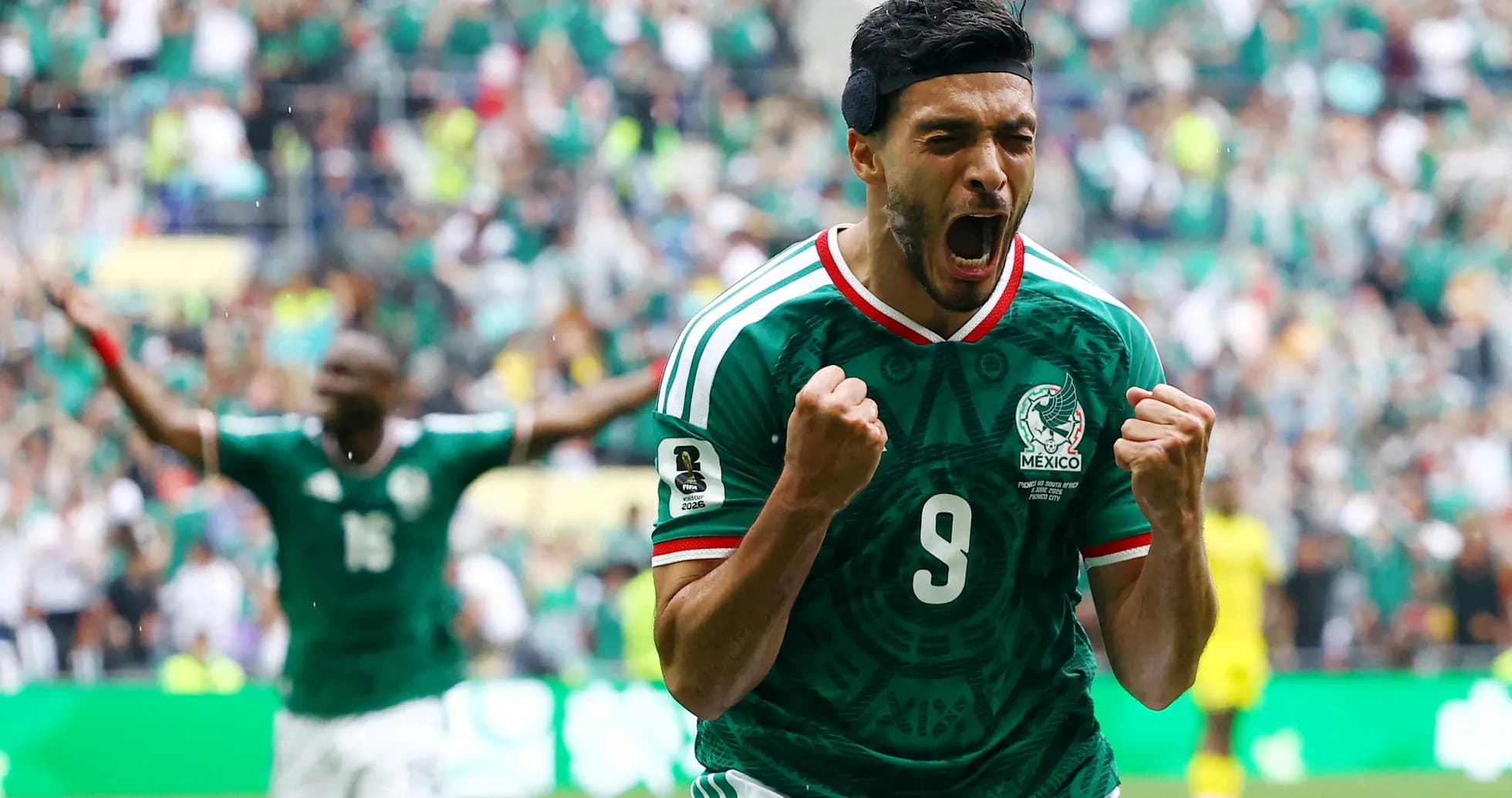
Aguirre’s in-game management then sharpened Mexico’s control. On 66 minutes, Gilberto Mora (IN) came on for Álvaro Fidalgo (OUT), and Luis Chávez (IN) replaced Brian Gutiérrez (OUT), refreshing the midfield legs without altering the structure. Within a minute, the pressure told: on 67 minutes, Raúl Jiménez finished from a Roberto Alvarado assist, the 2-0 reflecting Mexico’s territorial and chance advantage. Jiménez’s movement as the lone forward was crucial, constantly occupying central defenders and opening lanes for late runs from midfield.
From there, Mexico managed the game intelligently. On 76 minutes, Armando González (IN) came on for Raúl Jiménez (OUT), and Edson Álvarez (IN) replaced Erik Lira (OUT), slightly hardening the midfield shield to guard against any late South African counters. Julián Quiñones (OUT) made way for Alexis Vega (IN) on 79 minutes, maintaining attacking threat in wide areas while freshening the press.
Broos responded with attacking substitutions of his own, but they were reactive and hamstrung by the numerical deficit. On 56 minutes, Thalente Mbatha (IN) came on for Lyle Foster (OUT), and on 61 minutes Themba Zwane (IN) replaced Jayden Adams (OUT), both aimed at injecting more control and creativity. Later, on 77 minutes, Oswin Appollis (IN) came on for Aubrey Modiba (OUT), and Evidence Makgopa (IN) replaced Iqraam Rayners (OUT), effectively reshaping into a back four with extra forwards. However, with only 3 total shots and no blocked attempts, South Africa never established enough possession or territory to make those changes count.
The late disciplinary incidents further underlined the strain on South Africa. Already carrying an earlier yellow for “Foul” to Teboho Mokoena on 17 minutes and another to Nkosinathi Sibisi for “Foul” on 74 minutes, their frustration peaked when a VAR “Card upgrade” review on 82 minutes preceded Themba Zwane’s red card for “Violent conduct” at 84 minutes. Down to nine men, South Africa’s shape collapsed into survival mode. Mexico also finished with ten after César Montes was sent off at 90+2 minutes for “Professional foul last man”, but by then the tactical contest was effectively decided.
In statistical terms, Mexico’s 1.41 xG from 16 shots (4 on goal, 5 blocked, 9 inside the box) was a fair reflection of their territorial dominance and structured chance creation. The 3 corner kicks and repeated entries into the box showed how consistently they advanced into dangerous zones. South Africa’s 0.07 xG, 3 shots and single corner illustrated how thoroughly they were pinned back.
The passing profiles reinforced the tactical story. Mexico’s 520 passes, 467 accurate (90%), point to a controlled, possession-based approach with good circulation through the lines. South Africa’s 335 passes, 272 accurate (81%), are more typical of a deep-lying, reactive side struggling to build. Ronwen Williams (South Africa) made 2 saves, mirroring Mexico’s 4 shots on target and underlining that while Mexico were on top, they were more about control than relentless finishing.
Overall, this was a match where Mexico’s 4-1-4-1 structure, superior ball circulation and intelligent in-game management systematically dismantled South Africa’s 5-3-2, with discipline issues and numerical inferiority compounding the visitors’ tactical problems.