.svg&w=384&q=75 "Naijagoal logo")
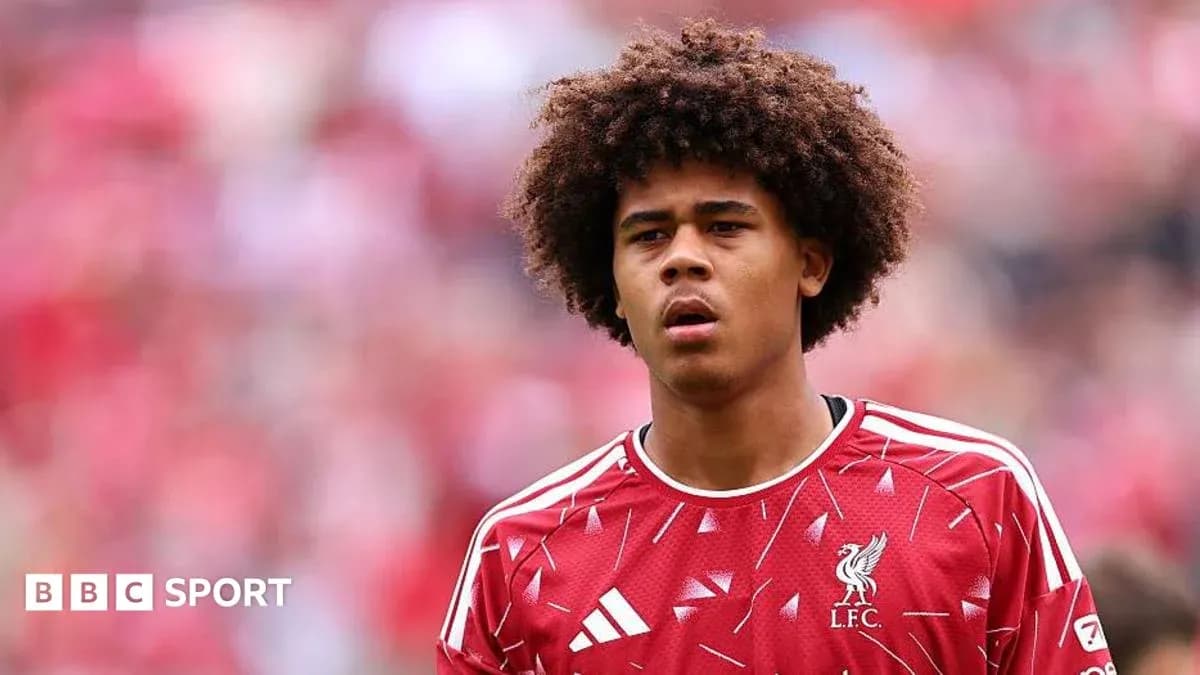

Ifeanyi Ndukwe: Liverpool's Promising Defender Facing Work Permit Challenges
Liverpool have stumbled through their first pre-season under Andoni Iraola, but in the middle of the uncertainty a new name has jolted Anfield awake: Ifeanyi Ndukwe.
Eighteen years old. Six foot six. And playing like he has no intention of waiting his turn.
A teenager thrown in at the deep end
Liverpool’s summer has been uneven. Wins over Sunderland and Wrexham, but two-goal leads tossed away against Leeds and Monaco. Performances that flicker, then fade. A squad that still looks light in key areas.
Nowhere more so than at centre-back.
Joe Gomez limped out of the first friendly. £60m signing Jeremy Jacquet has been stuck on the sidelines with a nagging knee issue. Giovanni Leoni is still working his way back from a serious knee injury. Iraola needed bodies. He found a presence.
Ndukwe, the Austrian youth international signed from Austria Vienna, has suddenly been playing far more than anyone at the club expected this early. Two full 90-minute outings, another 80-minute shift, and then a start alongside Virgil van Dijk against Monaco at Anfield on Sunday.
That was the night the wider fanbase really noticed him.
Within minutes he had the Kop gasping: a neat backheel to wrong-foot Monaco’s Mika Biereth, then a series of clean, aggressive defensive duels that made him look like he’d been patrolling that back line for years. Not a kid filling in. A defender staking a claim.
Van Dijk, not easily impressed, called him a “big talent” and a “big guy” who wants to learn, and spoke about the conversations they’ve already had. The Liverpool captain was clear: this is a player who needs games, then needs to come back ready to stay.
On pure football merit, you could argue Ndukwe has already put his name into the frame to replace Ibrahima Konate, whose departure has left a glaring vacancy next to Van Dijk.
But this is modern English football. Talent is only half the battle.
The Brexit wall
Here is the brutal twist. Ndukwe will not be lining up next to Van Dijk when Liverpool open their Premier League campaign against Newcastle.
Not because Iraola doesn’t rate him. Not because the teenager hasn’t done enough. Because he is not allowed.
Post-Brexit rules mean Ndukwe does not currently meet the points threshold for a UK work permit. Without that, he cannot obtain a Governing Body Endorsement, and without a GBE, he cannot be registered to play competitive matches for Liverpool.
So for all the promise he has shown in July and August, he will be locked out of the real thing in 2026 unless his status changes.
Since the UK left the European Union, every foreign signing has become a puzzle. Young players, especially those who are not yet established at the very top level, now have to tick off criteria across a points-based system: the strength of the league they play in, minutes on the pitch, international caps, European competition. It all feeds into that magic total.
Ndukwe, developed at Austria Vienna and with one senior appearance there, plus a standout Under-17 World Cup with Austria last November, simply doesn’t have enough on his CV yet.
Liverpool saw the potential early. They agreed a £2.6m deal in principle in January, then waited until he turned 18 this summer to complete the move. In footballing terms, the timing looks perfect. In regulatory terms, it leaves him in limbo.
One golden slot, already taken
There is a workaround: the Elite Significant Contribution (ESC) route. These are special slots reserved for foreign players who don’t qualify for a standard GBE but are deemed important enough to bend the rules.
Premier League and Championship clubs can access up to four ESC places. But those slots are not handed out freely. They depend on how many minutes a club gave to England Qualified Players (EQP) in the previous season.
The threshold is 35% of minutes. Hit that, and you can use four ESC slots. Fall below it, and the number drops.
Liverpool’s EQP percentage last season was low enough that they only earned one ESC place. And that has already gone to another 18-year-old: Senegalese forward Mor Talla Ndiaye.
The numbers behind that are stark. Across the Premier League campaign, Freddie Woodman, Gomez, Rhys Williams, Curtis Jones, Trey Nyoni and Rio Ngumoha were the only English players in Liverpool’s squad, combining for 83 appearances. At the same time, the club lost Trent Alexander-Arnold, Jarell Quansah and Tyler Morton, and loaned out Harvey Elliott.
The consequence is that Ndukwe, for now, has no pathway via an ESC slot. The door he needs is bolted by last season’s selection patterns.
A loan that has to be perfect
So the plan shifts. If Ndukwe cannot play for Liverpool yet, he must play somewhere that accelerates his journey back.
He will still feature in pre-season, including the final friendly against Como on 16 August. That will be the last glimpse Anfield gets of him in a Liverpool shirt for a while.
After that, his future moves abroad.
His agent, Georg Lederer, has been clear on the strategy. In July he said a loan club will be found where Ndukwe can gain experience “at a very high level”, and described the situation as a “great opportunity” given the number of top international clubs already showing concrete interest. On Monday, Lederer confirmed they are still weighing up options across Europe.
The stakes are obvious. Ndukwe must reach 15 points in the work permit system while out on loan to qualify automatically for a visa. The higher the level of the league, the more minutes he plays, the more those points rack up.
Pick the right club, and the target is within reach quickly. It is understood that, with the right move, he could hit the required total by January. That would open the door for Liverpool to recall him mid-season and finally register him for competitive football.
There is a catch. Any club taking him on loan knows that if he explodes and hits that threshold early, Liverpool may bring him back in the winter window. For a side planning a full-season partnership at centre-back, that uncertainty is a problem.
Yet this is the reality of the modern market. For Liverpool, the calculation is simple: send him somewhere strong enough to build his points, but stable enough to develop him properly. For the loan club, it is a gamble on a defender who might not see out the season but could transform their back line while he is there.
Anfield’s glimpse of the future
Strip away the bureaucracy and the spreadsheets, and the football story is compelling.
An 18-year-old who impressed at a World Cup for his country’s youth side. A £2.6m investment from a club that prides itself on spotting defenders early. A pre-season in which he has gone from unknown to crowd favourite, sharing a back four with Van Dijk and earning the captain’s public backing.
He has already shown enough to leave Liverpool supporters wanting more, just as they learn they may have to wait.
The irony is hard to miss. In a summer when Iraola’s defence looks short, when Konate has gone and injuries are biting, one of the most convincing performers at centre-back cannot be used when the real football starts.
So Ndukwe will go out into Europe, chasing minutes, chasing points, chasing a work permit that will let him come back and finish what he has started.
If the right club steps up, Liverpool’s long-term defensive picture could look very different by the time January rolls around.