.svg&w=384&q=75 "Naijagoal logo")

Iran and New Zealand Share Spoils in Thrilling World Cup Opener
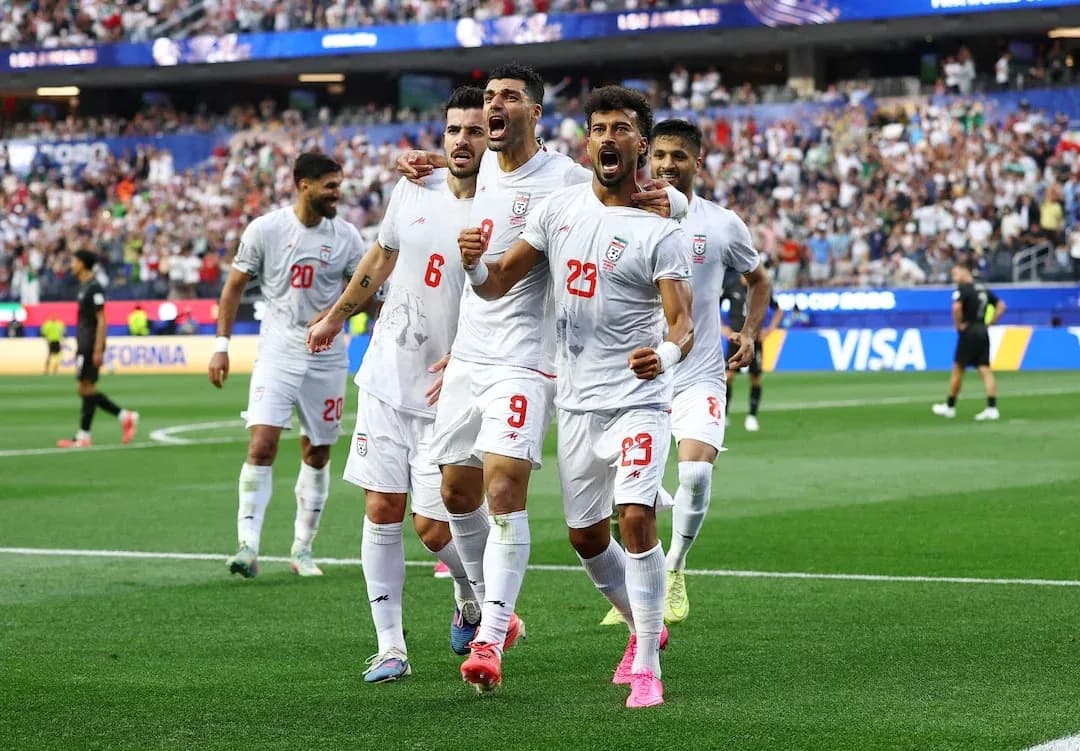
Under the Los Angeles night sky at SoFi Stadium, Iran and New Zealand opened their World Cup campaigns with a 2-2 draw that felt less like a cautious group-stage sparring match and more like an early statement of identity from both squads. Following this result, Group G is delicately poised: New Zealand sit 1st and Iran 2nd, each on 1 point, each with a goal difference of 0 after scoring 2 and conceding 2 overall.
I. The Big Picture – Two Blueprints on Display
On paper it was a clash of structures as much as nations: Iran in a classic 4-4-2 under Amir Ghalenoei, New Zealand in a modern 4-2-3-1. The numbers from their season snapshot underline how evenly matched they were on the night. At home, Iran have played 1 and drawn 1, scoring 2.0 goals per game and conceding 2.0. On their travels, New Zealand mirror that: 1 away game, 1 draw, 2.0 goals scored and 2.0 conceded.
The timing of Iran’s goals hints at a side that grows into games. Heading into this game they had scored 50.00% of their goals between 31-45 minutes and 50.00% between 61-75, and that pattern of mid-half surges was visible again in the way their wide players and full-backs pushed on once they settled.
New Zealand’s statistical profile is more skeletal at this early stage – no minute-by-minute distributions yet – but the raw totals tell enough: they have found the net 2 times away and conceded 2, with no clean sheets and no failures to score. This is a team that will trade chances.
II. Tactical Voids and Discipline – Where Edges Emerge
In a tournament opener, absences can distort plans, but here the squads were largely at full strength, at least in terms of available personnel. The bench options told their own tactical stories. Iran had a deep pool of forwards – Mehdi Ghayedi, Ali Alipour, Amirhossein Hosseinzadeh, Alireza Jahanbakhsh and Dennis Eckert Ayensa – suggesting Ghalenoei is prepared to turn a 4-4-2 into something far more aggressive if the game state demands it. In midfield, Roozbeh Cheshmi, Mohammad Ghorbani, Mahdi Torabi and Amirmohammad Razzaghinia offered different profiles of control and creativity.
New Zealand’s bench was built for structural flexibility rather than sheer attacking volume. Defenders like Tyler Bindon, Francis De Vries, Nando Pijnaker and Tommy Smith gave the All Whites the option of shoring up a lead or switching to a back three, while forwards Ben Waine, Kosta Barbarouses, Jesse Randall and Benjamin Old could inject pace and verticality around Chris Wood.
Discipline may become a hidden hinge in this group. For Iran, the cards data is already telling. Overall they have 1 yellow card, and it arrived late: 100.00% of their bookings so far have come between 76-90 minutes. Ehsan Hajsafi embodies that edge. In just 25 minutes, he collected 1 yellow, committed 1 foul, and yet still won 2 of his 3 duels and completed 100% of his 7 passes. He is simultaneously a stabiliser and a risk – a defender who can close games but also drag Iran into dangerous disciplinary territory as legs tire.
New Zealand, by contrast, emerge from this opener with a clean disciplinary slate: no yellow or red cards recorded in their season stats so far. That calmness under pressure, especially in a system that asks a lot of the double pivot of Joe Bell and Marko Stamenic, could prove crucial as the group tightens.
III. Key Matchups – Hunter vs Shield, Engine vs Enforcer
The headline duel that will define both teams’ trajectories is already clear: Elijah Just against Iran’s defensive structure. Just has exploded into the tournament as one of its early stars. In total this campaign he has 2 goals from 2 shots, both on target, and a rating of 9. He completed 26 passes at 84% accuracy, created 1 key pass, and won 5 of 11 duels. He is not just a finisher; he is a constant problem between the lines.
Iran’s first line of resistance to that kind of roaming threat lies in their back four and the screening presence of Saeid Ezatolahi. Shoja Khalilzadeh and Ali Nemati operated as a compact central pairing, but it was the full-back Ramin Rezaeian who emerged as Iran’s standout defender and, paradoxically, their most dangerous attacking outlet. In total this campaign Rezaeian has 1 goal and 1 assist, with 41 passes at 73% accuracy, 3 tackles, 2 interceptions, and 7 duels won out of 8. He is both shield and spear.
The “Engine Room” confrontation pivots around Ezatolahi and Saman Ghoddos against Bell and Stamenic. Bell’s role is understated but essential: keeping New Zealand’s shape intact in front of the defence. Stamenic, alongside him, must handle runners like Mohammad Mohebi and Aria Yousefi, who attack half-spaces from midfield in Iran’s 4-4-2.
Further upfield, another narrative thread emerges: Chris Wood as creator rather than pure target man. In total this campaign Wood has 0 goals but 2 assists, with 4 key passes and 16 total passes at 87% accuracy. He still took 3 shots, 2 on target, but his value was in knitting play, dropping off the last line to release Just and Sarpreet Singh. For Iran, that means Khalilzadeh and Nemati cannot simply defend space; they must decide whether to follow Wood into midfield, potentially opening channels for late runners, or hold the line and allow him to turn.
IV. Statistical Prognosis – What This Draw Really Says
Following this result, both sides carry identical statistical signatures: 1 game, 0 wins, 1 draw, 0 losses, 2 goals for, 2 against, and a goal difference of 0. Neither has yet kept a clean sheet; neither has failed to score. The under/over patterns for Iran at home are stark: they have gone over 0.5 and 1.5 goals in every game so far, but stayed under 2.5. New Zealand’s early numbers away are similar in raw totals.
Translated into an xG-style tactical prognosis, this suggests that both teams are currently built for open, mid-range scoring games – matches where a 1-1 or 2-2 feels more natural than a cagey 0-0. Iran’s minute distributions point to vulnerability at the start of each half (they have conceded 50.00% of their goals between 0-15 and 50.00% between 46-60), while their own attacking spikes come later in those same periods. That creates a volatile overlap: if New Zealand can start halves quickly through Just and Singh, they can exploit Iran’s early-half fragility. But as the minutes tick towards the 31-45 and 61-75 windows, Iran’s wide threats and overlapping full-backs – especially Rezaeian – become increasingly dangerous.
With no penalties taken or missed by either side so far, the margins are still being drawn in open play. The early evidence points to two teams whose attacking structures are ahead of their defensive solidity. As Group G unfolds, the squad that first manages to turn these chaotic, chance-trading contests into controlled, low-xG battles will likely step out of this 2-2 mirror image and into genuine contention for the Round of 32.