.svg&w=384&q=75 "Naijagoal logo")

Henrik Larsson: The King of Kings at Celtic
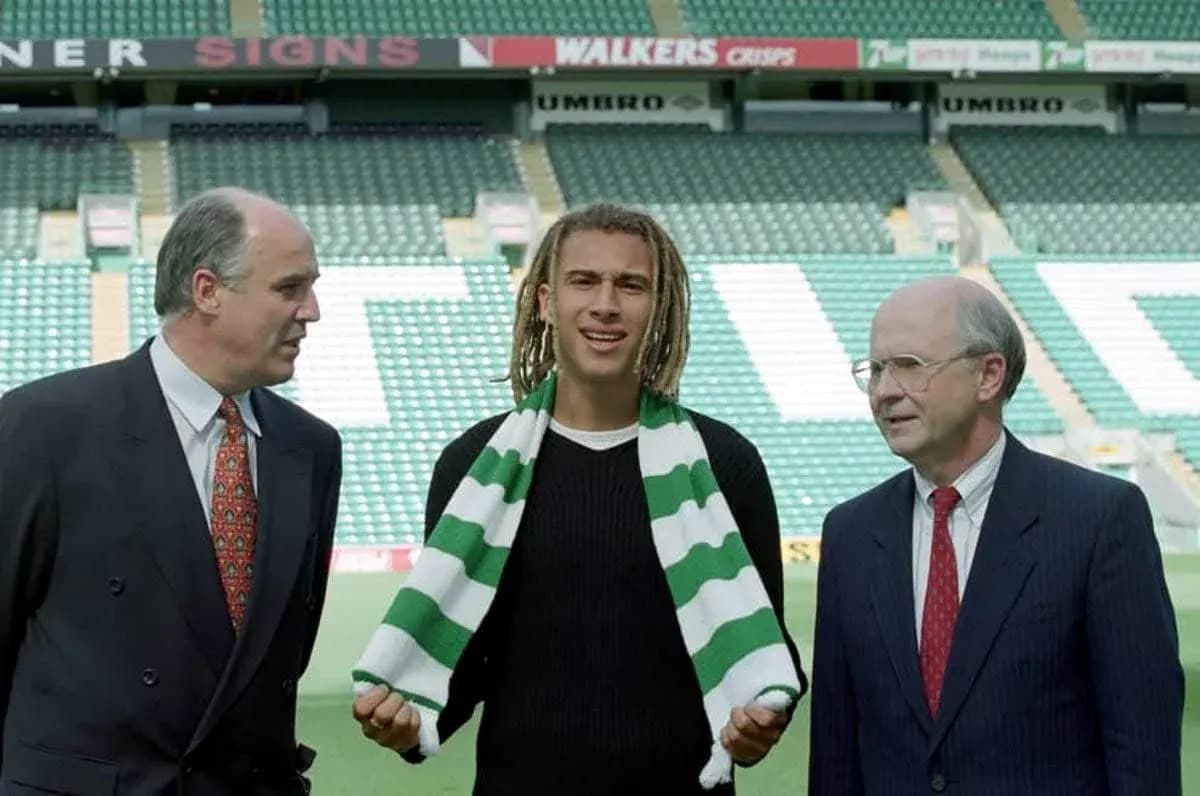
On a warm July day in 1997, a slim Swedish forward in a Hoops top and denim strolled out onto the Celtic Park turf. No fanfare, no fireworks. Just a new signing, £650,000 from Feyenoord, unveiled by a new manager, Wim Jansen, who trusted what he knew.
Celtic weren’t just introducing a player. They were unknowingly unveiling an era.
A Bargain That Changed Everything
The fee looked modest even then. Jansen understood the contract situation from his time in the Netherlands and moved quickly. It felt like a clever piece of business. Nobody could have guessed it would become one of the greatest bargains in British football history.
Yet the start was anything but regal.
Larsson’s first impression in competitive action was a misjudged pass that led to a goal in an opening-day defeat at Hibs. A nightmare beginning. The kind of moment that can swallow a new signing whole in Glasgow. Instead, it lit the fuse.
From there, the dreadlocked Swede began to stitch himself into Celtic’s fabric one performance at a time. A touch here, a finish there, a tireless shift up front. Week by week, the doubts faded. The affection grew. The support found its new talisman.
Stopping Ten and Starting a Legacy
By the end of that debut season, Larsson was no longer just a good signing. He was central to a resurrection.
Celtic lifted the League Cup. More importantly, they ended a decade-long wait for a league title, stopping Rangers from winning ten in a row. That achievement alone would have secured cult status for many players. For Larsson, it was only the prologue.
Under Dr Jozef Venglos, he went up another level. Thirty-eight goals in his second campaign. Not just a poacher, but a complete striker: movement, intelligence, aerial threat, finishing off both feet. He didn’t just lead the line. He defined it.
The Break That Didn’t Break Him
Then came Lyon. A horrific leg break that made even hardened professionals wince. Careers can end on challenges like that. Confidence can vanish. Fear can creep in.
Larsson refused to let it write his story.
He returned not diminished, but somehow sharper, more ruthless. That resilience said as much about him as any goal tally. For Celtic, his absence and the struggles that followed under John Barnes only underlined how much he meant to the team. When he came back, he didn’t just restore Celtic’s cutting edge. He restored belief.
O’Neill, Sutton and a Season for the Ages
When Martin O’Neill arrived, Larsson found the perfect stage and the perfect partner.
Alongside Chris Sutton, he formed a forward pairing that bullied defences and shredded game plans. Larsson was the spearhead, scoring an astonishing 53 goals in the 2000–01 season as Celtic completed a domestic treble, their first clean sweep in 32 years.
This was not just volume scoring. These were decisive, often spectacular goals at key moments. The kind that turn big games, define seasons and leave opponents beaten long before the final whistle.
Europe Takes Notice
Domestically, he had already become a phenomenon. Europe soon felt the full weight of his talent.
Celtic’s run to the UEFA Cup Final showcased Larsson on a broader stage. His goals dragged the team through tight nights and hostile grounds, his presence a constant threat to higher-profile opponents. In the final against Porto, he delivered two world-class finishes in a losing cause, extra-time heartbreak only serving to underline his class rather than diminish it.
On a night when Celtic fell short, their No. 7 still looked like he belonged at the very top of the European game.
The Numbers and the Myth
By the time he walked away from Celtic in 2004, the statistics were staggering: 242 goals in 313 appearances. Third on the club’s all-time scoring list. A strike rate that belongs in the realm of fantasy, not a league as unforgiving as Scotland’s, not in an era of constant pressure and expectation.
Yet Larsson’s impact cannot be measured by numbers alone. He became an emblem of a modern Celtic side that refused to be overshadowed, a leader by example whose work rate matched his flair. The goals were unforgettable. The attitude was unarguable.
King of Kings
Debates over the greatest Celt will always rage, as they should in a club with such history. The older generation will rightly evoke Jimmy Johnstone and the Lisbon Lions. Those who lived through the 1970s will point to Kenny Dalglish, another king who went on to be immortalised at Liverpool.
But for a vast swathe of supporters, especially those whose footballing lives were shaped in the late 1990s and early 2000s, Henrik Larsson stands alone. The best they have ever seen in the Hoops. The player who arrived as a clever signing and left as an institution.
On this day in 1997, Celtic signed a forward. What they truly secured was an identity, a standard, a symbol.
For many, he will always be exactly what the banners said.
The King of Kings.