.svg&w=384&q=75 "Naijagoal logo")

France Overpowers Senegal 3-1 in World Cup Opener
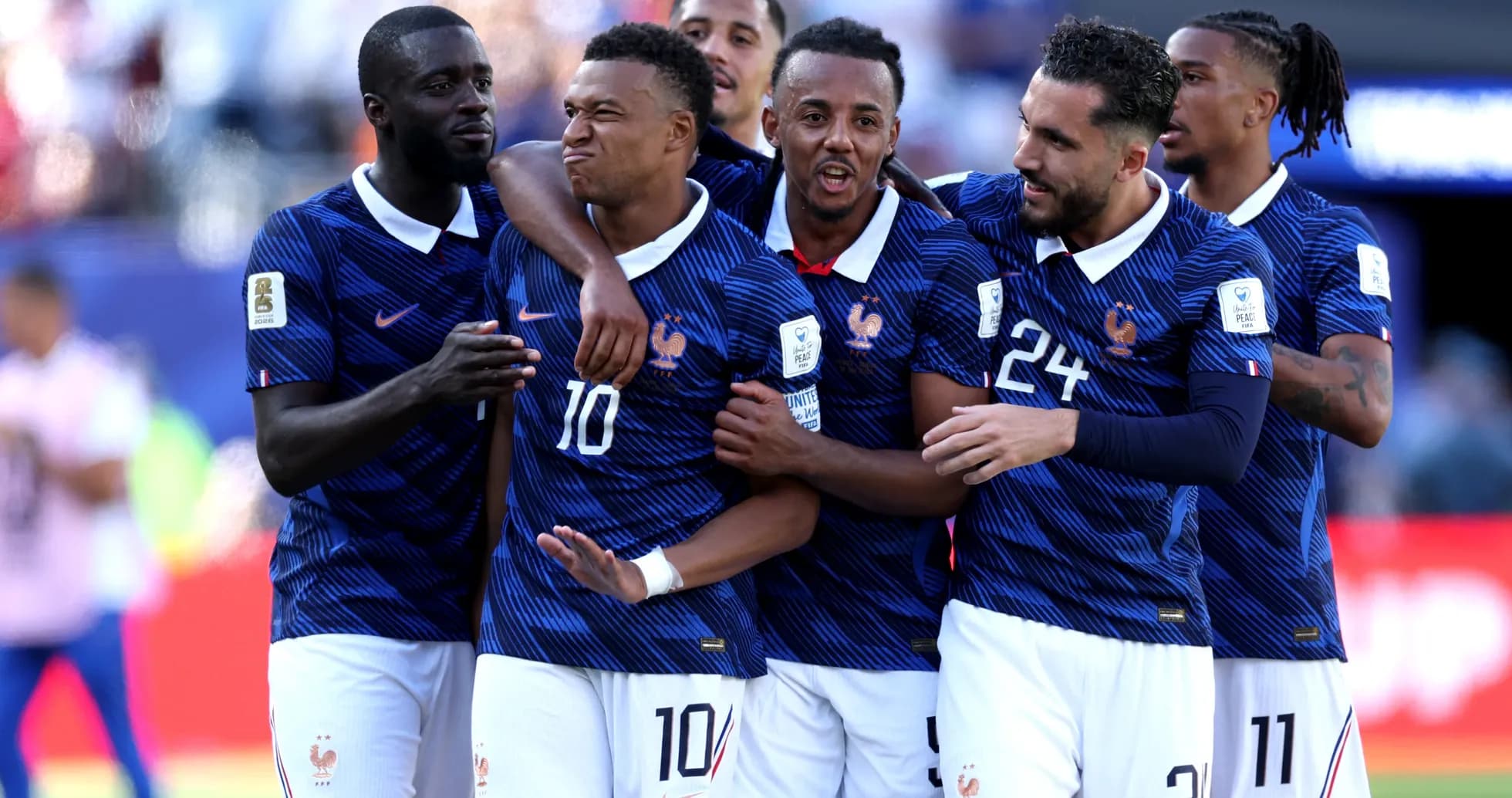
MetLife Stadium in East Rutherford hosted a meeting that felt more like a tactical statement than a simple group opener. France, nominally the home side, overpowered Senegal 3-1, a scoreline that now defines the early narrative of Group I. Following this result, France sit 2nd in the group on 3 points with a goal difference of 2, while Senegal trail in 3rd with 0 points and a goal difference of -2. For both, this was their first step in the 2026 World Cup; for France, it already looks like the blueprint of a deep run, for Senegal, the outline of a complicated path back into contention.
Deschamps stayed loyal to his trusted 4-2-3-1, but the personnel and the way the lines breathed across MetLife gave France a modern, aggressive edge. Mike Maignan anchored a back four of Jules Kounde, Dayot Upamecano, William Saliba and Theo Hernandez, a unit designed less to sit deep than to compress the pitch. Ahead of them, Aurelien Tchouameni and Adrien Rabiot formed a double pivot that alternated between screening and stepping into midfield traps, while the attacking band of Michael Olise, Ousmane Dembele and Desire Doue orbited around Kylian Mbappe as the lone striker.
On paper, Senegal mirrored the shape – also a 4-2-3-1 – but with a very different personality. Bouna Thiaw Pape’s side built their identity on compactness and transitional threat. Edouard Mendy stood behind a defensive line of Krepin Diatta, Kalidou Koulibaly, Moussa Niakhate and M. Diouf, with Idrissa Gueye and Pape Gueye tasked with choking central spaces. Ahead of them, Ismaila Sarr, L. Camara and Sadio Mane were supposed to feed Nicolas Jackson, the spearhead intended to hurt France on the break.
The structural symmetry created a match of mirrored intentions but unequal execution. Overall this campaign, France have played 1 match, winning it 3-1. At home in this tournament, they have scored 3 goals and conceded 1, averaging 3.0 goals for and 1.0 against. Senegal, on their travels, have played 1 match and lost it 3-1, with an away average of 1.0 goal for and 3.0 against. The numbers underline what the eye test at MetLife suggested: France’s attacking weight is already calibrated, Senegal’s defensive block still porous under elite pressure.
There were no notable absences reported for either side, and that completeness showed in the intensity of the duels. Disciplinary data for the tournament is still blank – no recorded yellow or red card distributions by minute for either team – but the flow of the game suggested controlled aggression rather than chaos. Both midfields tackled and pressed, yet neither side tipped into self-destruction.
The “Hunter vs Shield” duel was always going to be Kylian Mbappe against a Senegal back line built around Koulibaly and Niakhate. Mbappe arrived in this World Cup as one of its early headline acts: in total this campaign he has 2 goals from 1 appearance, all in this very match, with 4 shots, all on target, and an 8.2 rating. His 16 completed passes at 93% accuracy show how comfortable he was dropping off the line and linking play, not just sprinting into space.
For stretches, Koulibaly and Niakhate kept the French captain’s runs in front of them, but the problem for Senegal was the constellation around him. Dembele’s starting position on the right, Olise’s drifting between lines and Doue’s inside movements meant Mbappe could constantly choose his angle of attack. Once France tilted the field, Senegal’s shield cracked not only in the channels but in the half-spaces just outside the box, where Mbappe is lethal.
On the other side, Senegal’s own cutting edge arrived from the bench. Ibrahim Mbaye, listed with Senegal despite his French birth, stepped into the tournament with a fearless cameo: in total this campaign he has 1 goal from 1 appearance, converting his only shot on target and completing 8 passes at 87% accuracy. His movement between the lines troubled a French defence that, up to that point, had largely controlled Jackson. Mbaye’s impact hints at a selection question for Senegal going forward: do they dare start him to stretch defences earlier, even if it risks unbalancing their shape?
In the “Engine Room” battle, Tchouameni and Rabiot faced a double Gueye axis. France’s pair had a quieter statistical profile in the global tournament data, but their influence was clear in the way they suffocated transitions. Idrissa Gueye and Pape Gueye were forced into deeper starting positions, often receiving the ball under immediate pressure. That, in turn, blunted Mane and Sarr, who found themselves chasing longer balls rather than joining structured counters.
Senegal’s creative spark came from Iliman Ndiaye, another substitute who changed the game’s rhythm. In total this campaign, Ndiaye has 1 assist from 1 appearance, with 10 completed passes at 90% accuracy and 1 key pass. His ability to receive under pressure and slip vertical balls – including the assist that put Mbaye on the scoresheet – suggests he could become the primary conduit between midfield and attack in their remaining group matches.
From a statistical prognosis standpoint, the early numbers are stark. France’s total goal difference of 2 (3 scored, 1 conceded) is the product of a front line that already looks in sync and a defence that, while not flawless, rarely loses control of territory. They have yet to keep a clean sheet, but they have also never failed to score in this campaign, and they have not yet missed a penalty, with 0 taken and 0 missed.
Senegal’s total goal difference of -2 (1 scored, 3 conceded) reflects a side caught between ambition and caution. They have not failed to score either, but conceding 3 goals on their travels in a single outing is a red flag for knockout-level aspirations. The lack of penalty incidents – 0 taken, 0 missed – means their margin for error in open play is even thinner; they cannot rely on spot-kicks to correct structural flaws.
If we project forward using these early patterns, France’s xG profile – inferred from 3 goals on 4 shots on target from Mbappe alone, plus Bradley Barcola’s clinical contribution off the bench – suggests a team that will consistently generate high-quality chances, especially when they can pin opponents deep with their 4-2-3-1 press. Senegal’s defensive solidity, by contrast, looks fragile when stretched horizontally, particularly when full-backs like Diatta and Diouf are forced into repeated 1v1s without cover.
Following this result, the tactical arc of Group I is clear. France have announced themselves as a side whose attacking ceiling is already close to tournament-winning level, with Mbappe as the central threat and a deep bench featuring Barcola ready to twist games late. Senegal, meanwhile, must decide whether to double down on compactness or lean into the dynamism of Ndiaye and Mbaye to outscore opponents. The numbers say they are vulnerable; the flashes from their substitutes say they are far from finished.