.svg&w=384&q=75 "Naijagoal logo")

Canada vs Bosnia & Herzegovina: Tactical Draw in World Cup Opener
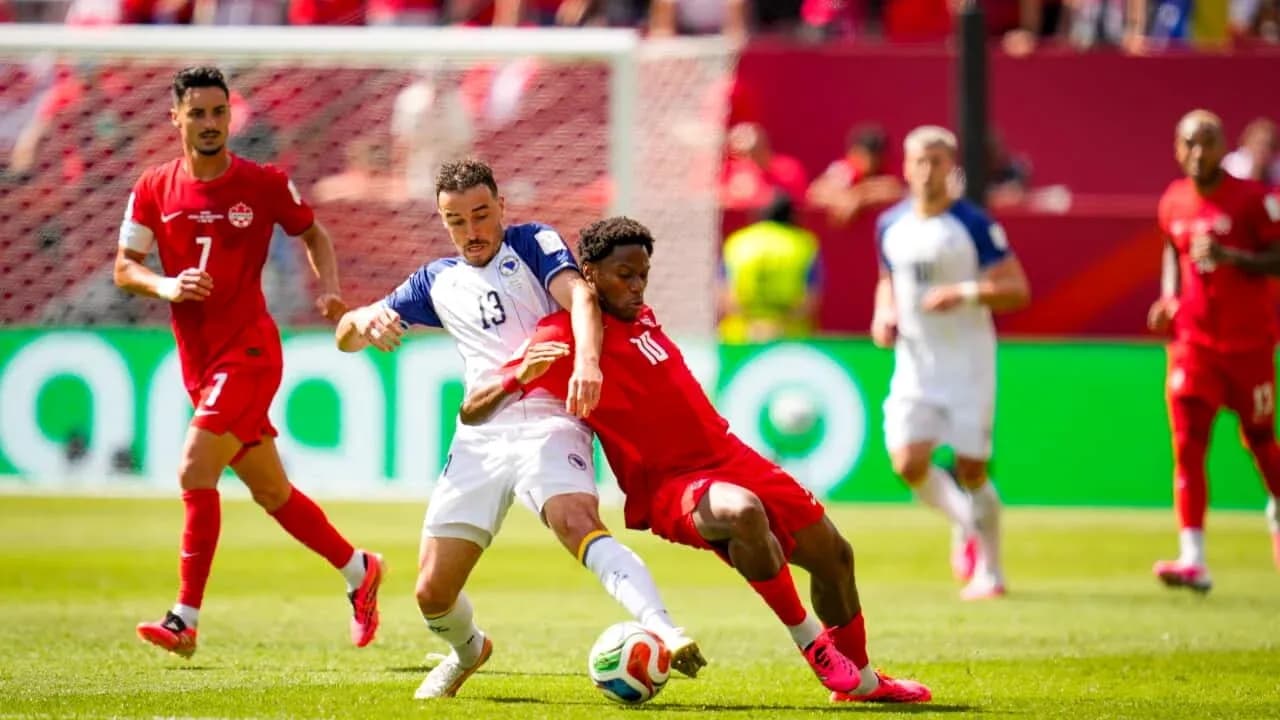
Canada and Bosnia & Herzegovina opened their World Cup Group Stage campaigns at BMO Field with a tactically rich 1-1 draw that showcased contrasting interpretations of a 4-4-2. Canada, under Jesse Marsch, dominated territory and possession but needed a late structural tweak and bench impact to cancel out Bosnia & Herzegovina’s more compact, counter-oriented approach under Sergej Barbarez.
Canada’s 4-4-2 started aggressively, with full-backs Alistair Johnston and Richie Laryea pushed high to pin back the Bosnian wide midfielders. The double pivot of Ismael Koné and Stephen Eustaquio tried to dictate with short circulation, while Tajon Buchanan and Liam Millar held wide starting positions to stretch the line and create channels for Jonathan David and Tani Oluwaseyi. That plan produced a clear territorial advantage: 61% possession, 415 passes and 9 corners, but initially lacked penalty-box efficiency.
Bosnia & Herzegovina mirrored the 4-4-2 shape but used it in a far more conservative, vertically direct way. The back four of Amar Dedić, Nikola Katić, Tarik Muharemović and Sead Kolašinac stayed narrow and deep, with Benjamin Tahirović and Ivan Bašić screening in front. Esmir Bajraktarević and Amar Memić were tasked with shuttling out to Canada’s full-backs but primarily protected the half-spaces. Up front, Ermedin Demirović and Jovo Lukić worked as first defenders, pressing only on triggers rather than in a high block.
The opening goal on 21 minutes reflected Bosnia & Herzegovina’s game plan. After absorbing pressure, they exploited Canada’s advanced full-backs with a more direct phase. Kolašinac stepped in from the left to provide the assist, and Lukić finished clinically, punishing Canada’s centre-backs Derek Cornelius and Luc De Fougerolles, who had been left exposed by aggressive positioning around the ball. That sequence underlined the risk in Marsch’s high line: Canada’s rest defence in transition was essentially a 2+2 structure that Bosnia & Herzegovina targeted with early forward passes.
Defensively, Bosnia & Herzegovina leaned into physicality to disrupt Canada’s rhythm, committing 20 fouls and drawing three yellow cards. The compact 4-4-2 block forced Canada to funnel play wide, where crosses were largely managed by Katić and Muharemović. Canada’s 13 total shots and 10 efforts inside the box show they eventually accessed dangerous zones, but the final action was often rushed or crowded, reflected in 4 blocked shots.
Marsch’s in-game management was decisive. At 61 minutes, he executed a triple substitution to alter the attacking dynamics: Promise David (IN) came on for Jonathan David (OUT), Ali Ahmed (IN) came on for Tajon Buchanan (OUT), and Jacob Shaffelburg (IN) came on for Liam Millar (OUT). This effectively refreshed all three of Canada’s advanced lanes. Promise David offered more direct runs off the shoulder, Ahmed injected central energy and ball-carrying from midfield, and Shaffelburg brought a more aggressive 1v1 profile on the flank.
Barbarez responded a minute later, replacing Lukić with Samed Baždar (IN) and Bašić with Armin Gigović (IN) at 62 minutes, shifting his front line and midfield balance. Later, at 74 minutes, Kerim Alajbegović (IN) came on for Amar Memić (OUT) and Ivan Šunjić (IN) replaced Esmir Bajraktarević (OUT), further reinforcing central stability and fresh legs in wide midfield. These changes nudged Bosnia & Herzegovina toward an even more conservative late-game block, prioritising protection of the lead.
Canada’s key structural shift came with the introduction of Cyle Larin (IN) for Tani Oluwaseyi (OUT) on 76 minutes, shortly after the earlier attacking refresh. With Larin as a classic penalty-box reference and Promise David buzzing around him, Canada’s front line became more vertical and penalty-area oriented. The equaliser on 78 minutes was a direct validation of this adjustment: Cyle Larin scored for Canada, assisted by Promise David. The pattern underlined a clearer division of roles—Larin occupying centre-backs and attacking crosses, Promise David attacking second balls and spaces between the lines.
From that point, Canada’s structure resembled a 4-2-4 in possession, with both wide players and both strikers pinning the back line, while Koné and Eustaquio held a broad double pivot to recycle pressure and guard against counters. Bosnia & Herzegovina, by contrast, sank into a low-to-mid block, accepting that their attacking threat would be limited to sporadic counters.
In goal, Maxime Crépeau (Canada) had a relatively quiet but high-leverage evening, making 2 saves behind a defence that allowed just 3 shots on target. His role was more about sweeping and starting build-up than high-volume shot-stopping. At the other end, Nikola Vasilj (Bosnia & Herzegovina) made 1 save, but his defensive unit limited clear, on-target looks despite Canada’s pressure, forcing many attempts into blocks or off-target efforts.
Statistically, the draw aligns closely with the underlying numbers. Canada generated 1.25 xG to Bosnia & Herzegovina’s 0.98, mirroring a match where the hosts had the volume and territory but not overwhelming superiority in chance quality. Both goalkeepers are credited with -0.26 goals prevented, suggesting that the finishing and goalkeeping largely tracked expectation rather than featuring extreme over- or under-performance.
Passing data illustrates the stylistic divide. Canada completed 415 passes, 310 accurate at 75%, indicative of sustained possession phases and structured build-up. Bosnia & Herzegovina, with 270 passes and 172 accurate at 64%, were more direct and risk-accepting with the ball, prioritising verticality over retention. The corner count (9-4 to Canada) further reinforces the territorial tilt.
Discipline also tells a tactical story. Canada committed 10 fouls and collected 2 yellow cards, Bosnia & Herzegovina 20 fouls and 3 yellows, reflecting a more aggressive, interruption-based defensive strategy from Barbarez’s side to break Canada’s rhythm and protect central spaces. Ultimately, the 1-1 result at BMO Field feels like a fair synthesis: Canada’s structural dominance and late tactical tweaks earned them parity, while Bosnia & Herzegovina’s compact 4-4-2 and efficient early counter justified a share of the points.