.svg&w=384&q=75 "Naijagoal logo")

Brazil vs Morocco Match Report: 1-1 Draw Analysis
Brazil 1-1 Morocco at MetLife Stadium opens Group C with both sides moving to 2 points from two games and maintaining their positions in the qualification places. Brazil stay second with 2 points and a goal difference of 0 (2 goals for, 2 against), while Morocco remain top on 2 points with the same goal difference (2 for, 2 against), separated only by existing group tiebreakers.
Match Report
The game’s first clear breakthrough came on 21' as Morocco struck from their first major attacking pattern. A Morocco goal — Ismael Saibari finished clinically inside the box, assisted by Brahim Díaz, after a sharp combination through the right half-space, putting the North Africans 0-1 up.
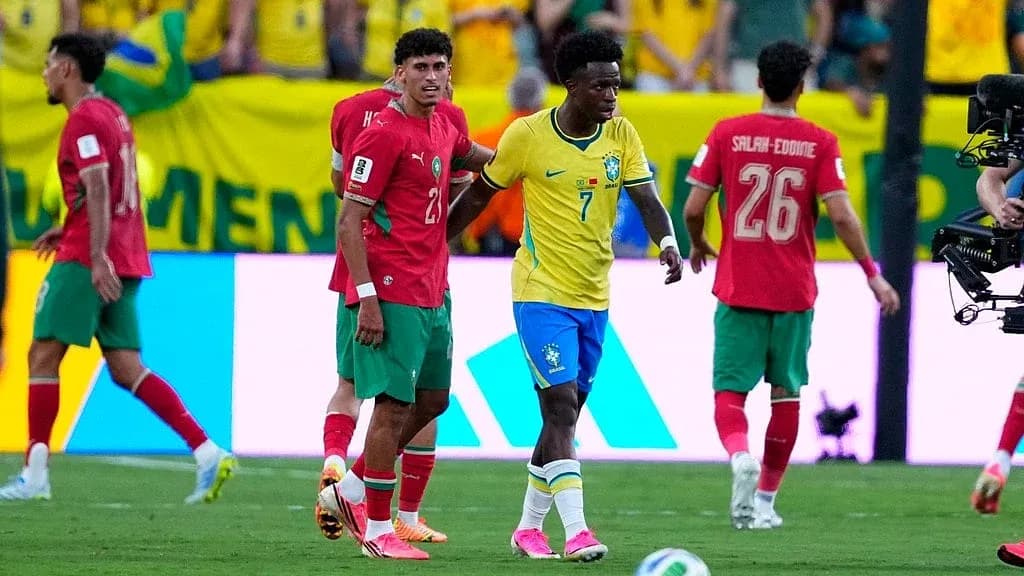
Brazil responded with more aggressive occupation of the wide channels and were rewarded on 32'. Brazil goal — Vinicius Junior (assisted by Bruno Guimaraes) arrived from the left to guide home a low cut-back, capping a more direct spell of Brazilian pressure and levelling the score at 1-1.
The intensity of Brazil’s counter-press began to show in the disciplinary column. On 37', Casemiro (Brazil) — yellow card (Tripping) — was booked after halting a Moroccan transition in midfield. Six minutes later, on 43', Ibanez (Brazil) — yellow card (Tripping) — followed him into the book for a late challenge near the edge of the area, underlining Brazil’s increasing reliance on tactical fouls to manage Morocco’s counters.
Brazil reset their structure at half-time with a double substitution at 46'. Danilo replaced Ibanez (Brazil), moving into the back line to offer more secure buildup on the right. Simultaneously, Fabinho replaced Casemiro (Brazil), a like-for-like change aimed at preserving defensive balance while avoiding a second yellow risk in midfield.
On 61', Brazil sought extra attacking thrust between the lines. M. Cunha replaced Lucas Paqueta (Brazil), with Cunha operating as a more vertical, forward-running presence from the central band. A minute later, on 62', Luiz Henrique replaced I. Thiago (Brazil), shifting Brazil’s attacking reference towards more mobility and wide-to-central runs rather than a fixed penalty-box target.
Morocco answered with their own structural tweaks on 65'. C. Talbi replaced B. Diaz (Morocco), removing the main creator of the opening goal but adding fresh energy in the advanced line. At the same time, S. El Mourabet replaced A. Ounahi (Morocco), injecting new legs into central midfield to maintain Morocco’s compact block as Brazil’s possession grew.
With Brazil increasingly camped in Moroccan territory, the North Africans refreshed their defensive unit on 80'. A. Salah-Eddine replaced N. Mazraoui (Morocco), introducing a new left-back to deal with Brazil’s right-sided combinations, while A. Amaimouni replaced B. El Khannouss (Morocco) to add work rate and ball-carrying threat on the break. In response, Brazil altered their midfield profile as Danilo Santos replaced Bruno Guimaraes (Brazil) on 80', trading some creativity for additional stability and counter-pressing presence in the centre.
The final change came on 89', with Morocco adjusting their forward line for the closing moments. S. Rahimi replaced I. Saibari (Morocco), withdrawing the goalscorer and adding a fresher runner to chase long balls and press Brazil’s buildup in stoppage time. Neither side, however, could convert late half-chances, and the match closed at 1-1.
Fixture Statistics & Tactical Audit
- xG: Brazil 1.24 vs 1.28 Morocco
- Possession: Brazil 54% vs 46% Morocco
- Shots on Target: Brazil 4 vs 2 Morocco
- Goalkeeper Saves: Brazil 1 vs 3 Morocco
- Blocked Shots: Brazil 4 vs 6 Morocco
The numbers point to a finely balanced contest where the 1-1 scoreline was broadly fair. Morocco’s marginally higher xG (1.28 vs 1.24) reflects the quality of their best chances, especially around Saibari’s opener and a handful of transitions, even though they produced only 2 shots on target. Brazil, with 4 shots on target and a small possession edge (54%), controlled territory for longer spells but often faced a dense Moroccan block that forced attempts into crowded zones, as shown by Morocco’s 6 blocked shots. Bono’s 3 saves against Brazil’s 4 efforts on goal underline that Brazil tested the goalkeeper more frequently, but not decisively enough to tilt the match beyond parity, while Alisson had relatively little to do behind a defence that restricted Morocco to few on-target efforts.
Standings Update & Seasonal Impact
For Brazil, this second successive 1-1 draw moves them to 2 points from two group matches, with a new goals-for tally of 2 and goals-against also at 2, leaving their goal difference at 0. They remain in 2nd place in Group C, still within the “Advancing to the Round of 32” positions but with work to do in their final group game to secure progression without relying on other results.
Morocco likewise advance to 2 points, now with 2 goals scored and 2 conceded for a goal difference of 0, and they stay top of Group C on existing tiebreakers. Remaining in the “Advancing to the Round of 32” zone, they have preserved control of their destiny; another positive result in their final group fixture should be enough to confirm qualification, though the tight points spread means any slip could still invite late jeopardy.
Lineups & Personnel
Brazil Starting XI
- GK: Alisson
- DF: Douglas Santos, Gabriel Magalhães, Marquinhos, Roger Ibañez
- MF: Bruno Guimarães, Casemiro, Vinícius Júnior, Raphinha, Lucas Paquetá
- FW: Igor Thiago
Morocco Starting XI
- GK: Bono
- DF: Noussair Mazraoui, Chadi Riad, Issa Diop, Achraf Hakimi
- MF: Ayyoub Bouaddi, Neil El Aynaoui, Bilal El Khannouss, Azzedine Ounahi, Brahim Díaz
- FW: Ismael Saibari
Post-Match Verdict
This was a controlled but not ruthless Brazil performance, with their slight dominance in possession (54%) and higher volume of shots on target (4 vs 2) offset by Morocco’s compact defensive structure and shot blocking (6 blocks). Brazil’s attacking plan improved after half-time with the introductions of M. Cunha and Luiz Henrique, who added more vertical movement, yet the final pass and finishing lacked the edge to translate a marginal xG advantage into a winning scoreline.
Morocco executed a disciplined, resilient game plan, allowing Brazil territory but protecting central zones effectively, as reflected in their higher number of blocked shots (6) and the fact that Alisson was called into action only once. Their offensive threat came in concentrated moments, particularly around Saibari’s goal and a few transition attacks that explain their slightly higher xG (1.28). In tactical terms, this was a solid defensive display rather than an expansive attacking show, but it was enough to earn a point that keeps them in control of their group fate.