.svg&w=384&q=75 "Naijagoal logo")

World Cup Last 16: England Faces Mexico Amid Altitude Myths
Six days, 16 games, and half the World Cup field is gone. The tournament has snapped into sharper focus, but not without a jolt or two along the way.
Germany are out. On penalties. To Paraguay.
The numbers said Germany had roughly a 63% chance of progressing. The shoot-out said otherwise. It was the standout shock of the first knockout round, the kind of result that rips a hole in the bracket and hands opportunity to anyone ready to seize it.
Had Senegal held on against Belgium, that would have been on the same scale. They couldn’t. Belgium survived, but the warning flare is there for every favourite still standing.
Morocco’s win over the Netherlands carried the scent of an upset, but the data tells a more nuanced story. Elo ratings had the Dutch at only around 55% to go through – almost a coin toss. It was one of the most balanced ties of the round, and it played out that way.
Some of the supposed mismatches delivered the real drama. Cape Verde, given only a 10% chance of progressing, dragged holders Argentina into extra time and came uncomfortably close to detonating the tournament. Congo, with just a 17% pre-match probability, led England with 15 minutes to play. The favourites advanced, but not without feeling the breath of elimination on their necks.
A familiar last 16 – with five outsiders
The shape of the last 16 feels very familiar. Asia has disappeared from the competition. All but two African teams are gone. Europe and South America dominate the bracket once more.
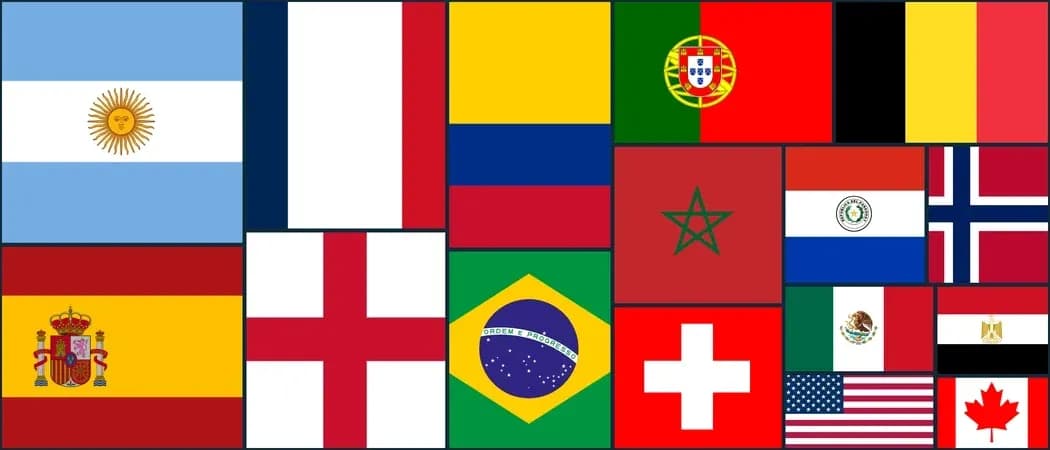
Only Canada, Egypt, Mexico, Morocco and the United States remain from outside the traditional power base. Between them, they carry just about a 3.5% chance of lifting the trophy. They are the outliers, the long shots, the ones trying to bend history.
At the other end of the spectrum, Argentina are still the team to beat, but their grip has loosened. Extra time against Cape Verde came at a cost in the numbers: their probability of winning the World Cup has dipped slightly to 28%. One reason is structural – with Germany removed by Paraguay, France’s path has cleared.
France now sit at 14% to win the tournament. Spain, clinical in their dismantling of Austria, have moved to 16%. Both cruised through their last-16 ties: Spain barely broke stride, France were similarly untroubled by Sweden. Each is one game closer to the trophy, and the model reflects that.
England’s probability has nudged up to 12%. That rise says as much about the shrinking field as it does about Gareth Southgate’s side. Brazil and Argentina still loom in their half of the draw, waiting beyond the immediate hurdle.
That immediate hurdle is Mexico, in Mexico City.
England, Mexico and the thin air of Mexico City
The match comes with a familiar storyline: altitude.
Mexico City sits roughly between 2000 and 2250 metres above sea level. The narrative writes itself – thin air, heavy legs, gasping visitors, acclimatised hosts. But what does the evidence actually say?
Strip away the folklore and look at thousands of international matches played at different heights, rounded to the nearest 500 metres, and the picture is far less dramatic.
At or near sea level – within 250 metres either side – home teams win about 55% of the time. Around a third of all international matches are played in that band. Between 250 and 750 metres, where about 6% of matches sit, the pattern barely shifts. Even in the 2000–2250 metre range, which includes Mexico City, home teams win only 52% of the time. That is a lower home-win rate than at sea level.
Raw percentages, though, can mislead. Stronger teams tend to win more at home regardless of altitude, weaker teams less so. To untangle that, the model leans on Economic Observatory Elo ratings – a system tightly correlated with FIFA rankings and historically strong at predicting international results.
Those ratings generate an expected probability of a home win, scaled between 0 and 1. By coding an actual home win as 1 and anything else as 0, then subtracting the Elo expectation and taking the mean, you get a clean measure: how much more (or less) often home teams win than they “should”.
This is where altitude starts to bite.
The teams that typically play at serious altitude are not global heavyweights in Elo terms: Bolivia above 3000 metres; Ecuador, Ethiopia and Mexico above 2000. Once you control for that, a pattern emerges. Below about 1750 metres, home wins happen roughly as often as the ratings predict. Above that threshold, home teams begin to outperform expectations.
At the very highest altitudes, the over-performance gap reaches around 20 percentage points. Statistically, that still sits within the margin of error, but it hints at something real. Altitude does appear to hand an edge to the hosts – just not the overwhelming, decisive advantage often claimed.
Which brings us back to England in Mexico City.
On neutral terms, even allowing for home advantage, the model has England at 1.6 expected goals to Mexico’s 0.6. That gap translates into a 62% chance of England winning in normal time, 13% for Mexico, and a 25% likelihood of a draw and penalties.
If you build in a hypothetical altitude effect – shave 0.25 expected goals off England, add 0.25 to Mexico – the balance shifts but doesn’t flip. England’s win probability falls to 48%, Mexico’s rises to 24%, with the rest again heading to spot-kicks. The thin air narrows the gap; it does not erase it.
England remain the stronger side by past results and by other measures, including squad values from Transfermarkt. Altitude is a leveller, not a magic trick. Mexico may gain something from the conditions and England’s limited acclimatisation time, but the data stops short of calling this a 50–50 contest.
The rest of the last 16: favourites, traps and a stubborn Paraguay
Across the bracket, the simulations offer a clear, if not infallible, map.
Argentina are 77% likely to progress against Egypt. England are put at 74% to get past Mexico. Morocco, buoyed by that win over the Netherlands, are 70% favourites against Canada.
Spain are rated 72% likely to knock out Portugal in a heavyweight Iberian clash. Colombia hold a 70% edge over Switzerland. Brazil are at 69% to beat Norway. Belgium have a 64% chance of seeing off the United States.
Then there is France against Paraguay.
On paper, the world champions should roll on. The model is more cautious. France are given only a 62% chance of progressing, the lowest of any favourite in this round. Paraguay’s reputation from Group D holds: compact, disciplined, hard to break down. Aside from their opener against the United States, they have been exactly that.
The expected goals tell the story of a grind. France are projected at just 1.1 xG, Paraguay at 0.6. For a free-scoring French side, that is a notable squeeze. It points to a tight, attritional contest – quite possibly their sternest examination so far, and very much at odds with any assumption of a comfortable stroll.
The bracket is set, the numbers are in, and the margins are shrinking. Germany are gone, France and Spain are closing in, Argentina are clinging to favourite status, and England are about to find out how much the air in Mexico City really matters.