.svg&w=384&q=75 "Naijagoal logo")
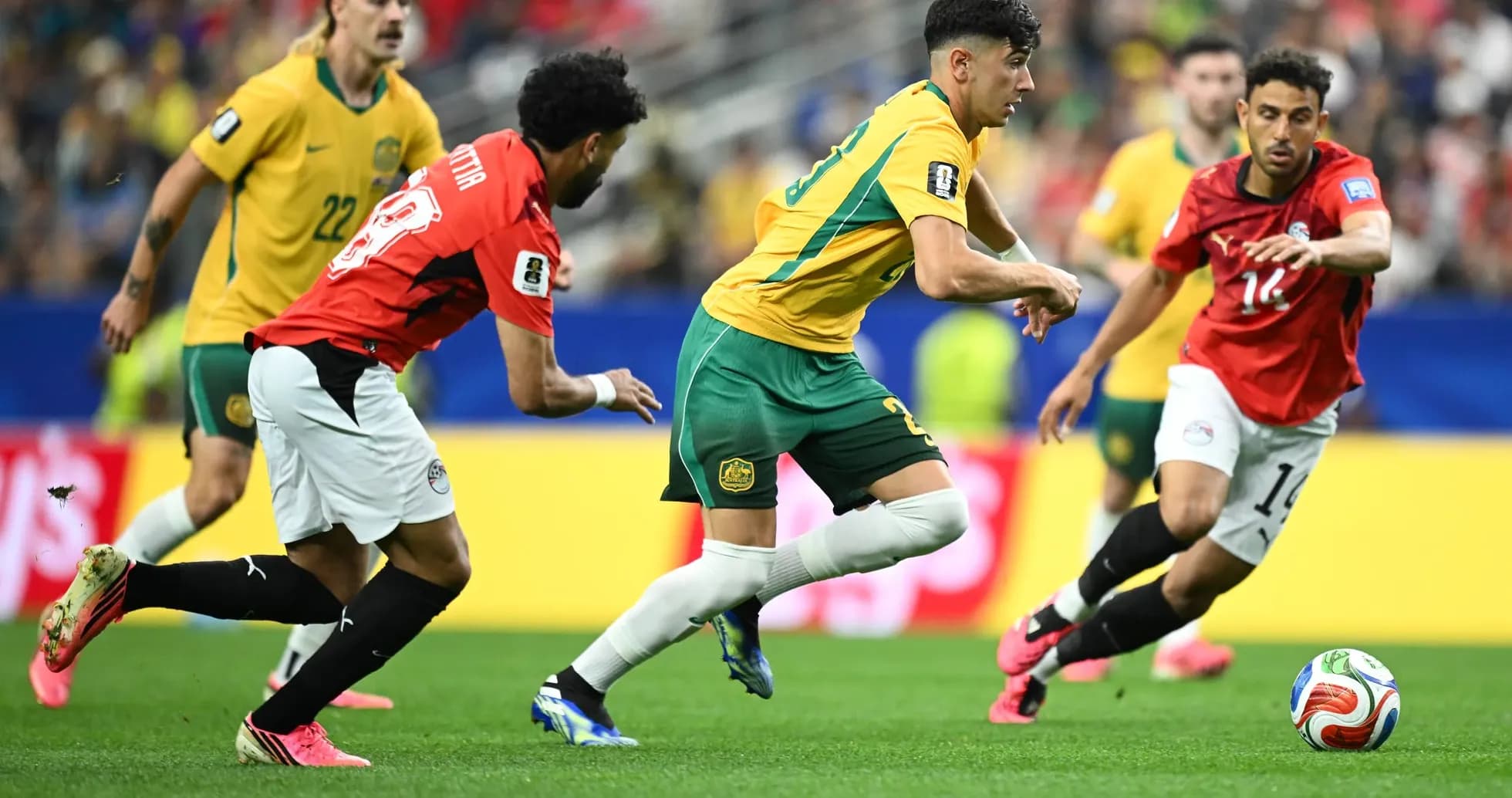

Australia vs Egypt: Tactical Analysis of Round of 32 Elimination
Australia’s Round of 32 elimination to Egypt at AT&T Stadium was decided on penalties, but tactically the story over 120 minutes was one of contrasting structures: Australia’s 3-4-2-1 trying to compress and counter against Egypt’s more ball-dominant 4-4-2. Egypt’s 4-1 win in the shootout (2-4 on the official record) ultimately reflected their greater control and chance volume, even if an own goal dragged the tie back to parity.
Egypt's Tactics
Egypt’s 4-4-2 was possession-oriented from the outset. With 58% of the ball and 723 passes (614 accurate, 85%), they built patiently through Hamdy Fathy and Marwan Attia in central midfield and used the full-backs, especially Karim Hafez, to create width. The first goal on 13 minutes underlined this pattern: Hafez advanced from left-back and delivered for Emam Ashour, whose run from the right side of midfield broke Australia’s last line. It was a textbook exploitation of the space outside Australia’s wide centre-backs in the 3-4-2-1.
Australia's Tactics
Australia’s 3-4-2-1, with Patrick Beach in goal behind a back three of Lucas Herrington, Harry Souttar and Alessandro Circati, aimed to protect central areas and spring forward through the dual “10s” Cristian Volpato and Connor Metcalfe behind Nestory Irankunda. But with only 42% possession and 507 passes (404 accurate, 80%), they spent long periods without the ball, forced to defend deep and narrow. The wing-backs Jordan Bos and Aziz Behich were pinned back by Egypt’s wide players, limiting Australia’s ability to progress cleanly into the final third.
Turning Point
The turning point for Australia came from a structural tweak at half-time. At 46', Bos (OUT) was replaced by Kai Trewin (IN). This shifted the balance of the left side: rather than a high, attacking wing-back, Australia now had a more conservative profile, stabilising the flank against Egypt’s rotations with Hafez and Omar Marmoush. The equaliser at 55' was officially an own goal by Mohamed Hany, but tactically it stemmed from Australia finally forcing play into the Egyptian box, where their presence and pressure induced the defensive error.
Australia's Attacking Profile
Australia’s attacking profile was volume-heavy but low in quality. They produced 16 total shots to Egypt’s 14, but only 1 shot on goal versus Egypt’s 4. The 10 attempts inside the box were often rushed or blocked (9 blocked shots), reflecting Egypt’s compact penalty-area defending and good last-ditch timing from Yasser Ibrahim and Rami Rabia. The expected goals numbers capture this clearly: Australia at 0.87 xG against Egypt’s 1.36 xG. Australia found shooting positions but not truly clear chances.
Egypt's Adjustments
Egypt’s 4-4-2 evolved through substitutions into a fresher, more direct front line for extra time. On 67', Hamdy Fathy (OUT) made way for Hossam Abdelmaguid (IN), while Mostafa Ziko (OUT) was replaced by Haissem Hassan (IN), adding more mobility and vertical threat. Later, at 80', Hafez (OUT) was replaced by Mahmoud Trézéguet (IN), which effectively turned the left flank into a more attacking corridor, with a winger-type profile pushing Australia’s right side deeper. In extra time, Hamza Abdelkarim (IN) came on for Omar Marmoush (OUT) at 106', and at 120' Marwan Attia (OUT) was replaced by Mahmoud Saber (IN), giving Egypt fresh legs in central areas to maintain their pressing intensity and passing rhythm in the closing minutes.
Australia's Bench Usage
Australia’s bench usage was heavily tilted toward adding energy and penalty options rather than reconfiguring the entire structure. At 74', Nestory Irankunda (OUT) was replaced by Mohamed Touré (IN), and Volpato (OUT) by Ajdin Hrustić (IN), injecting a more creative left-footed presence between the lines and a more physical runner up front. At 91', Metcalfe (OUT) made way for Awer Mabil (IN), and Aiden O’Neill (OUT) for Paul Okon-Engstler (IN), further refreshing the attacking midfield and central areas as the game moved toward extra time. The late change at 119' was purely goalkeeping strategy for the shootout: Patrick Beach (OUT) was replaced by Mathew Ryan (IN), signalling confidence in Ryan’s penalty-saving profile.
Goalkeeper Workloads
In goal, Beach (Australia) and Mostafa Shobeir (Egypt) had very different workloads in terms of quality. Australia allowed 4 shots on target and Beach made 3 saves; Egypt allowed only 1 shot on target, with Shobeir called into action once. The goals prevented metric, at -0.9 for both sides, suggests each goalkeeper conceded slightly more than the modelled expectation from the shots faced, underlining that this was not a match defined by spectacular goalkeeping but by defensive structures and shot quality.
Defensive Cohesion
Defensively, Egypt’s back four and double pivot were more cohesive. They conceded 16 shots but blocked 6 of them and kept Australia largely to speculative efforts. Their foul count (14) versus Australia’s 12 shows a willingness to break play when Australia did manage to transition. The disciplinary events highlight targeted interventions: at 105', Haissem Hassan (Egypt) — Foul, and at 120', Yasser Ibrahim (Egypt) — Foul. Both bookings came late, in phases where Egypt were managing transitions and set-piece risks rather than chasing the game.
Conclusion
Australia’s 3-4-2-1 did succeed in congesting central channels and forcing Egypt to work for their chances, but the cost was an inability to sustain possession or create repeated high-quality entries. Their 4 corner kicks to Egypt’s 7 also reflect Egypt’s greater territorial pressure. Off the ball, Australia’s shape was often a 5-4-1, with the wing-backs dropping deep; this reduced space for Salah and Ziko between the lines but left room for Egypt’s full-backs to progress.
Statistically, Egypt’s superiority in possession, passing accuracy, and xG aligned with the eye-test of territorial control and more coherent chance creation. Australia’s path back into the match came from structural resilience and set-piece or chaos moments rather than sustained attacking patterns. Over 120 minutes, the tactical balance tilted toward Egypt, and when the game was finally reduced to penalties, that underlying control was converted into a 4-2 shootout win, sending Egypt through from the Round of 32.