.svg&w=384&q=75 "Naijagoal logo")


Spain vs Austria: A Clash of Footballing Identities
SoFi Stadium in Inglewood staged a Round of 32 meeting that felt like a clash of footballing identities. Spain arrived as group winners from Group H, with 7 points and a goal difference of 5 after three matches, a side yet to concede in the tournament. Austria, second in Group J with 4 points and a goal difference of 0, came in as a dangerous, volatile opponent: 6 goals scored and 6 conceded in the group phase, capable of chaos in either box.
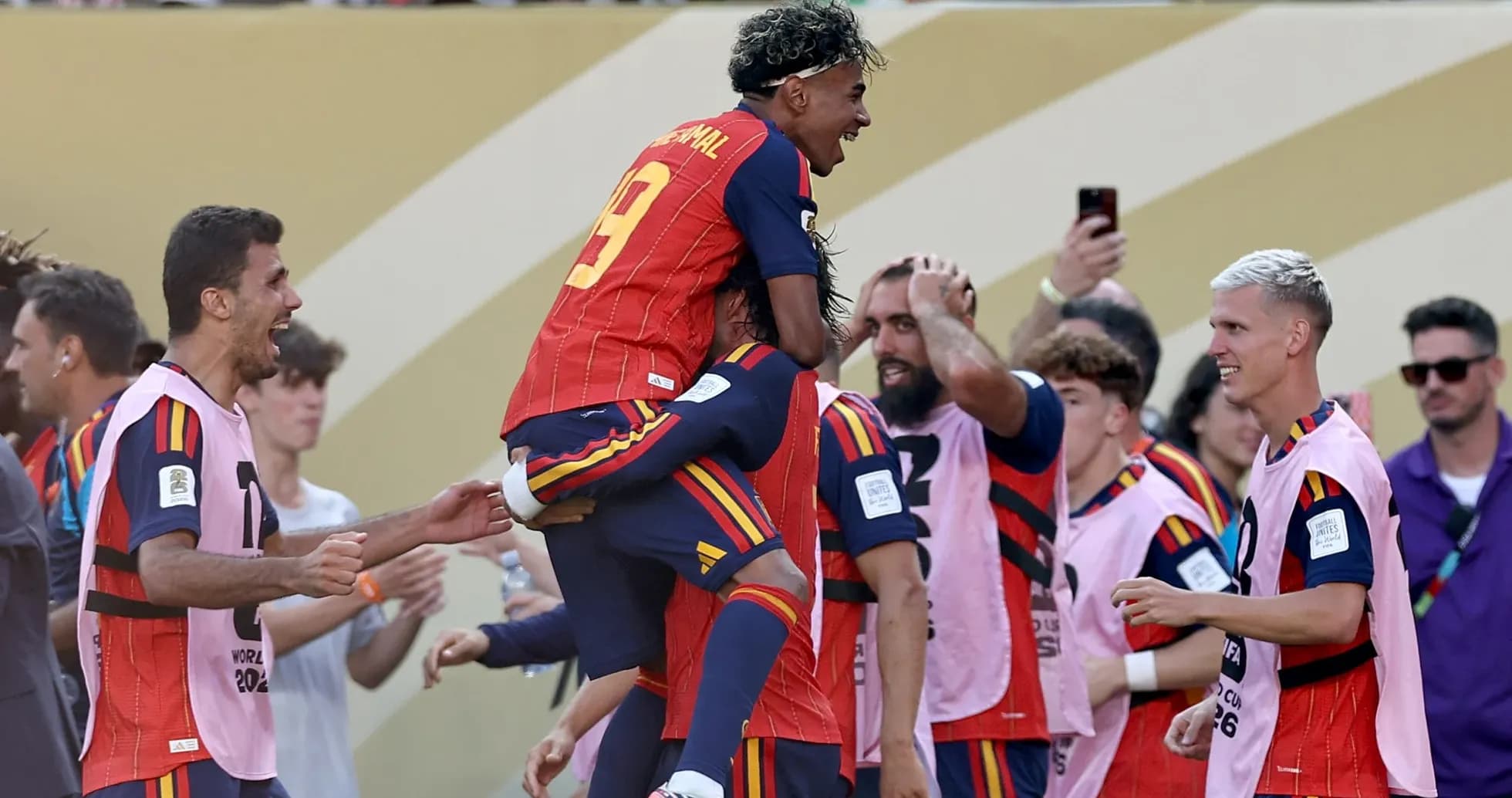
Luis de la Fuente doubled down on Spain’s evolving tournament identity with a 4-2-3-1 that looked like a hybrid between classic Spanish control and a more vertical, wing-driven model. Unai Simón sat behind a back four of Pedro Porro, Pau Cubarsí, Aymeric Laporte and Marc Cucurella. Rodri and Pedri formed the double pivot, with Lamine Yamal, Dani Olmo and Álex Baena supporting Mikel Oyarzabal as the nominal striker.
Ralf Rangnick mirrored the shape on paper with his own 4-2-3-1, but the Austrian version was built for transition and aggression. Alexander Schlager was protected by Stefan Posch, Kevin Danso, David Alaba and Konrad Laimer across the back. Nicolas Seiwald and Xaver Schlager anchored midfield, with Romano Schmid, Paul Wanner and Marcel Sabitzer operating behind Michael Gregoritsch.
Seasonal Numbers
Heading into this game, Spain’s seasonal numbers in the World Cup underlined the contrast between the sides. Overall they had played 4 fixtures, winning 3 and drawing 1, with no defeats. At home they had played 3, winning 2 and drawing 1, while on their travels they had played 1 and won it. The attacking output was quietly ruthless: in total this campaign Spain had scored 8 goals, with 7 at home and 1 away. The overall scoring average stood at 2.0 goals per match, built on 2.3 at home and 1.0 away. More striking was the defensive perfection: in total this campaign Spain had not conceded a single goal, with 0 against at home and 0 away, an overall average of 0.0 conceded.
Austria’s path was far more turbulent. Overall they had played 4 fixtures, with 1 win, 1 draw and 2 defeats. At home they had played 1 and won it, while on their travels they had played 3, drawing 1 and losing 2. In total this campaign they had scored 6 goals, split evenly as 3 at home and 3 away, for an overall scoring average of 1.5 goals per match (3.0 at home and 1.0 on their travels). But the defensive side of the ledger told the story of a team constantly on the brink: in total this campaign Austria had conceded 9 goals, 1 at home and 8 away, for an overall average of 2.3 goals conceded (1.0 at home and 2.7 away). There were no clean sheets, and they had failed to score twice, both away from home.
Disciplinary Profiles
The disciplinary profiles hinted at how the contest might be refereed by Glenn Nyberg. Spain’s yellow cards this tournament had been concentrated in two phases: 50.00% between minutes 46-60 and 50.00% between 91-105, suggesting a side that tends to foul more when managing second-half momentum and late-game pressure. Austria’s bookings were front-loaded and frantic at the end: 20.00% of their yellows came in minutes 0-15, another 20.00% in 31-45, and a late spike with 60.00% between 76-90. That pattern aligned with Rangnick’s high-energy starts and emotionally charged finishes, and hinted at a risk of late indiscipline if Spain controlled the ball and tempo.
Key Players
Individually, the narrative revolved around two emblematic figures. For Spain, Mikel Oyarzabal arrived as one of the World Cup’s most efficient forwards. He had made 4 appearances, all starts, for a total of 301 minutes, scoring 4 goals and adding 1 assist. His 15 shots, with 8 on target, spoke to a player finding good positions rather than simply volume shooting. Operating as the tip of Spain’s 4-2-3-1, his movement between the lines and into the box would be the “Hunter” in this tie.
For Austria, the “Shield” was Stefan Posch, and his statistical profile was more complex. He had appeared 4 times, all as a starter, logging 333 minutes as a defender. Across those minutes he had made 10 interceptions and engaged in 35 duels, winning 16. He had also committed 7 fouls, drawn 3, and picked up 2 yellow cards. Intriguingly, he appeared in both the top yellow cards and top red cards lists, but his card record in this tournament remained at 2 yellows and 0 reds. That dual listing underlined how central his aggression is to Austria’s defensive identity, but also how fine the line is between committed defending and costly indiscipline.
Tactical Matchup
Tactically, the Hunter vs Shield duel was layered. Oyarzabal’s tendency to drift into half-spaces and link with Dani Olmo and Lamine Yamal would repeatedly test the axis of Posch and Danso, with Alaba stepping across as a covering presence. Austria’s back line, which on their travels had conceded 8 goals already, would be asked to hold a high line at times to compress space for Spain’s midfielders, yet still track the diagonal runs that Spain’s front four are so adept at making.
Behind that battle, the “Engine Room” confrontation was equally decisive. Rodri and Pedri against Xaver Schlager and Nicolas Seiwald framed the game’s rhythm. Spain’s double pivot is built for suffocating control: Rodri as the metronome, Pedri as the connector through the inside channels. Austria’s pair is more combative, tasked with breaking patterns and springing counters towards Sabitzer and Wanner. Given Austria’s overall average of 2.3 goals conceded and Spain’s overall scoring average of 2.0, the Austrian midfield’s capacity to disrupt first passes into Rodri and Pedri was critical to preventing wave after wave of structured attacks.
Statistical Prognosis
From a broader statistical prognosis, the trajectories were diverging even before a ball was kicked. Spain’s overall record of 3 wins and 1 draw, with 8 scored and 0 conceded, painted the picture of a side whose xG profile would almost certainly lean heavily in their favour: high shot volume, controlled territory, and minimal chances allowed. Their clean-sheet streak across all 4 fixtures, combined with Austria’s failure to score in 2 of their 3 away matches, suggested that Austria’s attacking xG would likely be limited to transitional bursts rather than sustained pressure.
Austria’s numbers hinted at volatility rather than stability. In total this campaign they had already experienced a 3-1 home win as their biggest victory and a 3-0 away defeat as their heaviest loss. That spread, plus an away defensive average of 2.7 goals conceded, implied that if Spain established early control, the match could tilt heavily in their favour. The fact that Austria’s only penalty in the tournament had been converted (1 scored from 1, with 0 missed) showed clinical edge when chances came, but their inability to keep any clean sheet meant they were always likely to be chasing.
Conclusion
Overlaying style on statistics, the tactical preview narrows to a simple equation. Spain, with their immaculate defensive record and a forward in Oyarzabal who is already on 4 goals, are built to accumulate pressure, trust their structure, and let quality tell in the final third. Austria, with no clean sheets and a tendency to collect 60.00% of their yellow cards in the final quarter-hour, are set up to fight, disrupt and hope their transitions break through a defence that has yet to be breached.
In a knockout tie at SoFi Stadium, that balance of control versus chaos was always likely to lean towards the side that could impose its rhythm. The numbers, the shapes, and the key matchups all pointed to Spain’s methodical dominance against Austria’s brave but brittle resistance.