.svg&w=384&q=75 "Naijagoal logo")

World Cup 2023: The Last Dance for Legends
The world gathers. Italy watches.
At 20:00 tonight, the most ambitious World Cup in history kicks off at the legendary Estadio Azteca, with Mexico–South Africa opening a tournament that stretches across a maxi American stage and runs all the way to a final on 19 July. Forty‑eight national teams, three opening ceremonies, one trophy – and a glaring absence: the Azzurri, present only on the benches.
Messi the hunted, not the hunter
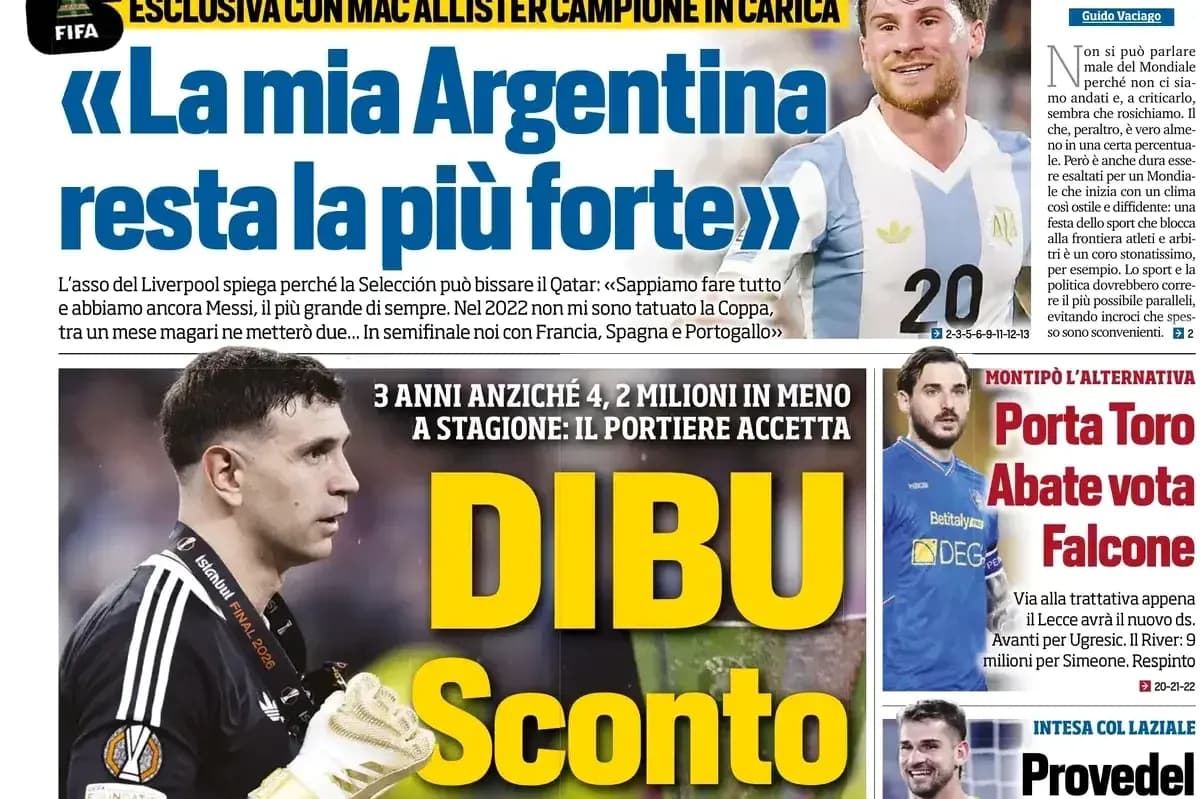
Lionel Messi arrives as reigning champion and standard-bearer of a Argentina side that refuses to loosen its grip on the throne. The message from the Albiceleste camp is clear: “It will be tough to beat us.” Alexis Mac Allister, fresh from a standout season with Liverpool, lays it out with the calm of a man who already knows the route.
His conviction is blunt. Argentina, he says, “remains the strongest.” They know how to win this tournament because they have done it, recently and in the most intense of circumstances in Qatar. They still have Messi, “the greatest of all time,” and that alone reshapes the balance of fear in any stadium they enter.
Mac Allister admits he resisted the temptation to mark 2022 permanently on his skin. No World Cup tattoo then. This time? He jokes that in a month he might have two. Confidence, not arrogance. For the semi‑finals he sees a royal square: Argentina, France, Spain and Portugal. Four giants, four philosophies, one collision course.
Spain raise their hand
Spain do not hide. Rodri, the metronome of La Roja, goes further than cautious optimism. For him, the level of this World Cup has risen, and within that rise, Spain are favourites. Not outsiders, not dark horses. Favourites.
His stance fits a team that has rebuilt without losing its identity. Technique, possession, positional play – the old principles remain – but wrapped now in a more direct, more aggressive edge. If the algorithm that various models point to has Spain at the top of the projections, Rodri is happy to wear that target.
France: brilliance with a warning label
France, as always, arrive with an attack that reads like an awards shortlist. Kylian Mbappé leads a frontline that defenders study on video and still struggle to solve on grass. The French squad overflows with stars, to the point where the question writes itself: can you have too much?
The concern around Didier Deschamps’ side is not talent, but balance. So many egos, so much firepower. An attack to be feared, certainly, but also a dressing room that demands management of the highest order. If they click, they can blow the tournament apart. If not, the same brilliance that dazzles could blind them.
The last dance for two icons
This is World Cup edition No. 23, and it doubles as a farewell tour for two icons of the modern game. Their names sit at the centre of every pre‑tournament narrative, their legacies already carved in stone. This World Cup is not about defining them, but about how they choose to exit the stage.
The sense of “last dance” hangs over the competition. Every touch, every goal, every grimace under the summer heat carries the weight of finality. The spotlight won’t move from them easily, not with entire generations measuring their own football memories against these careers.
France and Argentina sit on top of most predictions, yet the data models keep whispering the same word: Spain. Between emotion and algorithm, this World Cup opens on a fault line.
Italy’s colours on the touchline
On the pitch, Italy are missing. On the touchline, they are everywhere.
Three Italian coaches carry the tricolore into this World Cup: Carlo Ancelotti, Fabio Cannavaro and Vincenzo Montella. Three very different profiles, one shared heritage.
Ancelotti, “our Carletto,” brings his encyclopaedia of finals and dressing rooms to the international stage. His presence alone gives his team a gravitas that others envy. Cannavaro, the captain of Berlin 2006, now tries to transfer the authority he had with the armband to the technical area. Montella, the more restless tactician, arrives with ideas and a point to prove.
For Italian football, it is a strange reflection: tactically exported, technically absent. The whole world is there. Apart from the Azzurri.
A World Cup stretched to the limit
Three opening ceremonies underline the scale of this project, a tournament expanded to 48 participants and spread across a vast geography. The opening act belongs to Mexico and South Africa at the Azteca, a stadium that carries ghosts and glory in equal measure.
From tonight until 19 July, the calendar is relentless. Group stages that will test depth more than ever, knockout rounds that could punish any hint of fatigue. Rotations will not be a luxury but a necessity. Coaches will earn their salaries on the training pitch as much as on the touchline.
The narrative threads are already in place. Messi defending the crown. Mbappé hunting it. Rodri pushing Spain into the role of favourite. Portugal lurking with their own constellation of talent. France balancing on the edge between dominance and overload.
The whistle in Mexico City will cut through all the talk.
The last dance for legends begins, and with Italy watching from the outside, the question shifts from who will win to how this World Cup will redraw the map of power in the game.