.svg&w=384&q=75 "Naijagoal logo")

William Saliba's Injury: A Major Setback for Arsenal
William Saliba’s World Cup heartbreak has turned into a nightmare for Arsenal.
The defender suffered a serious back injury while playing for France in their 2-0 World Cup semi-final defeat to Spain and is expected to be out for four to five months, according to L’Equipe. For Mikel Arteta, it rips a pillar out of the structure he has built in north London.
Saliba’s body gives way
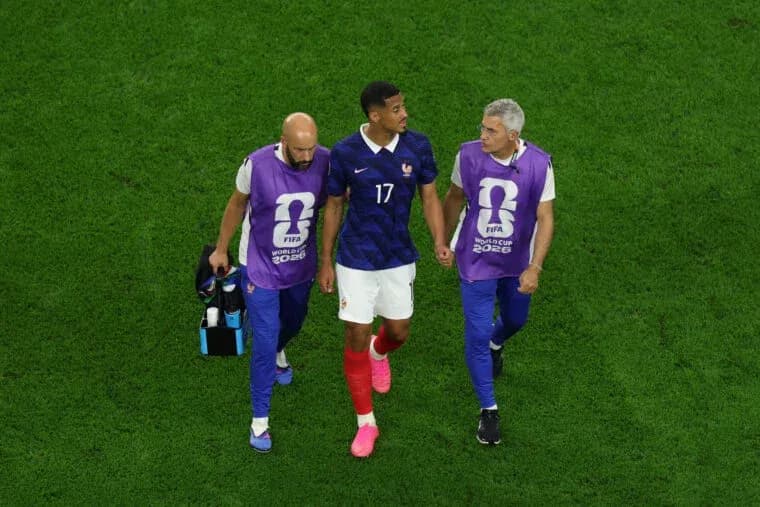
Saliba, 25, had been struggling with persistent discomfort throughout the match before finally succumbing just half an hour in. As France chased the game, their defensive leader simply could not go on.
“I can’t take it anymore, my back is dead,” he reportedly told team-mate Dayot Upamecano moments before being withdrawn in the 30th minute.
It was more than just a substitution. It was a tipping point. Once Maxence Lacroix came on to replace him, Les Bleus’ back line lost its poise and authority, underlining how far ahead of his peers Saliba now operates.
The concern runs deeper than one tournament. Saliba has previously battled chronic back problems, and this latest setback raises serious questions about his long-term durability at the very peak of the game.
Arsenal’s defensive cornerstone removed
For Arsenal, the timing could hardly be worse. Saliba has become one of the Premier League’s outstanding centre-backs, the calm at the heart of a side chasing major honours at home and in Europe. His blend of anticipation, recovery pace and composure on the ball underpins the way Arteta wants his team to defend high and dominate territory.
Take that away and the entire defensive equation changes.
His absence stretches well into the new season, leaving Arsenal to navigate the opening months without the man who has quietly become their most irreplaceable outfield player. Recruitment plans, tactical tweaks, leadership in the back line – all of it must now be reconsidered.
A solution from within?
Yet Arteta may not need to look outside his own dressing room for an answer.
Cristhian Mosquera is the name that keeps surfacing. Young, Spanish, and already showing the temperament of a seasoned professional, he has the profile to step into the void if Arsenal trust him with the responsibility.
Last season, Mosquera displayed a rare mix for a defender of his age: composure in possession, sharp defensive reading, and the physical presence required to cope with elite forwards. He does not mirror Saliba, few do, but he offers enough tools to grow into that role rather than simply plug it.
Handing him regular minutes alongside Gabriel Magalhaes would be a bold call, but it could accelerate his development dramatically. Gabriel’s aggression and experience, paired with Mosquera’s calm and intelligence, carries the potential to form a new partnership at the heart of Arsenal’s defence.
Replacing a player of Saliba’s quality is never a straight swap. It is a reconstruction. Arsenal must adapt, not copy.
Mosquera may not have expected this opportunity so soon. Football rarely waits. The stage is there, the gap is huge, and the question now is simple: can he turn a crisis into his breakthrough?