.svg&w=384&q=75 "Naijagoal logo")

Golden Boot Race at the 2026 World Cup: Who Will Score Most?
“Sometimes in football, you have to score goals.”
Thierry Henry tossed that line out in 2008. In 2026, with only four games left at this World Cup, it feels less like a quip and more like a mission statement.
The trophy is the thing everyone came for. But there is another chase running alongside the hunt for the crown: the Golden Boot. It rarely lands in the hands of the champion. Not since Ronaldo’s eight goals for Brazil in 2002 has the tournament’s top scorer climbed the same podium as the World Cup winners.
This time, with an expanded format — 16 extra teams, 40 more matches than Qatar 2022 — the goals have flowed. Just Fontaine’s mythical 13 for France in 1958 still stands untouched, yet the volume of chances and chaos has given this Golden Boot race a wild, open feel.
And it is being led, fittingly, by familiar giants.
How the Golden Boot is decided
Since 1992, the rules have been clear when players finish level on goals: assists decide the ranking.
That tiebreak came into play in 2010. Spain’s David Villa, Uruguay’s Diego Forlan and the Netherlands’ Wesley Sneijder all matched Thomas Muller’s five goals. Muller walked away with the award because he had three assists, two more than any of his rivals.
In 2006, FIFA added another layer. If goals and assists are identical, the player with fewer minutes on the pitch takes it. Ruthless, but simple: same output, less time, greater impact.
With that in mind, every pass, every cut-back, every minute now matters as much as the goals themselves.
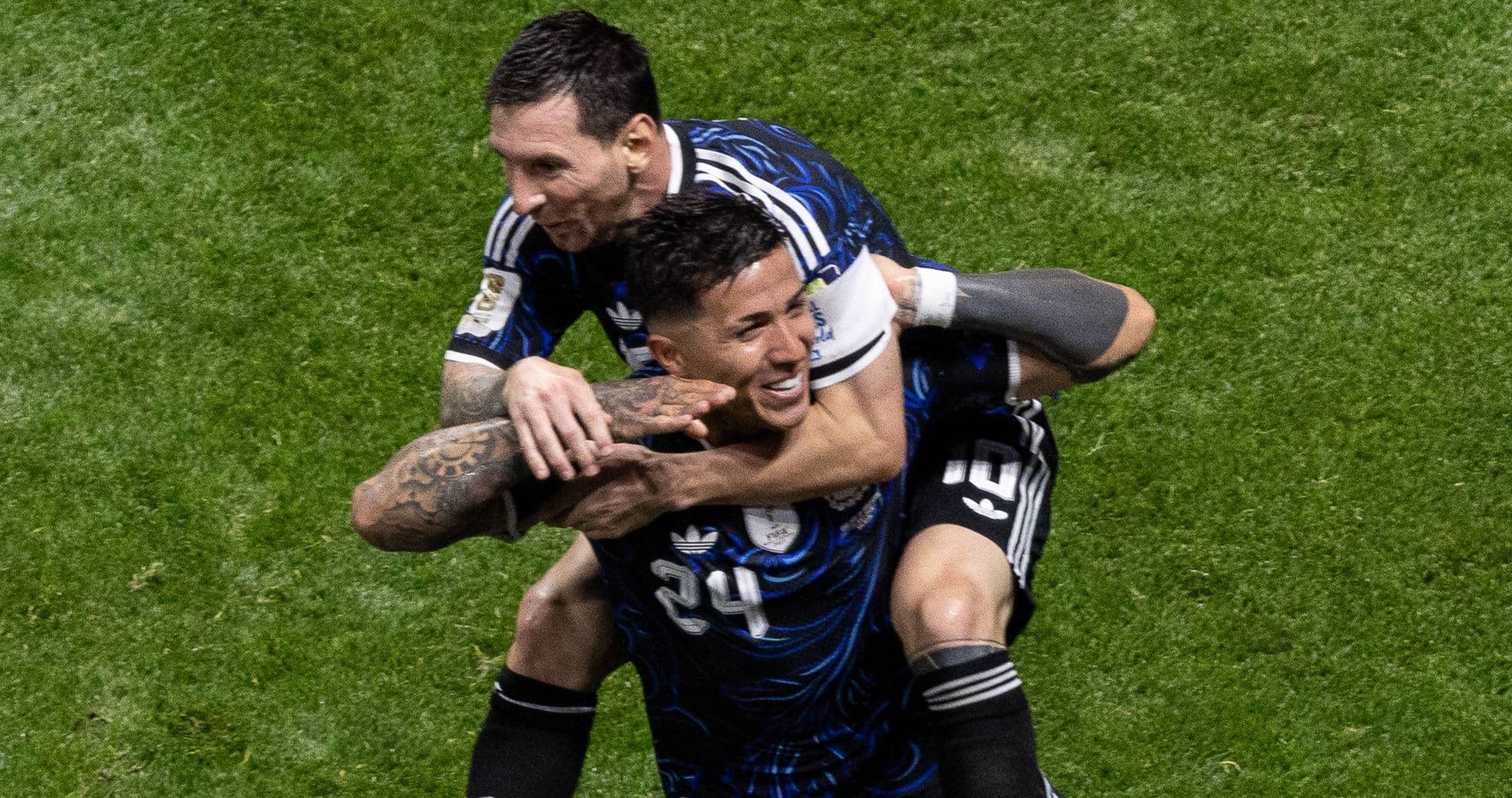
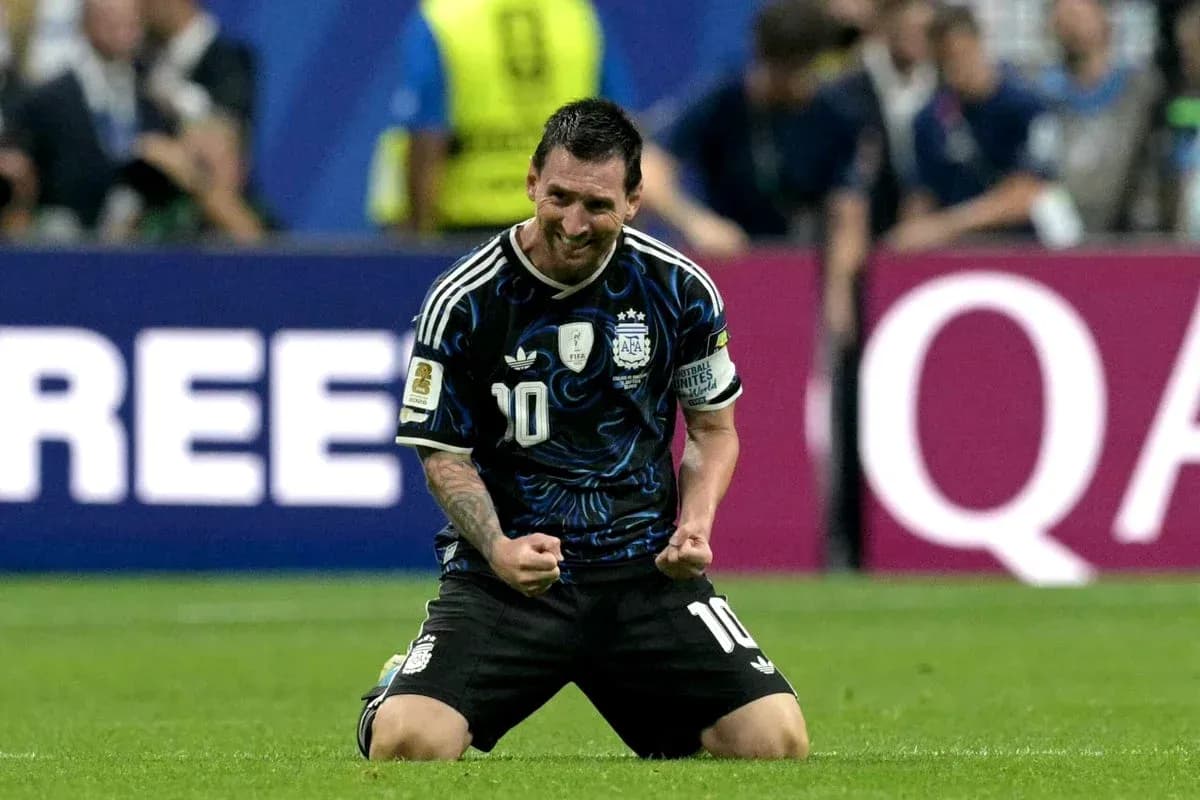
1. Lionel Messi (Argentina) – 8 goals
(4 assists – 712 minutes)
Messi’s World Cup began with a warning shot. He thought he had opened his account against Algeria, only for VAR to pull him back for offside. No flag could save Algeria later in the half, though, when he swept a 20-yard strike beyond Luca Zidane.
After the break, he pounced. Zidane spilled a low effort from Alexis Mac Allister, and Messi, alive to the rebound, rolled in his second of the night.
The hat-trick goal was pure Messi. A curling effort from the edge of the box, shaped like a pass into a corridor that did not exist, Zidane stranded, the net rippling in slow inevitability.
He missed a penalty against Austria in Argentina’s second game, then responded as only he can. A first-time finish from Facundo Medina’s ball gave him his fourth of the tournament and, with it, the outright men’s World Cup all-time scoring record. He stayed hungry. Another close-range finish late on, after his own shot had been blocked, took him to five in two games.
Rested from the start against Jordan in the final group match, he still found time to bend in an 80th-minute free kick. Goal seven came in the round of 32 against Cape Verde. Goal eight, the most dramatic of the lot, arrived as a late equaliser against Egypt in the next round, a strike that kept Argentina alive and tightened his grip on the Golden Boot race.
Eight goals, four assists, and still the tournament is not done with him.
2. Kylian Mbappe (France) – 8 goals
(3 assists – 666 minutes)
Mbappe’s World Cup opened like a statement of intent. Two goals in a 3-1 win over Senegal set the tone: direct, ruthless, unstoppable in full flow.
Against Iraq, he lashed in the opener from distance, then, after a long weather delay in Philadelphia, returned to the pitch and doubled France’s lead. The pause did nothing to cool him.
He carried that edge into the knockouts. Two clinical finishes against Sweden in the round of 32, a penalty converted against Paraguay, another goal in the quarter-final against Morocco. Every round, he found a way.
Spain finally shut the door in the semi-final, a 2-0 defeat that ended France’s title hopes and froze Mbappe’s tally at eight. His last chance to tilt the Golden Boot his way now lies in the third-place play-off on Saturday.
Messi leads on assists. Mbappe trails by a single pass. The margins could not be finer.
3. Erling Haaland (Norway) – 7 goals*
(0 assists – 537 minutes)
Erling Haaland arrived at his first World Cup with the weight of inevitability. He played like a man determined to justify it.
Against Iraq, he scored twice. The first, a sliding, instinctive finish inside the six-yard box from David Moller Wolfe’s low cross. The second, pure aggression: he charged down the goalkeeper, forced the error, and bundled the ball over the line.
Senegal felt the full range of his finishing next. A composed sweep into the corner brought his third of the tournament, and a clever volleyed strike his fourth.
In the round of 32 against Ivory Coast, he delivered when it mattered most, prodding in a late winner in a 2-1 victory. Then came Brazil. Norway stunned them, and Haaland struck twice, his second a surprise effort that underlined his knack for appearing exactly where defenders least want him.
Seven goals, no assists, and now out of the tournament. His number is on the board. Others must chase it down.
4. Jude Bellingham (England) – 6 goals
(1 assist – 574 minutes)
Jude Bellingham has driven England’s campaign from midfield with the authority of a veteran and the energy of a teenager.
He scored in both of England’s opening group wins: first in the 4-2 victory over Croatia, then again in the 2-0 defeat of Panama. Those early strikes felt like a bonus. They soon became a pattern.
In the last 32 against Mexico, he stepped up with a brace. Then he did it again in the quarter-final against Norway, another two goals that hauled him into the thick of the Golden Boot conversation.
Six goals, one assist, and crucially fewer minutes than his captain, Harry Kane. On the tiebreakers, every second he spends off the pitch strengthens his position.
5. Harry Kane (England) – 6 goals
(1 assist – 627 minutes)
Harry Kane began his World Cup the way he so often does: scoring when it counts.
Two goals in the 4-2 win over Croatia, a quieter night in the goalless draw with Ghana, then a sharp finish against Panama in the final group game to restore his rhythm.
In the round of 32 against DR Congo, he turned match-winner, striking twice in the second half to drag England through. Against Mexico in the next round, he held his nerve from the penalty spot to reach six goals.
He matches Bellingham for goals and assists but loses out on minutes played. For now, that keeps him just behind his midfield teammate in the Golden Boot pecking order.
=6. Ousmane Dembele (France) – 5 goals
(2 assists – 492 minutes)
Ousmane Dembele came into this World Cup with a curious record: 19 major tournament appearances, no goals.
That statistic evaporated in an instant. He scored France’s third in the 3-0 win over Iraq, a release as much as a finish. Then he exploded.
Against Norway, Dembele produced a first-half hat-trick, a blur of movement and precision that finally married his talent with end product on the biggest stage. His fifth of the tournament arrived in the quarter-final against Morocco.
Five goals, two assists, and a late surge that turned him from peripheral figure into one of France’s most dangerous weapons.
=6. Mikel Oyarzabal (Spain) – 5 goals
(1 assist – 519 minutes*)
Spain stumbled out of the blocks with a frustrating draw against Cape Verde. Mikel Oyarzabal helped drag them back into stride.
Against Saudi Arabia, he struck twice in a 4-0 win, his movement and timing too sharp for a tiring defence. In the round of 32 against Austria, he repeated the trick with another brace in a 3-0 victory.
His most significant contribution, though, came from the spot in the semi-final against France. Oyarzabal stepped up and converted to open the scoring in a game loaded with tension.
Five goals, one assist, and a central role in Spain’s march deep into the tournament.
=8. Vinicius Junior (Brazil) – 4 goals*
(1 assist – 505 minutes)
Vinicius Junior started this World Cup by rescuing Brazil.
Morocco led, the pressure grew, and then he cut across the ball with that familiar whip, thundering in an equaliser that spared his country a damaging defeat.
Against Haiti, with Brazil already in control thanks to two Matheus Cunha goals, he added his second of the tournament, a flourish in a dominant display. Scotland then gifted him his third, Scott McKenna’s error leaving him clean through to finish past Angus Gunn in Brazil’s final group match.
His fourth came the simple way: a back-post header from a teasing Bruno Guimaraes cross, the kind of goal that looks easy only because of the timing and positioning involved.
Four goals, one assist, and now, with Brazil out, his tally is locked.
=8. Ismaila Sarr (Senegal) – 4 goals*
(1 assist – 419 minutes)
Ismaila Sarr lit up Senegal’s Group I clash with Norway.
His first goal, an awkward, clipped effort while falling to the turf, somehow found its way in. His second, in the same game, was more orthodox but just as decisive in a narrow 3-2 defeat.
He added a third in Senegal’s final group match against Iraq, then struck again against Belgium in the round of 32, a reminder of his threat on the counter.
Four goals, one assist, and a tournament that showcased his ability to hurt elite opposition.
=8. Julian Quinones (Mexico) – 4 goals*
(1 assist – 440 minutes)
Julian Quinones wasted no time. He scored the first goal of the entire World Cup, opening Mexico’s campaign with the opener in a 2-0 win over South Africa.
He struck again in a 3-0 victory over Czech Republic, then once more delivered the opener in the last-32 tie against Ecuador. Against England in the same round, he added another to his tally.
For those who watched him top-score in the Saudi Pro League with 33 goals in 31 games, none of this came as a shock. Four goals here underline that his domestic numbers are no illusion.
=10. The chasing pack – 3 goals
Behind them, 11 players sit on three goals, all hoping for one final surge. For some, that chance has already gone. For others, it may come in a semi-final, a third-place play-off, or the final itself.
A prize with its own history
The Golden Boot, introduced as the Golden Shoe in 1982, has long recognised the World Cup’s deadliest finisher, even if the accolade was unofficial before then.
In 2022, Kylian Mbappe joined rare company by scoring a hat-trick in the final, matching Geoff Hurst’s feat from 1966. Unlike Hurst, he did not lift the trophy, but his eight goals equalled Ronaldo’s 2002 benchmark for a single tournament.
Four years earlier, Harry Kane’s six goals carried England to the semi-finals and earned him the award, despite their eventual loss to Croatia.
Now, in 2026, the race has tightened into something more personal. Messi and Mbappe are locked on eight. Haaland lurks one back, frozen on seven. Bellingham and Kane wait on six, with Dembele and Oyarzabal just behind.
The World Cup will crown a champion soon enough. The sharper question, as the last games unfold, is simpler and more ruthless:
Who will keep scoring when it matters most?