.svg&w=384&q=75 "Naijagoal logo")

West Ham's Boardroom Split Over Nuno’s Future After Relegation
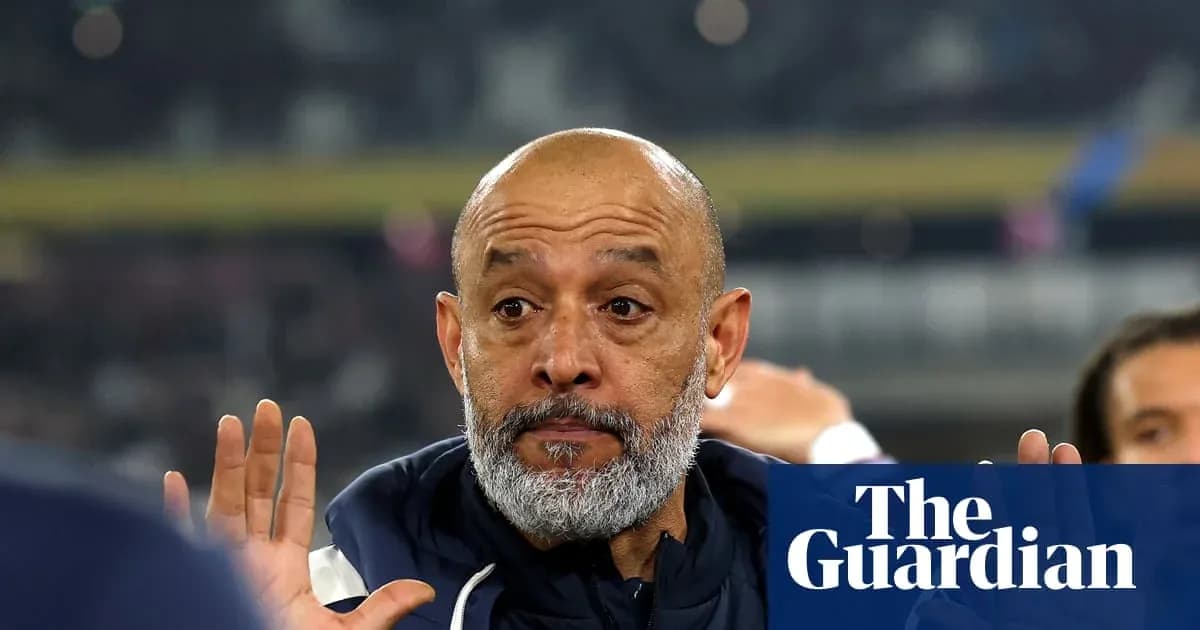
West Ham’s relegation has not only dragged the club into the Championship; it has blown open a fault line in the boardroom over whether Nuno Espírito Santo should be the man to lead the recovery.
The Portuguese coach was summoned for crisis talks on Monday, a meeting framed as decisive but now emblematic of a club wrestling with itself. A verdict on his future is expected before the end of the week. The expectation inside the game remains that West Ham will move on without him. The reality is more tangled.
Boardroom split over Nuno
The division is clear. Daniel Kretinsky, the Czech billionaire and second-largest shareholder, is pushing for Nuno to stay. He sees value in continuity at a moment of upheaval, and his stance has given the manager a lifeline that did not seem to exist when relegation was confirmed.
On the other side stands David Sullivan. The largest shareholder, the dominant figure at West Ham for 16 years, is far less convinced. His doubts carry weight. For more than a decade and a half, little has happened at the club without his fingerprints on it, and he has become the lightning rod for supporter anger over the team’s slide into the second tier.
That anger boiled over during last Sunday’s win over Leeds, when Sullivan was targeted by fans who hold him responsible for the decline. The mood around the ownership has rarely been more toxic.
Power balance shifting
Behind the scenes, the politics are shifting. Kretinsky has a deal in place to increase his stake and move level with Sullivan in terms of control. The co-owners are each poised to buy a portion of the Gold family’s 25.1% shareholding, a move that would leave them sharing power in the boardroom.
Relegation complicates everything. The drop is expected to hit the value of that deal, adding another layer of financial calculation to a football decision that already feels fraught.
One source has put the chances of Sullivan walking away at 50-50. At 77, and under sustained pressure from the stands, the prospect of selling up after relegation is real. Yet his direct involvement in talks with Nuno tells a different story: a man still deeply embedded in the club’s immediate future, not one heading for the exit.
Sullivan is also understood to be engaged in discussions over how to reconstruct the squad for life in the Championship, with the clear aim of mounting an immediate promotion push. That planning, and who leads it from the dugout, will define the next phase of West Ham’s modern history.
Nuno’s leverage and the next move
Nuno arrived last September on a three-year contract after replacing Graham Potter. On paper, that kind of term suggests a long-term project. In reality, the deal was written with an escape hatch on both sides.
The contract includes a clause allowing West Ham to dismiss the 52-year-old without paying compensation. It cuts the other way too: Nuno can walk away for nothing. His appetite to stay and manage in the Championship is not a footnote; it is central to the decision now facing the club.
If he believes the boardroom is fractured and the backing uncertain, he has the option to step away before the rebuild begins. If he stays, he does so knowing that at least one of the two powerbrokers is fully behind him, and the other remains unconvinced.
Names are already circling as potential successors. Scott Parker, with promotion experience at Fulham and Bournemouth, is in the frame. Slaven Bilic, a former West Ham manager who retains affection in parts of the fanbase, is another possibility. Gary O’Neil, whose recent work has enhanced his reputation as an organiser and firefighter, is also under consideration.
Each candidate offers a different route back, a different style, a different message to a fanbase that has endured too many false dawns.
For now, though, everything comes back to that split boardroom and a manager waiting for clarity. West Ham have fallen. The question that hangs over the club is simple and brutal: who do they trust to lead the climb?