.svg&w=384&q=75 "Naijagoal logo")

Tottenham's Tactical Masterclass in 1-0 Victory Over Everton
Tottenham’s 1-0 win over Everton at Tottenham Hotspur Stadium was a tightly controlled, structurally disciplined performance built on a clear 4-2-3-1 framework against an almost mirrored shape. Despite the even 50–50 split in possession and near-identical passing volumes (373 vs 377), Roberto De Zerbi’s side generated the better territory and shot quality, turning their superior volume of attacks into the game’s decisive moment before half-time.
In build-up, Tottenham’s back four of Pedro Porro, Kevin Danso, Micky van de Ven and Destiny Udogie spread very wide, with Rodrigo Bentancur and João Palhinha forming a stable double pivot. With 373 passes and 85% accuracy (317 accurate), Spurs circulated the ball confidently through the first two lines, using Porro and Udogie to create width and drag Everton’s wide midfielders back. This allowed Dejan Spence, Conor Gallagher and Mathys Tel between the lines to rotate positions around Richarlison, constantly trying to pin James Tarkowski and Michael Keane.
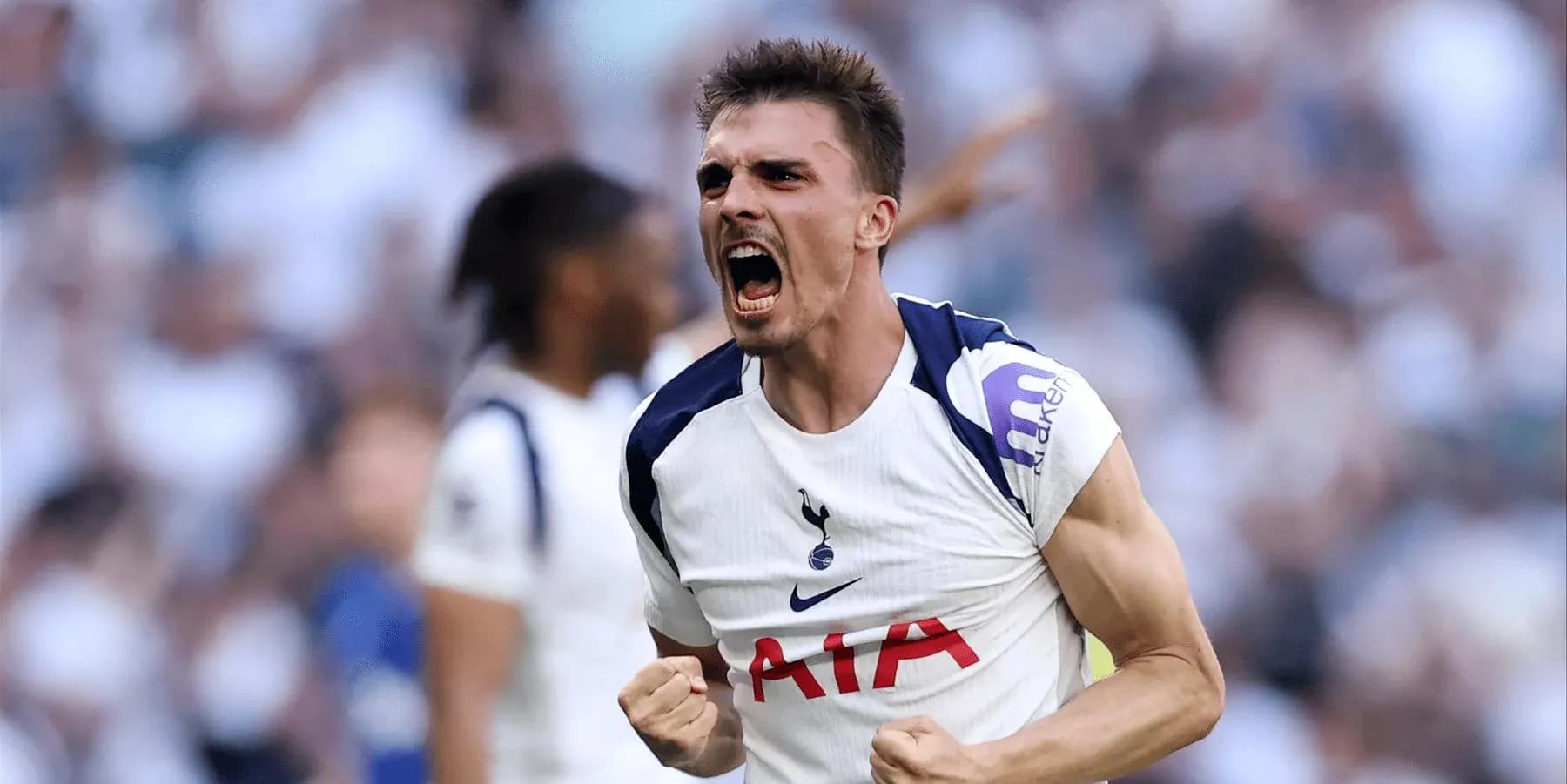
Palhinha’s role was central to both the structure and the scoreline. Operating as the deeper of the two pivots, he stepped forward aggressively when space opened, and his 43rd-minute goal – the only one of the match – rewarded Tottenham’s insistence on attacking through the inside channels rather than relying solely on crosses. With 20 total shots and 15 of them inside the box, Spurs repeatedly managed to work the ball into high-value central locations. The xG figure of 0.99 reflects a game of accumulated half-chances rather than clear one-on-ones, but the volume and proximity to goal underline that the attacking plan was effective in pushing Everton back.
Defensively, Tottenham were proactive rather than reactive. Their 15 fouls and two yellow cards show a willingness to break up transitions early, especially once ahead. The press was usually triggered when the ball went into Everton’s double pivot of James Garner and Tim Iroegbunam. Bentancur stepped high to jump onto the first pass, with Gallagher and Tel collapsing inside from the half-spaces. When the press was broken, Palhinha dropped into the back line to create a temporary back five, allowing the full-backs to stay relatively aggressive on Everton’s wide players.
Despite facing only nine total shots and just one on goal, the defensive workload was not trivial. The nine blocked shots for Tottenham are a key tactical marker: the centre-backs and screening midfielders consistently held their positions in front of the box, closing down Everton’s attempts before they could test A. Kinsky (Tottenham). That compactness meant Kinsky was called upon for only one recorded save, but it also highlights how well the defensive unit protected him by contesting shots at source rather than relying on last-line interventions.
Everton, under Leighton Baines, mirrored the 4-2-3-1 but played a more cautious, counter-oriented game. With 377 passes at 83% accuracy (314 accurate), they were tidy enough in possession but struggled to progress centrally. The front quartet of Tom Cannon Barry, Iliman Ndiaye, Kiernan Dewsbury-Hall and Merlin Röhl often received the ball with their backs to goal, forced wide or into low-percentage efforts. Everton’s nine total shots included seven from inside the box, but the low xG of 0.34 shows that most of these were from crowded positions or poor angles, frequently under immediate pressure from Danso and van de Ven.
Jordan Pickford (Everton) had a relatively quiet afternoon in terms of direct shot-stopping, registering one save. However, the pressure he faced was more about volume than isolated high-danger moments. Tottenham’s 20 shots, nine of them blocked, suggest repeated waves of attacks where Everton’s back line and midfield had to throw bodies in front of efforts before they reached Pickford. The identical goals prevented figure of -0.32 for both teams indicates that neither goalkeeper significantly outperformed or underperformed the quality of chances faced; the difference came from Tottenham simply creating more.
Substitutions reflected the tactical priorities of both coaches. At 62 minutes, Everton introduced T. George (IN) for M. Rohl (OUT) and H. Armstrong (IN) for Jake O’Brien (OUT), freshening both the right flank and midfield energy to chase the game. Later, Beto (IN) replaced T. Barry (OUT) and C. Alcaraz (IN) came on for K. Dewsbury-Hall (OUT), with Séamus Coleman (IN) taking over from Tim Iroegbunam (OUT). These changes tilted Everton slightly more direct, but they still struggled to generate clean looks through Tottenham’s compact block.
De Zerbi’s changes were more about game management. R. Kolo Muani (IN) for Richarlison (OUT) and Pape Matar Sarr (IN) for Tel (OUT) at 73 minutes added fresh running up front and extra energy in midfield. Later, A. Gray (IN) replaced Bentancur (OUT) and James Maddison (IN) came on for Gallagher (OUT), giving Spurs better ball retention and press resistance in the closing stages. Finally, Radu Drăgușin (IN) for Udogie (OUT) at 90 minutes was a clear move to reinforce aerial presence and see out the final moments with added defensive security.
The disciplinary pattern also tells part of the tactical story. Everton’s early yellow for Jake O’Brien on 13 minutes for “Foul” signalled their need to disrupt Tottenham’s rhythm in wide areas. Later, James Tarkowski’s booking on 89 minutes, again for “Foul”, underlined the strain on Everton’s central defenders as they dealt with late Spurs counters and hold-up play. Tottenham’s cards were more situational: Pape Matar Sarr was cautioned on 80 minutes for “Simulation”, a by-product of trying to win territory and slow the tempo, while João Palhinha’s 87th-minute yellow for “Handball” came from a defensive intervention, again consistent with his combative screening role.
Statistically, the match was balanced in possession and set pieces (seven corners each), but Tottenham’s superiority in shot volume (20 vs 9), blocked efforts (9 vs 3) and xG (0.99 vs 0.34) validates the 1-0 scoreline as a fair reflection of territorial and qualitative control. Both teams recorded two yellow cards, but Tottenham managed their aggression within a coherent pressing scheme, while Everton’s bookings were more reactive to being stretched.
Overall, Tottenham’s 4-2-3-1 functioned as a flexible, ball-dominant structure that created sustained pressure and protected A. Kinsky (Tottenham) effectively. Everton’s mirrored shape, despite honest work and disciplined defending in phases, lacked the central progression and final-third clarity to seriously threaten the home side’s lead. The tactical edge lay in Spurs’ ability to turn equal possession into superior territory and shot quality, and then to close the game out with intelligent substitutions and a compact late-game block.