.svg&w=384&q=75 "Naijagoal logo")

Crystal Palace vs Arsenal: A Tactical Review of the Season Finale
Selhurst Park closed its Premier League season under grey London skies with a fixture that felt like a snapshot of the entire campaign’s hierarchy: Crystal Palace, 15th and clinging to mid-table survival, hosting champions Arsenal, who finished top with 85 points. The league table told a stark story before a ball was kicked – Palace with a goal difference of -10 (41 scored, 51 conceded), Arsenal with a commanding +44 (71 for, 27 against) – and the 2-1 away win followed that script while still hinting at Palace’s stubborn streak.
I. The Big Picture – Structures and Seasonal DNA
Oliver Glasner stayed loyal to Palace’s season-long identity, rolling out the 3-4-2-1 that has been his default (33 league uses). D. Henderson sat behind a back three of N. Clyne, J. Lerma and C. Riad, with D. Munoz and R. Cardines as wing-backs flanking the central pairing of W. Hughes and D. Kamada. Ahead, J. Devenny and I. Sarr supported J. S. Larsen as the lone striker.
This shape mirrored Palace’s broader numbers: at home they averaged 1.0 goals for and 1.2 against, a team comfortable in congestion and attrition rather than chaos. Seven home clean sheets and seven home games where they failed to score underline that this is a side built to keep games tight rather than to blow them open.
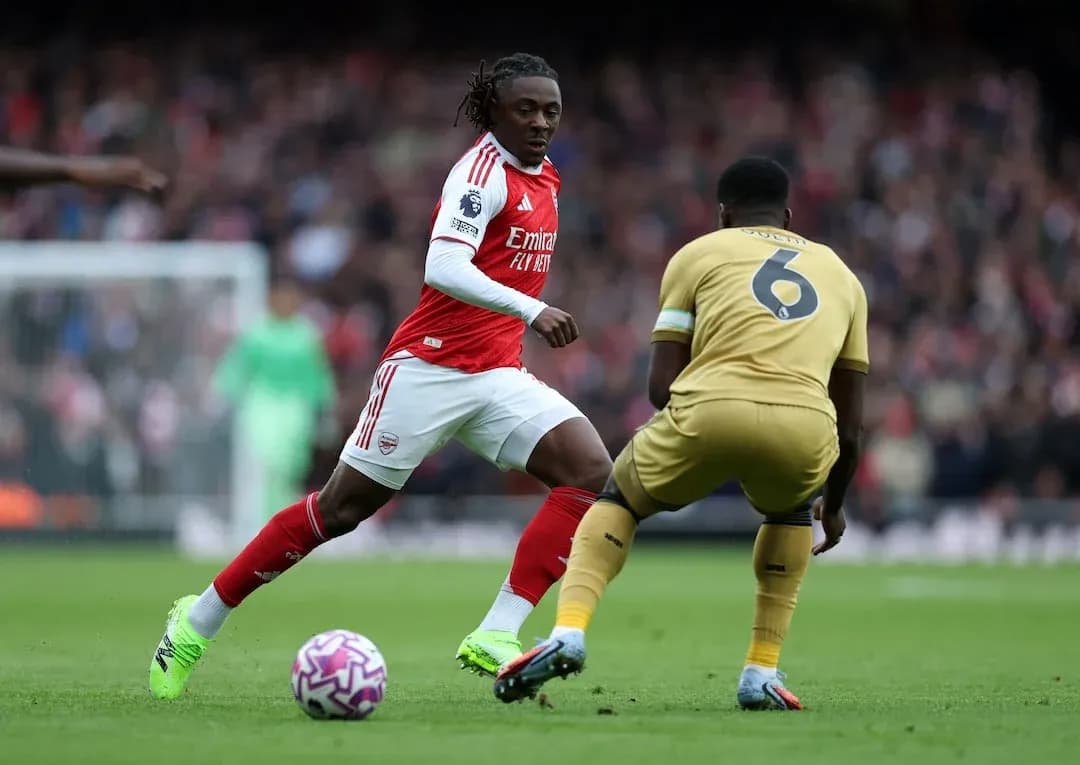
Arsenal, meanwhile, arrived as a finished article. Mikel Arteta opted for a 4-2-3-1, the secondary system to his season’s 4-3-3 but one that made sense against a back three. K. Arrizabalaga was shielded by a back four of M. Zubimendi, C. Mosquera, P. Hincapie and R. Calafiori. In front, C. Norgaard and M. Lewis-Skelly formed the double pivot, with N. Madueke, M. Dowman and G. Martinelli supporting Gabriel Jesus.
Heading into this game, Arsenal’s numbers on their travels were those of a ruthless, controlled machine: 11 away wins from 19, scoring 30 and conceding just 16. An away average of 1.6 goals for and 0.8 against framed them as a side that did not need volume of chances to decide contests, and 8 away clean sheets backed that up.
II. Tactical Voids – Absences and Edge
Both benches were shaped by who was missing rather than simply who was picked. For Palace, the absence of C. Doucoure (knee injury) and C. Richards (ankle injury) stripped depth and physicality from the spine. B. Sosa’s injury further weakened their options at wing-back, and the curious listing of E. Nketiah as a Palace absentee underlined a thin attacking roster behind J. S. Larsen and J. Mateta.
For Arsenal, the absences of J. Timber (ankle injury) and B. White (knee injury) removed two of Arteta’s most flexible defenders. That made the selection of Zubimendi as a nominal right-back and Calafiori on the left more revealing: Arsenal were prepared to accept a slightly makeshift back line in exchange for technical security in the first phase.
Disciplinary patterns across the season also coloured the risk profile. Palace’s yellow cards were spread, but with pronounced spikes: 18.42% of their yellows came between 31-45 minutes and another 18.42% between 46-60, plus 18.42% again from 76-90, pointing to a side that often has to foul to reset when pressure builds. Their reds were rare but telling, split evenly between 46-60 and 61-75 (one in each band), usually around the time legs tire and distances grow.
Arsenal’s bookings tilted heavily towards the final third of games: 21.57% of yellows between 61-75 minutes and 25.49% between 76-90. That late-game aggression is often the price of a high defensive line and sustained pressing, but with no red cards across the campaign, it is aggression under control.
III. Key Matchups – Hunter vs Shield, Engine Room vs Enforcer
The obvious “Hunter vs Shield” narrative belonged to V. Gyökeres, Arsenal’s 14-goal spearhead across the season, even though he started this one on the bench. His league profile – 41 shots, 22 on target, and 3 penalties scored from 3 – casts him as a penalty-box finisher who thrives on service rather than volume. When he enters, he attacks the space that Palace’s back three often leave when their wing-backs are forced deep.
Palace’s defensive “shield” was conceptually split between the starting trio and the looming presence of M. Lacroix on the bench. Over the season Lacroix blocked 18 shots and anchored Palace’s back line across 35 appearances, but Glasner’s choice of Clyne–Lerma–Riad here suggested a preference for mobility and build-up angles over pure aerial dominance. Without Lacroix from the start, Palace’s back line was more nimble but less imposing, a trade-off that plays into Arsenal’s quick combinations around the box.
In midfield, the “Engine Room” duel was subtle but decisive. For Palace, W. Hughes and D. Kamada were tasked with compressing central spaces and linking transitions to Sarr and Devenny. Kamada’s role, in particular, was to knit the first and second lines, providing calm progression against Arsenal’s press.
Opposite them, C. Norgaard and M. Lewis-Skelly offered different gears. Norgaard’s job was to screen Larsen, intercept into the half-spaces and recycle quickly; Lewis-Skelly’s was to carry and connect, turning regains into vertical thrust. This double pivot sat in front of a defence that, heading into this game, conceded just 0.7 goals per match overall and only 0.8 on their travels – numbers that speak to both structure and individual quality.
Out wide, G. Martinelli and N. Madueke stretched Palace’s 3-4-2-1 horizontally, pinning Munoz and Cardines back and denying Palace the licence to turn their wing-backs into wingers. Each time Palace tried to step their wide men higher, Arsenal threatened the channels behind them.
IV. Statistical Prognosis and xG Lens
While the raw Expected Goals figures are not provided, the season-long profiles allow a plausible tactical prognosis for how this 2-1 away win likely took shape. Arsenal, with an overall scoring average of 1.9 goals per match and 1.6 away, did not need to generate a flood of chances to hit their usual mark. Their defensive record – just 27 goals conceded in 38 matches – suggests that Palace’s route to an xG-heavy performance was always narrow: set-pieces, broken play, or the occasional direct ball into Larsen or, later, Mateta.
Palace’s own averages – 1.1 goals scored overall and 1.0 at home, against 1.3 conceded overall and 1.2 at home – point toward a match where their “ceiling” is a single goal unless Arsenal suffer a structural collapse. That did not happen. Instead, the champions likely controlled territory, kept Palace’s shots to low-value zones, and relied on the quality of Gabriel Jesus, Martinelli and the late introduction of players like V. Gyökeres or M. Ødegaard to tilt the xG balance.
Following this result, the numbers and the narrative align. Palace end the season as a resilient but limited 15th-placed side, defined by compact shapes and narrow margins. Arsenal walk away from Selhurst Park as worthy champions: 26 wins, 71 goals scored, and a defensive record that, even on their travels, rarely cracked. The 2-1 scoreline reads tight; the underlying tactical and statistical landscape suggests it was exactly the kind of controlled, slightly nervy win that titles are built on.