.svg&w=384&q=75 "Naijagoal logo")

Switzerland Dominates Algeria with Tactical Brilliance
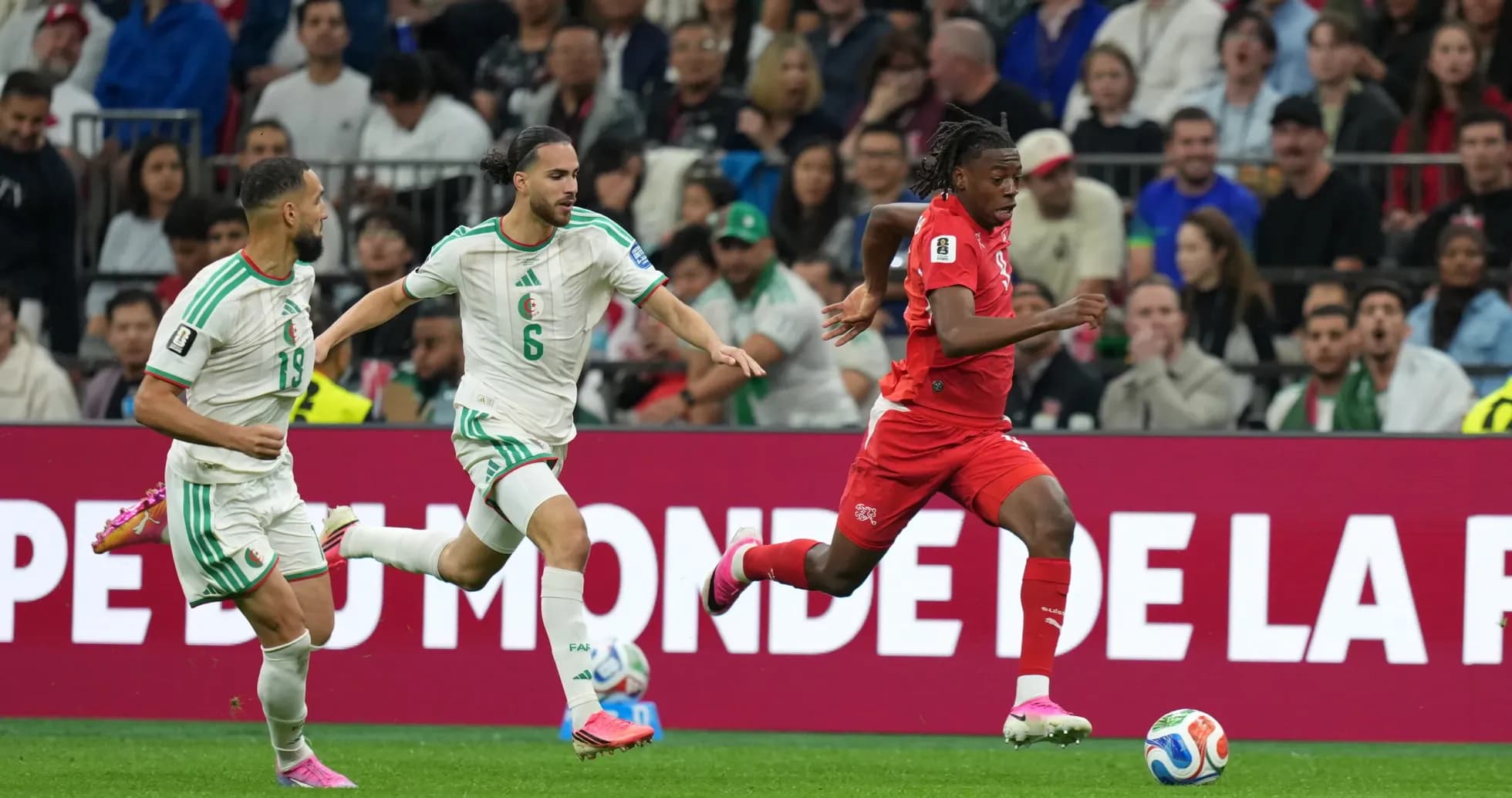
Switzerland’s 2-0 victory over Algeria at BC Place was a clinic in controlled, efficiency-first knockout football, built on a compact 4-2-3-1 structure and ruthless exploitation of key moments rather than territorial dominance. Despite ceding 55% possession and facing a technically gifted Algerian midfield, Murat Yakin’s side dictated where the game was played and how dangerous it became.
Out of possession, Switzerland’s 4-2-3-1 was extremely narrow and vertically well-connected. Granit Xhaka and Remo Freuler formed a disciplined double pivot in front of a back four of Ricardo Rodríguez, Manuel Akanji, Nico Elvedi and Denis Zakaria. The wide trio of Rubén Vargas, Johan Manzambi and Dan Ndoye consistently tucked inside, closing Algerian passing lanes into the half-spaces and forcing play toward the flanks. This compactness explains how Algeria could complete 476 accurate passes at 85% yet produce only 8 shots and 0.73 xG: they circulated the ball, but were repeatedly denied central progression into genuinely threatening zones.
Switzerland’s attacking plan revolved around rapid vertical transitions and early use of their central striker. The opening goal on 10 minutes encapsulated the idea: Breel Embolo dropped and spun into space, with Manzambi connecting play between the lines before Embolo finished to give Switzerland the 1-0 platform they wanted. With only 45% possession, Switzerland still generated 11 shots, 9 from inside the box, and 2.56 xG. The shot profile shows how well their structure converted fewer phases of possession into high-quality entries: whenever they broke Algeria’s first line, runners from the “3” line (Vargas, Manzambi, Ndoye) surged into the channels, pinning the Algerian back four and isolating defenders in wide 1v1s.
The second goal, scored by Ndoye just after the interval at 46’, was tactically decisive. Coming immediately at the start of the second half, it punished Algeria’s attempt to push their defensive line higher and commit more numbers forward. Switzerland’s ability to strike so early after the restart suggests a deliberate emphasis from Yakin on aggressive first minutes in each half: pressing triggers were sharper, and the front four attacked space behind Algeria’s full-backs before the North Africans could re-establish their rest-defense structure.
Defensively, Switzerland’s back line was notably clean in its box management. With only 2 blocked shots and 10 fouls overall, they defended more by positioning and anticipation than by last-ditch interventions. Akanji and Elvedi controlled depth, stepping out early to prevent Ibrahim Maza or Houssem Aouar from receiving on the half-turn between the lines. Zakaria, nominally a right-back, often narrowed to form a three in the first phase, giving Rodríguez license to step slightly higher on the opposite side and assist in ball progression.
In goal, Gregor Kobel (Switzerland) was rarely overworked but remained reliable, making 2 saves. The low save count is less a reflection of passivity and more evidence of how well the block in front of him restricted Algeria’s shot volume and angles. At the other end, Luca Zidane (Algeria) also recorded 2 saves, but the underlying numbers (Switzerland’s 2.56 xG) show that the chances he faced were generally of higher quality; the negative goals prevented figure for Algeria underlines that the Algerian goalkeeper unit underperformed relative to shot difficulty.
Vladimir Petkovic’s Algeria lined up in a 4-3-3 with Ramiz Zerrouki, Nabil Bentaleb and Farès Chaïbi in midfield, and a front three of Riyad Mahrez, Ibrahim Maza and Houssem Aouar. On paper this offered technical superiority and central overloads, and in practice it delivered control of the ball and territory. But the structure had flaws in rest defense and vertical protection. With full-backs Rayan Aït-Nouri and Rafik Belghali encouraged to advance, Algeria often left large spaces beside Aïssa Mandi and Ramy Bensebaini. Switzerland repeatedly targeted these channels with Embolo’s diagonal runs and Ndoye’s surges from the right, particularly in transition.
Algeria’s 8 total shots, with 5 inside the box, indicate they did occasionally manage to access dangerous zones, but the lack of clear, repeated patterns in the final third was evident. Much of their threat depended on individual actions from Mahrez or Aouar rather than structured combinations. Switzerland’s midfield duo stayed tight to Zerrouki and Bentaleb, preventing them from stepping forward into shooting positions or playing line-breaking passes with time and space. When Algeria tried to compensate by pushing Chaïbi higher, they lost some of their central stability, making them even more vulnerable to Swiss counters.
The substitution pattern reinforced the tactical story. At 58’, Petkovic introduced Jaouen Hadjam (IN) for Houssem Aouar (OUT) and Amine Gouiri (IN) for Ramiz Zerrouki (OUT), effectively rebalancing his side with more attacking profiles and a fresh forward. Later, Anis Hadj Moussa (IN) replaced Riyad Mahrez (OUT) and Hicham Boudaoui (IN) came on for Nabil Bentaleb (OUT) at 71’, while Adil Boulbina (IN) entered for Rafik Belghali (OUT) at 82’. These moves tilted Algeria even more toward attack but further compromised their defensive structure, with Switzerland content to drop slightly deeper, protect the box and counter selectively.
Yakin’s changes were aimed at energy management and preserving structural integrity. Fabian Rieder (IN) came on for Vargas (OUT) and Noah Okafor (IN) for Manzambi (OUT) at 71’, adding fresh legs in the wide and central attacking lanes to keep Algeria honest in transition. Later, Zeki Amdouni (IN) replaced Embolo (OUT) at 83’, and Silvan Widmer (IN) for Zakaria (OUT) plus Michel Aebischer (IN) for Ndoye (OUT) at 87’ allowed Switzerland to close the game with renewed defensive intensity on the flanks and in the half-spaces, without altering the basic 4-2-3-1 shell.
Discipline also played a subtle tactical role. Algeria collected 2 yellow cards, both reflecting moments where Swiss transitions or duels forced reactive defending: at 36’, Farès Chaïbi (Algeria) — Tripping, and at 72’, Hicham Boudaoui (Algeria) — Roughing. Switzerland, by contrast, committed 10 fouls but avoided bookings, a sign of well-timed, mostly tactical infringements rather than reckless challenges.
Statistically, the contrast between possession and chance quality is stark. Algeria’s 55% of the ball, 561 total passes and 85% accuracy paint the picture of a team comfortable in circulation but lacking penetration. Switzerland, with 436 passes at 81% and just 45% possession, engineered more incisive attacks: 11 shots to Algeria’s 8, and 5 shots on goal versus 2. The 2.56 xG to 0.73 split underlines that this was not a smash-and-grab but a structurally sound performance where Switzerland’s game plan — compact mid-block, vertical transitions, and intelligent use of their attacking quartet — systematically produced better chances.
In the context of a World Cup Round of 32 tie, this match will be remembered as a demonstration of how a side can allow the opponent the ball yet dominate the scoreboard through superior spacing, clearer attacking patterns and more coherent defensive organization. Switzerland advanced because their 4-2-3-1 was not just a formation on paper, but a coordinated system that controlled risk, maximized the value of each attack, and left Algeria’s possession-heavy 4-3-3 largely sterile where it mattered most.