.svg&w=384&q=75 "Naijagoal logo")

Egypt Edges Past Australia in World Cup Quarter-Finals Drama
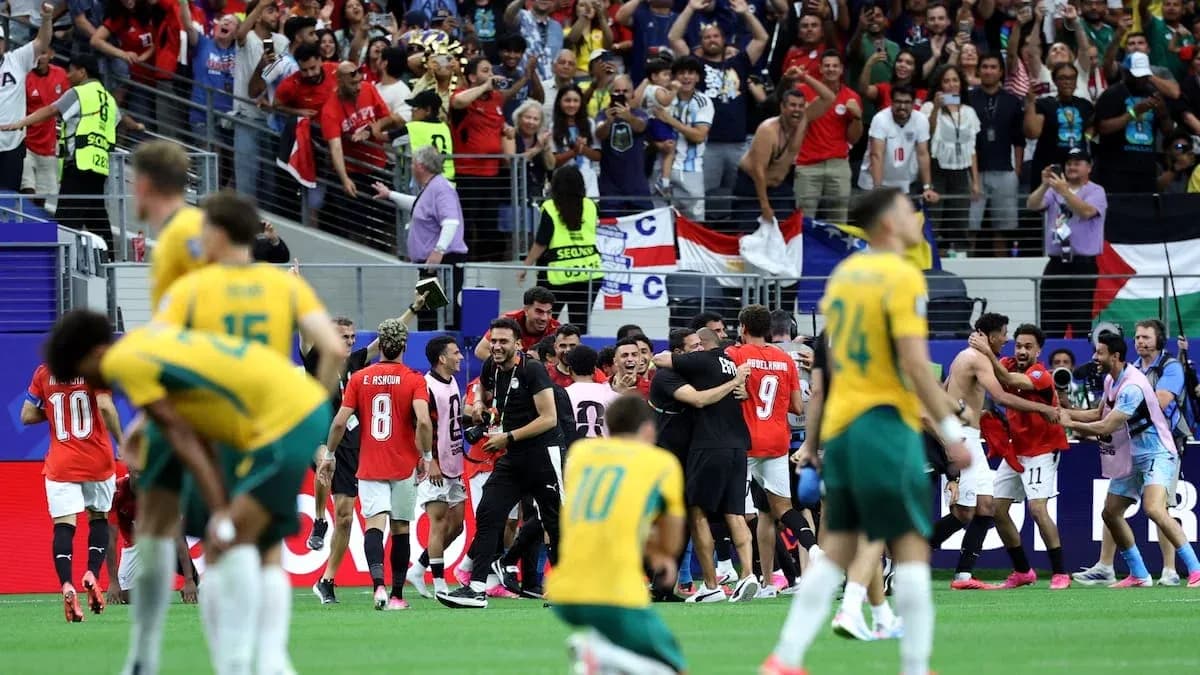
Egypt held their nerve from the spot to edge past Australia and reach the World Cup quarter-finals, on a night when the drama refused to loosen its grip until the very last kick.
A shootout under fire
Tony Popovic played his final card in the most brutal of lotteries. As extra time ticked away, he hauled off his starting goalkeeper and sent on Mathew Ryan, banking on the veteran’s experience to tilt the penalty shootout Australia’s way.
It did not start as planned.
Harry Souttar strode up first, in front of a wall of Egypt fans and a blizzard of whistles. The defender, usually so assured, lashed his kick over the bar. Advantage Egypt. The Socceroos were chasing from the very first strike.
Every taker that followed found the net, the tension cranking higher with each step and strike. Mohamed Salah, who had laboured for most of the night, walked forward with the stadium holding its breath. His response was ice-cold, a composed finish that underlined why he remains Egypt’s reference point, even when short of full fitness.
Australia clung on, penalty after penalty, until the moment the pressure finally broke through. Lucas Herrington, just 18 and carrying a nation’s hopes on young shoulders, crashed his effort against the bar. One more accurate Egyptian kick would end it.
Abdelmaguid delivered. He rolled his penalty home, sending Egypt through and sending Salah to his knees in tears of joy, while Australian players sank to the turf, hearts broken.
Egypt strike first, against the flow
The contest had begun with Australia on the front foot. Within five minutes, Cristian Volpato – the playmaker who chose the green and gold over Italy on the eve of this World Cup – rattled the top of the crossbar with a fierce effort. It was an early warning that Popovic’s side were not content to sit back.
Egypt, fresh from their first ever World Cup win in the group stage against New Zealand, looked jittery at the back. Yet they were the ones who landed the first blow.
Slightly against the run of play, Hossam Hassan’s team pieced together the move that changed the tone. Nestory Irankunda lost track of Emam Ashour at the far post, and Karim Hafez whipped in a teasing cross. Ashour met it with a firm header after 13 minutes, his second goal of the tournament, and Egypt were in front inside the cavernous, air-conditioned home of the Dallas Cowboys.
For an Australia side that had scored only twice in the group phase, the early goal set an awkward challenge. They had to chase, in front of 70,000 fans, against seven-time African champions who suddenly had something to protect.
Attrition, injuries and a subdued Salah
The first half became a grind. Australia struggled to turn territory into clear chances. Their first effort on target did not arrive until 10 minutes before the interval, when Aziz Behich stepped forward from full-back and drove a tame shot straight at Mostafa Shoubir.
There was a neat twist in that moment: Shoubir’s father, Ahmed, had played in goal for Egypt at the 1990 World Cup. Now the next generation was trying to guide his country into uncharted territory.
Salah, 34 and nursing a hamstring strain from Egypt’s previous match, hovered on the fringes. His presence alone unsettled defenders, but the familiar bursts of acceleration, the sharp cuts inside, were largely missing in an attritional opening 45 minutes.
The half ended with another blow for Australia. Jordan Bos, one of the quickest players at this tournament, was wiped out by a robust, flying challenge from Rabia. The wing-back stayed down, then had to be helped from the pitch. He did not reappear after the break, with Kai Trewin sent on in his place. For a side already light on cutting edge, losing such a powerful runner hurt.
A wild swing after the restart
Within seconds of the restart, Egypt should have tightened their grip. Omar Marmoush, the Manchester City attacker, found himself sliding in at close range, only to steer the ball wide when it looked easier to score. A let-off for Australia, and a moment that would quickly grow in significance.
Hassan had warned about Australia’s physicality before the game. His concern was justified. The Socceroos leaned into set-pieces, into duels, into every aerial ball. The pressure told on Mohamed Hany.
From an in-swinging free-kick, Hany – under heavy pressure – mistimed his header and diverted the ball into his own net 10 minutes after half-time. It was his second own goal of the tournament, and it dragged Australia level from nowhere.
The equaliser changed the mood entirely. Both teams suddenly sensed the same thing: history. Neither Egypt nor Australia had ever won a knockout match at a men’s World Cup. Ninety minutes would not be enough to separate them.
Egypt finish stronger, but can’t finish it
As the clock wound down, Egypt began to assert themselves again. Salah remained on the periphery in open play but still knitted moves together in flashes. One such passage almost settled it deep into added time, only for Australian goalkeeper Patrick Beach to spring to his right and beat away Ramy’s effort with an excellent, athletic save.
That stop dragged the tie into extra time, but the pattern stayed the same. Egypt carried the greater threat. Salah finally found a pocket of space early in the additional 30 minutes, only to blaze over with his weaker right foot. The chance went, and with it any realistic hope of settling the match without the ordeal of penalties.
By then, penalties felt inevitable.
A night that will linger
So it came down to the spot, to Souttar’s miss, to Herrington’s bar-rattler, to Salah’s calm, and Abdelmaguid’s decisive kick. Australia’s late gamble on Ryan did not pay off. Egypt, who had waited so long just to win a World Cup match, now have a knockout victory as well.
Salah, largely muted in the contest itself, still walked away as one of the night’s defining figures – not for a wonder goal from open play, but for the nerve he showed when the entire stadium turned its gaze on him.
Australia depart with regrets: the early dominance, the missed chances, the self-inflicted damage of an own goal and lapses in concentration. Egypt move on, battle-hardened and buoyed by breaking new ground.
The question now is simple: having finally learned how to win on this stage, just how far can this Egypt side go?