.svg&w=384&q=75 "Naijagoal logo")

USA Dominates Bosnia & Herzegovina in World Cup Knockout Match
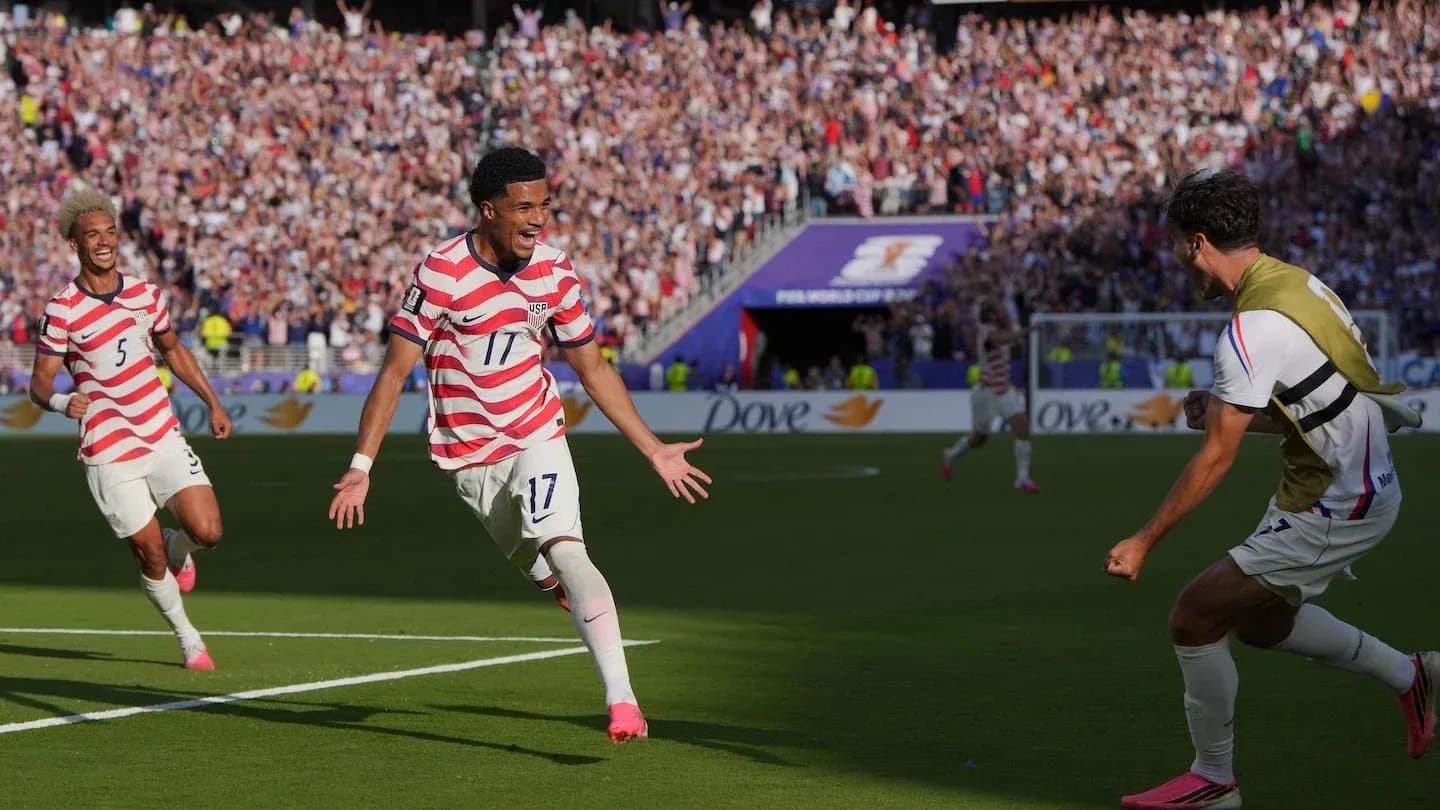
Levi’s Stadium, under knockout lights, staged a meeting of two very different footballing identities. In the Round of 32 of the World Cup, USA arrived as a front‑foot, high‑scoring group winner from Group D; Bosnia & Herzegovina came through a more attritional Group B path, hardened by setbacks but still dangerous. The 2–0 final score to USA reflected not just a good night, but the continuation of deeper seasonal trends.
USA's Season Profile
Heading into this game, USA’s season profile was that of an aggressive host. Overall they had played 4 matches, winning 3 and losing 1, with no draws. At home they had been perfect: 3 wins from 3, scoring 8 and conceding just 1. That gave them a home scoring average of 2.7 goals per game and only 0.3 conceded, a defensive platform that framed this tie. Across all venues, USA’s 10 goals for and 4 against produced a goal difference of +6, underlining how often their attacking ambition had been rewarded.
Bosnia & Herzegovina's Fragile Balance
Bosnia & Herzegovina arrived with a more fragile balance. Overall they had played 4 matches, with 1 win, 1 draw and 2 defeats. At home they had been potent, scoring 3 and conceding 1, but on their travels the picture was starkly different: 3 away games, no wins, 2 losses, 1 draw, just 2 goals scored and 7 conceded. That away average of 0.7 goals for and 2.3 against set the tone for a side that would likely defend deep and counter, especially against a USA team so comfortable dictating at home.
Tactical Lineups
The tactical chessboard was clear from the lineups. Mauricio Pochettino’s USA chose a 4‑3‑3, a shape that has been a core part of their World Cup identity. M. Freese started in goal behind a back four of S. Dest, C. Richards, T. Ream and A. Robinson. In front of them, the midfield trio of W. McKennie, T. Adams and M. Tillman offered a blend of control, pressing and vertical running. The front three of S. Dest advanced high on the right, F. Balogun through the middle and C. Pulisic from the left signalled USA’s intent to stretch Bosnia & Herzegovina horizontally and vertically.
Opposite them, Sergej Barbarez shifted Bosnia & Herzegovina into a 5‑3‑2, a clear response to USA’s wide threats. N. Vasilj anchored a five‑man defensive line of A. Dedic, N. Katic, T. Muharemovic, S. Radeljic and S. Kolasinac. In midfield, A. Gigovic, I. Sunjic and K. Alajbegovic formed a compact triangle tasked with screening central spaces and tracking USA’s midfield runners. Up front, the pairing of E. Dzeko and E. Demirovic offered a classic “target and runner” dynamic for counters and set‑pieces.
Absences and Continuity
The absences list underlined the quiet compromises behind USA’s bold shape. M. McKenzie (bruised foot) and C. Roldan (muscle bruise) were both ruled out. Neither is a headline star, but their versatility would have given Pochettino extra options to rotate at centre‑back and in midfield. Instead, the coach doubled down on continuity: the 4‑3‑3 had already been used twice this tournament, and here it was again, leaning into familiarity rather than experimentation.
Disciplinary Trends
Disciplinary trends also framed the risk landscape. USA’s season card profile showed a tendency to pick up yellow cards in the 16–30 minute window (20.00%) and then again between 46–60 minutes (40.00%), with a further 20.00% in the final 15 of normal time and 20.00% in early extra time. Their single red card this campaign had come in the 61–75 minute band, a reminder that their intensity can sometimes spill over just as matches enter the decisive phase. Bosnia & Herzegovina, by contrast, were at their most combustible late: 37.50% of their yellow cards had come between 76–90 minutes, and their only red card arrived in that same 76–90 band. In a knockout setting, that late‑game volatility was always likely to be a factor if they were chasing.
Key Battles
Within this framework, the “Hunter vs Shield” duel centred on F. Balogun against Bosnia & Herzegovina’s away defence. Overall, Balogun had 3 goals from 3 appearances, built on 8 shots (4 on target) and a rating of 7.23. He had drawn 7 fouls and committed 3, living constantly on the edge of duels, and his card profile was notable: 1 yellow and 1 red, an attacker who plays with real edge. Bosnia & Herzegovina’s away defence, meanwhile, had allowed 7 goals in 3 matches, with their biggest away defeat a 4–1 loss. Structurally, their five‑man line in this match tried to crowd Balogun’s space, but his movement between N. Katic and T. Muharemovic, plus the service from Pulisic and Dest, always threatened to pry open a unit that had struggled away from home all tournament.
On the other side, the “Engine Room” battle was defined by USA’s double pivot of Adams and McKennie against Bosnia & Herzegovina’s central trio. Adams, sitting deepest, was tasked with shutting down the direct balls into Dzeko’s feet and the second‑ball chaos that Demirovic thrives on. McKennie and Tillman, alternating their forward runs, targeted the channels beside A. Gigovic and K. Alajbegovic, trying to drag Bosnia & Herzegovina’s midfield out of its compact shell. For Bosnia & Herzegovina, Sunjic’s role as enforcer was crucial: break USA’s rhythm, slow transitions, and prevent Pulisic from receiving on the half‑turn in central pockets.
Defensive Structures
Defensively, USA’s numbers had suggested a robust structure heading into this tie: overall they had conceded 4 goals in 4 matches, an average of 1.0 per game, but at home just 1 goal in 3, reflecting how their pressing and territorial dominance sharpened on familiar ground. Bosnia & Herzegovina’s overall 8 goals conceded in 4 matches, and particularly their 7 conceded away, painted them as vulnerable when forced to defend for long stretches. Their lack of any clean sheet this campaign, home or away, was always going to be tested by a USA side that had failed to score in none of their matches.
Disciplinary Subplot
The disciplinary subplot added another layer. F. Balogun, who also appeared among the leading red‑card recipients, embodies USA’s fine line between aggression and overreach. On the Bosnia & Herzegovina side, T. Muharemovic had also collected a red card this tournament despite an otherwise solid defensive profile: 157 passes at 84% accuracy, 8 interceptions and 1 successful block. His duel with Balogun was as much psychological as technical; any mistimed challenge risked repeating that costly dismissal pattern, especially given Bosnia & Herzegovina’s tendency to collect cards late when fatigue and scoreboard pressure bite.
Statistical Prognosis
From a statistical prognosis standpoint, the contours were clear before a ball was kicked. USA’s home scoring rate of 2.7 and defensive concession of 0.3 at Levi’s Stadium‑type settings, combined with Bosnia & Herzegovina’s away record of 0.7 scored and 2.3 conceded, pointed towards a game tilted heavily in USA’s favour, both territorially and in chance volume. With neither side having taken or missed a penalty this tournament, the margins were always more likely to be decided in open play patterns and set‑piece execution rather than from the spot.
Conclusion
In the end, the 2–0 scoreline aligned almost perfectly with the underlying profiles. USA’s attacking trident, underpinned by a disciplined midfield and a back four comfortable in both build‑up and recovery, overpowered a Bosnia & Herzegovina side whose five‑man defence could not fully mask their away‑day frailties. The Round of 32 thus became less an upset stage and more a confirmation: USA’s high‑octane, front‑foot football is built on solid statistical foundations, while Bosnia & Herzegovina’s journey ends with the same story that shadowed them all tournament — brave in moments, but too porous when forced to survive for 90 minutes away from home.