.svg&w=384&q=75 "Naijagoal logo")

Spain Defeats Portugal 1-0 in World Cup Showdown
Portugal’s 0-1 defeat to Spain at AT&T Stadium in this World Cup Round of 16 tie was defined by Spain’s territorial control and superior chance quality, set against Portugal’s more direct, star-driven approach that never quite turned pressure into clear shots. The late winner from Mikel Merino crystallised patterns that had been visible all night: Spain’s midfield structure gradually grinding Portugal down, and Portugal’s attacking unit becoming increasingly stretched and disconnected as they chased transitions.
Spain’s overall blueprint was possession-based control: 55% of the ball, 531 passes with 467 accurate (88%), and a shot profile of 15 attempts, 6 on goal, 8 from inside the box. The xG split — 1.77 for Spain versus 0.58 for Portugal — underlines that this was not sterile domination but control that produced sustained penalty-box presence. Rodri’s anchoring role in front of Pau Cubarsí and Aymeric Laporte allowed Spain to hold a high line and compress the pitch, with Marc Cucurella and Pedro Porro providing width and rest-defense positions to smother Portuguese counters early.
Portugal, by contrast, leaned on verticality and individual talent. They produced 10 total shots, 2 on goal, with 7 inside the box, but the quality of those looks was generally low and often under pressure. Bruno Fernandes, João Félix and Pedro Neto tried to find Cristiano Ronaldo early with direct passes and crosses, yet Spain’s back four, supported by Rodri’s screening, kept most of Portugal’s final-third play in front of them. The 45% possession figure and 426 passes (357 accurate, 84%) show Portugal were not overrun, but they were reactive — their best moments came when they could break Spain’s structure rather than build through it.
Substitution Patterns
The substitution pattern from Roberto Martinez reinforced a shift from balanced control to all-out wing threat. On 56', Nélson Semedo (IN) came on for Nuno Mendes (OUT), tilting the right side towards more aggressive overlapping and earlier deliveries. The double change on 71' — Diogo Dalot (IN) for João Cancelo (OUT) and Rafael Leão (IN) for João Félix (OUT) — was a clear attempt to inject direct dribbling and pace down both flanks. Later, at 83', Bernardo Silva (IN) for Vitinha (OUT) and Francisco Conceição (IN) for Pedro Neto (OUT) converted the midfield into more of a creative carousel around Ronaldo, sacrificing some central stability for final-third craft.
These changes did increase Portuguese width and crossing threat, but they also played into Spain’s comfort defending a succession of slightly rushed attacks. Spain committed 13 fouls to Portugal’s 9, a sign of how often they were willing to break up transitions early rather than allow Portugal to run at their back line in space. The fact that Portugal still only managed 2 shots on target despite this more open, transition-heavy second half shows how well Spain controlled the zones just outside their box.
Spain’s Substitutions
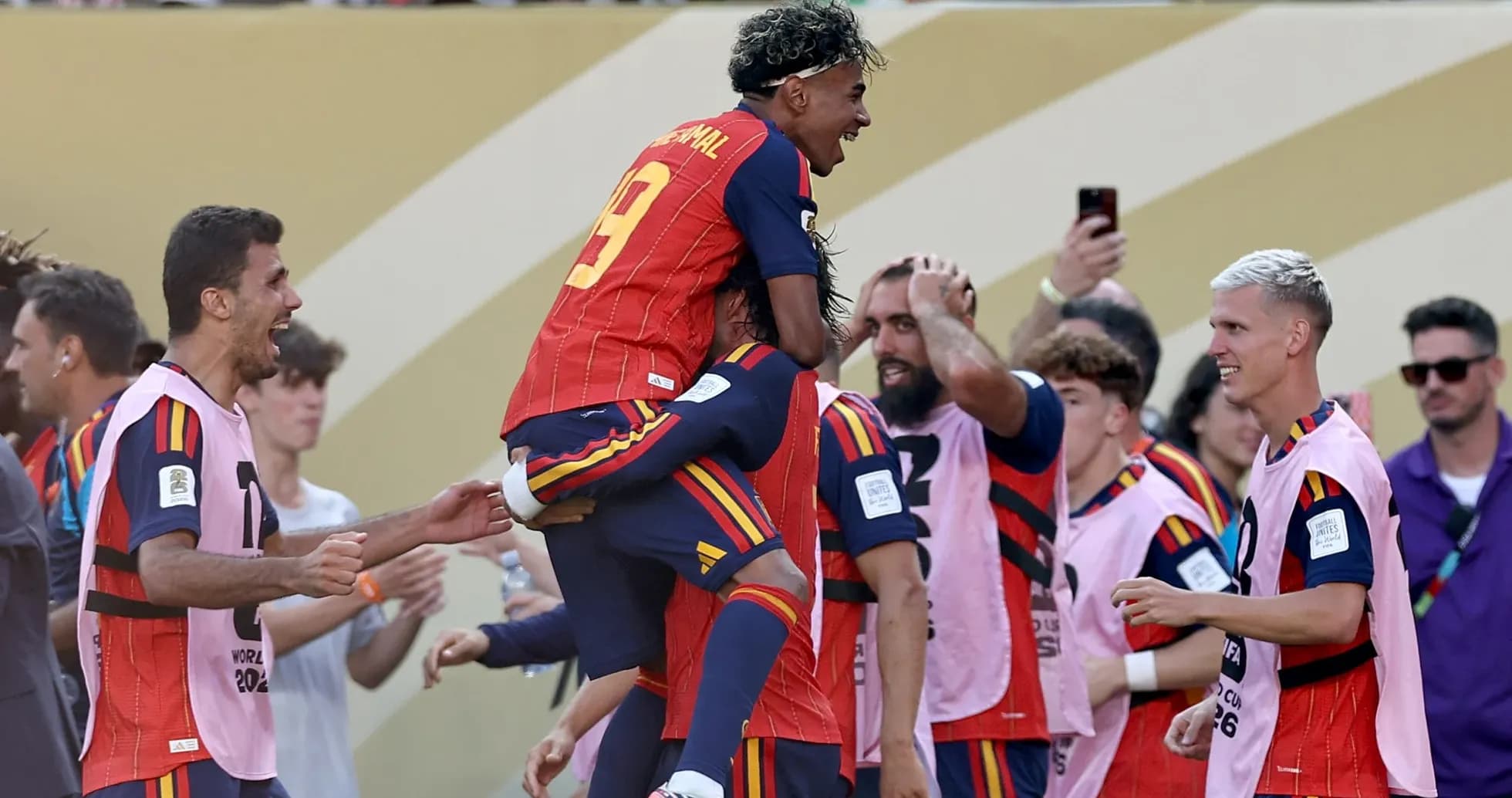
Luis de la Fuente’s substitutions were more about refreshing the same structure than changing it. At 75', Ferran Torres (IN) replaced Alex Baena (OUT), adding a more vertical runner between the lines and in behind. On 85', Mikel Merino (IN) came on for Dani Olmo (OUT) and Fabián Ruiz (IN) for Pedri (OUT), injecting fresh legs and aerial presence in the left half-space and central midfield. The decisive moment came from this reshaped midfield: at 90+1', Mikel Merino (Spain) arrived to score, assisted by Ferran Torres, rewarding Spain’s consistent occupation of the Portuguese box and their superior xG profile. At 90', Borja Iglesias (IN) replaced Mikel Oyarzabal (OUT), a late move aimed at holding the ball up and defending from the front in the dying minutes.
Defensively, both back lines were largely sound, each side registering 3 blocked shots. Portugal’s defensive block, anchored by Rúben Dias and Renato Veiga, held Spain at 0-0 until stoppage time, but the cumulative pressure of Spain’s 8 shots inside the area and their territorial edge eventually told. Spain’s back four, meanwhile, handled Ronaldo and the rotating cast around him with composure, with help from the midfield’s counter-press to prevent Portugal from combining centrally.
In goal, Diogo Costa (Portugal) was a key reason the match stayed goalless for so long. He made 5 saves and, crucially, posted 0.87 goals prevented against Spain’s 1.77 xG — a clear indicator that he outperformed the average expectation on the chances faced and kept Portugal alive deep into stoppage time. At the other end, Unai Simón (Spain) had a quieter but solid night, making 2 saves. Spain’s defensive structure meant he was rarely exposed to clear one-on-ones, and Portugal’s xG of 0.58 reflects how few truly clean looks they generated.
Discipline and Statistics
Discipline also mirrored the tactical story. Portugal collected 2 yellow cards — Bernardo Silva and Renato Veiga, both for “Foul” in the closing minutes — as they pushed higher and became more stretched trying to win the ball back. Spain took 1 yellow, Ferran Torres also for “Foul” at 90+9', emblematic of their willingness to disrupt play and protect the lead.
Statistically, Spain’s victory is strongly supported by the underlying numbers. They led in possession (55% to 45%), total shots (15 to 10), shots on goal (6 to 2), corners (7 to 3), and xG (1.77 to 0.58). Both teams had 3 blocked shots, but Spain’s higher volume and better locations meant they were consistently closer to scoring. Portugal’s passing was tidy but less progressive, and their late attacking reshuffle, while dangerous in moments, never truly bent the shot-quality balance in their favour.
In tactical terms, this was a match where Portugal’s star-driven, transition-focused plan nearly dragged the game to extra time, but Spain’s superior structure, bench management, and sustained occupation of the final third eventually produced the decisive action. The late Merino goal was not a smash-and-grab; it was the logical endpoint of Spain’s cumulative pressure against a Portugal side that ran out of ways to connect their attacking talent to high-quality chances.