.svg&w=384&q=75 "Naijagoal logo")

Saudi Arabia and Uruguay Open World Cup 2026 with 1–1 Draw
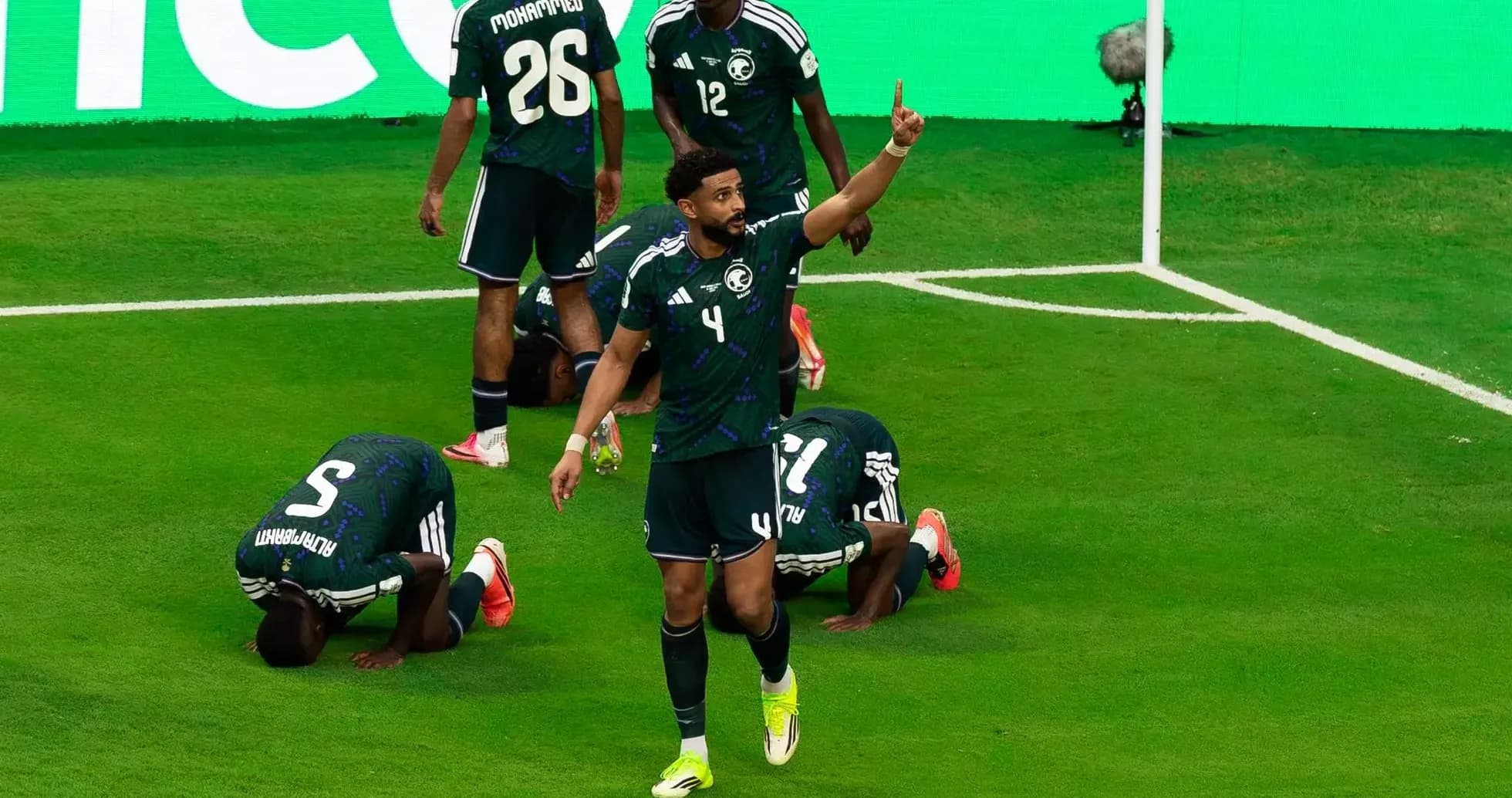
Under the Miami night at Hard Rock Stadium, Saudi Arabia and Uruguay opened their World Cup 2026 stories with a 1–1 draw that felt more like a prologue than a conclusion. In Group H, both sides emerge from this first chapter level on points, level on goal difference, and yet carrying very different tactical questions into the rest of the group.
I. The Big Picture – contrasting blueprints in the heat
Heading into this game, the numbers painted both teams as unknown quantities rather than fully formed contenders. Saudi Arabia came in with a pure home profile: 1 match played, at home, yielding 1.0 goals scored and 1.0 conceded on average. Uruguay, by contrast, had only traveled: 1 away game, also returning 1.0 goals for and 1.0 against. The symmetry in their statistical DNA foreshadowed the deadlock that followed.
Georgios Donis set Saudi Arabia up in a 4-4-2 that was as much about emotional control as it was about tactical order. The lines were tight, the distances small, the emphasis on collective work without the ball. Marcelo Bielsa answered with a 4-2-3-1, the familiar Bielsa structure built on verticality, high pressing and an aggressive use of the half-spaces. If Saudi Arabia sought to compress the game, Uruguay wanted to stretch it until it snapped.
With both sides finishing their opening fixture at 1 point and a goal difference of 0 (1 goal for, 1 against overall), the table shows them neck and neck: Uruguay ranked 1st in Group H, Saudi Arabia 2nd, separated only by tiebreak nuance rather than substance.
II. Tactical Voids – discipline, fatigue, and what was missing
The data brings no explicit list of absentees, but the patterns on the pitch hinted at what each side lacked. For Saudi Arabia, the void was not a missing name but a missing reference point in the final third. F. Al Buraikan and M. Al Juwayr formed the front two, but neither operated as a classic target man; instead, they drifted, pulled wide, and dropped short. Without a fixed pivot, Saudi Arabia’s transitions sometimes fizzled, forcing S. Al Dawsari to carry too much creative burden from the left of midfield.
Uruguay’s tactical void was of a different nature. The 4-2-3-1, with D. Nunez leading the line and a trio of F. Valverde, F. Vinas, and M. Araujo behind him, promised relentless pressure between the lines. Yet without a pure penalty-box poacher constantly occupying the centre-backs, their territorial dominance did not always translate into clear, repeatable chances.
Disciplinary trends added another layer. Heading into this game, Saudi Arabia’s only yellow card of the campaign had arrived in the 31–45’ window, a 100.00% concentration of bookings in that late first-half band. It spoke of a team that tightens the screws as the interval approaches, sometimes overstepping the line to protect a lead or break rhythm. Uruguay, by contrast, had no recorded yellow or red cards in any time range so far, suggesting either control in the challenge or a willingness to defend space rather than dive into tackles.
In Miami, that contrast was visible: Saudi Arabia’s back four, led by H. Tambakti and A. Al Amri, defended aggressively on the front foot, while Uruguay’s defensive unit – G. Varela, S. Caceres, M. Olivera, and M. Vina – often preferred to delay, contain, and trust the double pivot of M. Ugarte and R. Bentancur to intercept rather than lunge.
III. Key Matchups – Hunter vs Shield, Engine Room vs Enforcer
The central duel of this fixture lived where Bielsa always wants it: between Uruguay’s attacking line and Saudi Arabia’s defensive shield.
Hunter vs Shield: D. Nunez vs Saudi Arabia’s central defence
Nunez, as the lone forward, was the spearhead of Uruguay’s away attack that averages 1.0 goals per game on their travels. His movement into the left channel tried to drag Tambakti out of the line, creating gaps for late runners like Valverde and Vinas. Yet Saudi Arabia, who at home also concede 1.0 goals on average, managed to hold that line with impressive composure. Tambakti and Al Amri rarely overcommitted; they stayed compact, forcing Nunez to receive with his back to goal rather than sprinting into open grass.
Engine Room: M. Kanno vs M. Ugarte and R. Bentancur
If the scoreboard was balanced, the midfield battle was a rolling storm. M. Kanno, positioned centrally in Saudi Arabia’s 4-4-2, became the hinge between defence and attack. His job was brutal and simple: disrupt Uruguay’s rhythm, then find S. Al Dawsari or M. Abu Al Shamat early in transition. Against him, Ugarte and Bentancur formed a double pivot designed to suffocate counters at their source. Ugarte’s reading of second balls and Bentancur’s ability to step past the first Saudi line meant Uruguay could recycle pressure in waves.
This clash in the engine room shaped the tempo. When Kanno won his duels, Saudi Arabia could spring quickly, often targeting the channels for Al Buraikan. When Ugarte and Bentancur imposed themselves, Uruguay pinned Saudi Arabia back, with Valverde drifting inside from his advanced midfield role to overload central spaces.
Out wide, S. Abdulhamid and M. Al Harbi had to survive long spells against Uruguay’s advanced full-backs and wide midfielders. Varela and Vina pushed high, almost as auxiliary wingers, trying to stretch the Saudi block horizontally. The fact that Saudi Arabia still emerged with only 1 goal conceded – matching their home average of 1.0 against – was a testament to the discipline of the entire back four and the work rate of the wide midfielders, particularly Al Dawsari tracking deep.
IV. Statistical Prognosis – what this draw really says
Following this result, both teams share an identical statistical profile in the group: 1 match played, 1 draw, 1 goal scored, 1 conceded, goal difference 0, and 0 clean sheets. Saudi Arabia at home and Uruguay away both average 1.0 goals for and 1.0 against, suggesting that, at least at this early stage, neither side has yet carved out a distinct identity as either a free-scoring force or a defensive fortress.
The lack of penalties for both teams – 0 taken, 0 scored, 0 missed – hints at attacks that rely more on open-play combinations than constant box incursions. For Saudi Arabia, the absence of clean sheets and the concentration of yellow cards in the 31–45’ window underline the fine margins they walk when protecting their box late in the half. For Uruguay, the spotless disciplinary record but similar defensive numbers suggest a side that defends primarily through structure and pressing triggers rather than last-ditch interventions.
From an Expected Goals perspective – even without raw xG values in the data – the patterns are clear. Uruguay’s volume of possession and territorial control, driven by their 4-2-3-1, likely produced a higher xG total, but Saudi Arabia’s compact 4-4-2 ensured that many of those shots came from less-than-ideal locations. Conversely, Saudi Arabia’s attacks were fewer but more transition-based, the kind of breakaways that often generate high-quality chances even from limited volume.
The tactical verdict is that this 1–1 is less a stalemate and more a statement of balance. Saudi Arabia proved that their structure and collective work can blunt a high-octane, Bielsa-led side, while Uruguay demonstrated that their pressing and midfield control can dominate territory even when the scoreboard does not fully reward them.
As Group H unfolds, the question is which team will bend these symmetrical numbers in their favour. If Saudi Arabia can add a sharper edge to their front two without loosening the back four, their home average of 1.0 goals for could rise without a corresponding spike in goals against. If Uruguay can convert their structural dominance into cleaner, central chances for Nunez and the supporting cast, their away attack may yet outgrow its current 1.0 goal ceiling.
For now, the story is one of equilibrium: two teams perfectly balanced on paper, still searching for the tactical tweak that will tilt the World Cup narrative their way.