.svg&w=384&q=75 "Naijagoal logo")

Nottingham Forest vs Bournemouth: Tactical Analysis of 1-1 Draw
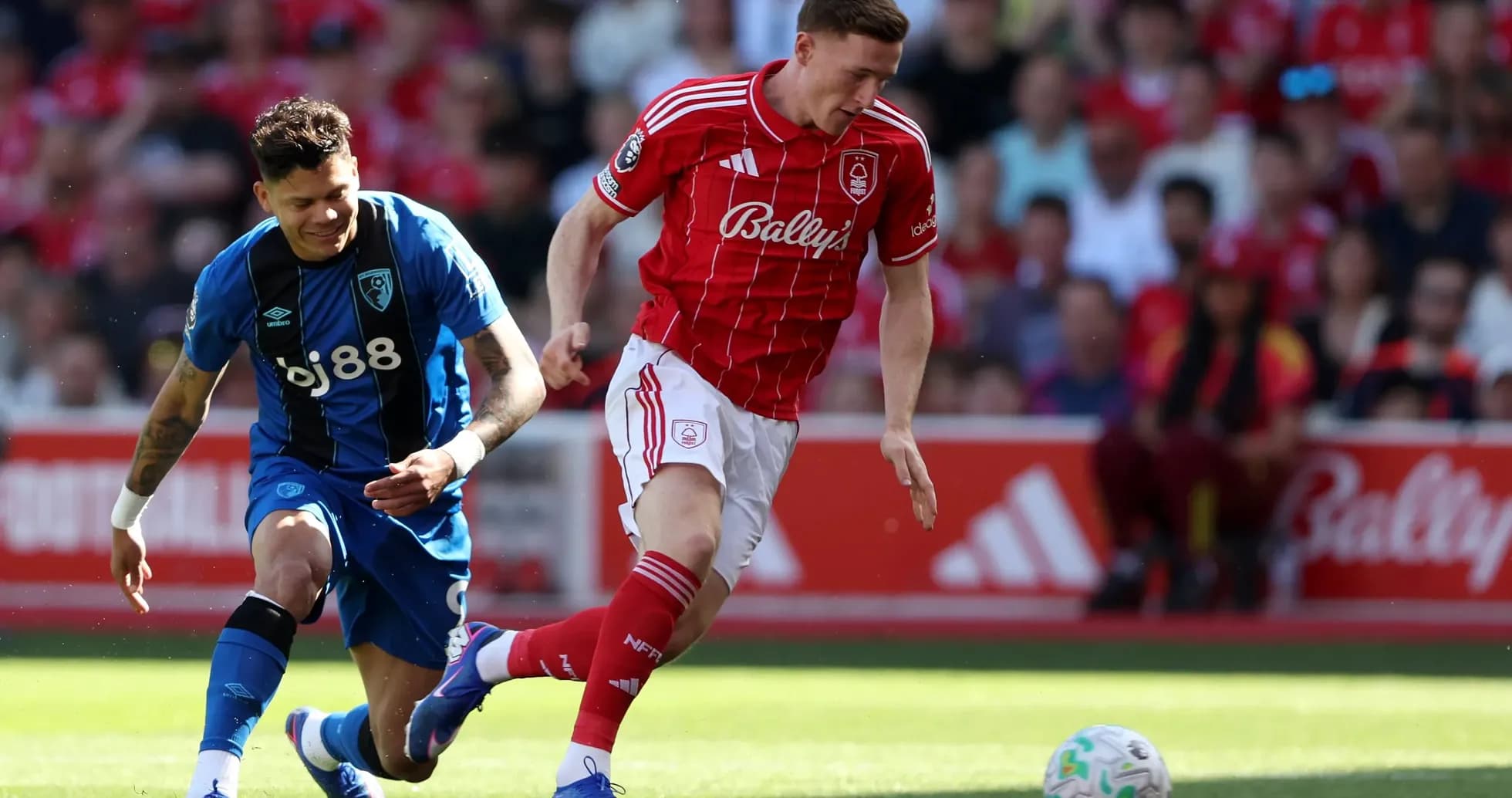
Nottingham Forest and Bournemouth closed their Premier League season at the City Ground with a 1-1 draw that broadly reflected the underlying numbers but came from two very different attacking structures. Forest, in a 4-4-2 under Vitor Pereira, tried to compress the game vertically and play quickly into the front two, while Andoni Iraola’s Bournemouth used their 4-2-3-1 to dominate possession, circulate through the double pivot and attack in waves from wide and half-space positions.
Forest’s 4-4-2 was clearly geared towards directness and second balls. The front pairing of Igor Jesus and C. Wood provided depth and aerial presence, with M. Gibbs-White operating as the advanced midfielder on the right side of the four, often stepping infield to become a de facto No. 10. O. Hutchinson on the opposite flank supplied the early cross and cut-back threat, and it was this right-sided overload that produced the opener: Hutchinson drove at the Bournemouth line and found Gibbs-White, whose 34' finish capped a move that reflected Forest’s intent to attack quickly once they broke the first press.
Behind them, I. Sangare and E. Anderson formed a physically strong but relatively direct central pair. Their remit was less about long passing sequences and more about winning duels and immediately feeding the front four. Forest finished with 396 passes, 307 accurate (78%), which is modest for a home side but consistent with a game plan built around transitions rather than control. The back four of N. Williams, Morato, N. Milenkovic and Cunha stayed fairly narrow, inviting crosses but protecting the central lane, and they were well supported by the two banks of four when out of possession.
Despite having less of the ball (45% possession), Forest were more incisive in the final third in the first half. They generated 15 total shots, with 10 inside the box and 5 on target, and forced Bournemouth into 7 blocked shots at the other end. Their xG of 1.87 underlines that the quality of chances created was strong, especially relative to the volume of possession they enjoyed. The trade-off was defensive exposure when Bournemouth broke through the first line; Forest conceded 17 shots and needed M. Sels (Nottingham Forest) to make 3 saves, though his goals prevented figure of -0.5 indicates he slightly underperformed the post-shot quality he faced.
Bournemouth's Approach
Bournemouth’s 4-2-3-1 evolved over the 90 minutes from a more cautious structure into a very aggressive, high-possession system. The double pivot of A. Toth and T. Adams provided the platform for 483 passes (405 accurate, 84%), recycling the ball and drawing Forest’s midfield out of shape. Higher up, the trio of Rayan, E. J. Kroupi and M. Tavernier floated between the lines, looking to exploit the spaces either side of Sangare and Anderson.
The equaliser on 54' encapsulated Bournemouth’s approach. A. Truffert, the left-back, advanced high and wide, stretching Forest’s right side. His delivery found Tavernier, who arrived from the left half-space to finish, a pattern that came from sustained possession and positional rotations rather than a single direct action. Bournemouth’s xG of 1 reflects that, while they took more shots (17 total, 6 inside the box, 11 from range), much of their effort came from outside the area, where Forest were content to allow lower-probability attempts.
Out of possession, Bournemouth’s press was more selective than full-throttle. Evanilson led the line, screening passes into Sangare and Anderson, while the three attacking midfielders jumped onto Forest’s full-backs when the ball went wide. This helped limit Forest to 6 corners and forced them into 3 offsides as they tried to release early runs in behind. Bournemouth’s foul count (7, versus Forest’s 11) and the card profile suggest they were more controlled in their defensive actions, choosing to block passing lanes rather than commit to risky tackles.
Substitution Patterns
As the game moved into the second half, the substitution patterns revealed both coaches’ tactical priorities. At 57', A. Toth (OUT) was replaced by B. Gannon-Doak (IN), a clear attacking shift from Iraola, sacrificing a pivot for an additional forward profile to increase presence between the lines and in the box. Later, at 73', Bournemouth refreshed their entire attacking midfield line: Evanilson (OUT) for E. Unal (IN), E. J. Kroupi (OUT) for J. Kluivert (IN), and Rayan (OUT) for A. Adli (IN). This triple change injected fresh legs and more direct dribbling and running power, reinforcing their territorial dominance and helping sustain pressure even as Forest’s block dropped deeper.
Pereira’s changes were more about rebalancing energy and preserving structure than radically altering shape. C. Wood (OUT) for T. Awoniyi (IN) at 62' maintained the twin-striker template but added more vertical running and counter-attacking threat. L. Netz (IN) for Cunha (OUT) at 63' suggested a desire for more attacking thrust from left-back, potentially to exploit spaces left by Bournemouth’s aggressive full-backs. At 65', the double change of R. Yates (IN) for E. Anderson (OUT) and N. Dominguez (IN) for I. Sangare (OUT) retooled the central midfield with fresher legs and slightly more passing security, aiming to survive Bournemouth’s growing control. Finally, J. McAtee (IN) for O. Hutchinson (OUT) at 78' shifted Forest’s wide threat towards a more creative, combination-based profile, better suited to counter-attacks than repeated 1v1 dribbles.
Discipline and Goalkeeping
Discipline played a minor but telling role in the game’s rhythm. The first card came on 33': James Hill (Bournemouth) — Foul, reflecting Bournemouth’s need to break a Forest transition before it developed. Later, at 67', Taiwo Awoniyi (Nottingham Forest) — Foul, was booked shortly after coming on, an indication of Forest’s increasingly reactive defending as they tried to disrupt Bournemouth’s circulation and prevent quick combinations around their box. With 11 fouls to Bournemouth’s 7 and one yellow card each, Forest accepted a higher defensive risk profile to protect their lead and then the draw.
In goal, both keepers had relatively similar statistical outputs but under different types of pressure. M. Sels (Nottingham Forest) made 3 saves, facing a higher shot volume and more attempts from distance, which contributed to his negative goals prevented value. D. Petrovic (Bournemouth) also recorded 3 saves, with the underlying goals prevented at -0.5 suggesting that Forest’s best chances were well-taken rather than squandered. The mirrored negative goals prevented numbers for both teams’ goalkeepers underline that the 1-1 scoreline was not driven by spectacular shot-stopping but by the balance of chance creation and finishing.
Statistical Summary
Statistically, the draw is easy to justify. Bournemouth’s 55% possession, superior passing volume and 17-15 shot edge speak to their territorial and structural control, especially after the break. Forest countered with better shot quality (xG 1.87 to 1), more efforts inside the box and a direct style that repeatedly put Bournemouth’s back four under strain. Forest’s 5 shots on target to Bournemouth’s 4, plus their 6 corners to 3, show that even with less of the ball they consistently carried threat.
From a season-pattern perspective, Forest’s approach fits a side comfortable ceding possession to create high-quality chances on transitions, while Bournemouth’s reflects a team increasingly committed to structured, possession-based attacks. The final 1-1 at the City Ground, with one yellow card per team and no reds, encapsulated a tactical duel where control and counter-control effectively cancelled each other out, leaving both sides with a point that aligned closely with the underlying metrics.