.svg&w=384&q=75 "Naijagoal logo")
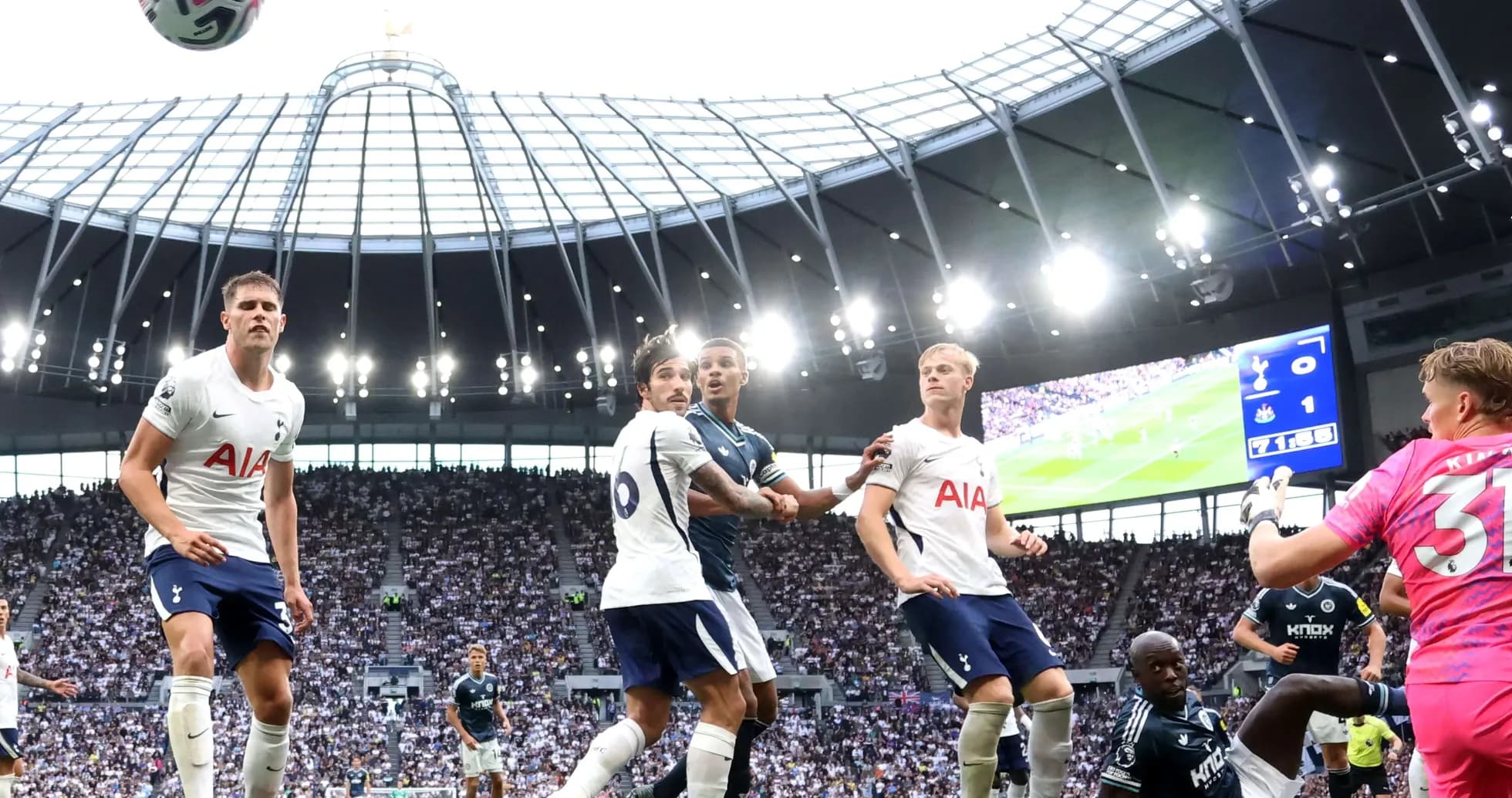

Newcastle Secures 2-0 Victory Over Tottenham at Home
The evening at Tottenham Hotspur Stadium closed with a stark contrast in trajectories. Newcastle walked off with a 2–0 away win, their second positive result to open the 2026 Premier League season, while Tottenham absorbed another bruising lesson under Roberto De Zerbi. After two rounds, Tottenham sit 20th with 0 points and a goal difference of -5 (0 scored, 5 conceded in total), while Newcastle are 5th on 4 points with a goal difference of 2 (4 scored, 2 conceded overall). The scoreline in London did not just reflect a single match; it echoed the early-season DNA of both squads.
Team Structures
Both coaches trusted the same base structure: a 4-2-3-1 on each side. For Tottenham, A. Kinsky started in goal behind a back four of A. Robertson, M. van de Ven, J. P. van Hecke and A. Gray. Ahead of them, R. Bentancur and S. Tonali formed the double pivot, with P. Porro, M. Fernandes and M. Tel supporting lone forward O. Marmoush. Matthias Jaissle mirrored the shape for Newcastle: L. Hornicek in goal; a back line of L. Hall, S. Botman, M. Thiaw and A. Dedic; the midfield screen of L. Miley and Nico; and an aggressive band of three in A. Elanga, J. Willock and H. Barnes behind striker Y. Wissa.
Yet the symmetry on the tactical board hid very different realities in the squads. Tottenham arrived shorn of creativity and incision: D. Kulusevski (knee injury), J. Maddison (knock), W. Odobert (knee injury), P. M. Sarr (injury) and X. Simons (knee injury) were all ruled out. That is essentially an entire tier of ball-carriers and line-breakers missing from De Zerbi’s blueprint. In their place, the coach leaned heavily on structural discipline and vertical running from M. Tel and O. Marmoush, hoping Tonali and Bentancur could control rhythm.
Newcastle had their own absentees – D. Burn (ankle injury), Joelinton (injury), V. Livramento (hamstring injury) and W. Osula (injury) – but crucially retained their primary offensive core. The spine of S. Botman, Nico, L. Miley and the attacking trident remained intact, and the numbers heading into this game suggested a side comfortable in chaos. In total this campaign Newcastle had scored 4 goals in 2 matches, with a total average of 2.0 goals for per game and 1.0 conceded. On their travels, they had already produced a 0–2 win, keeping an away clean sheet and averaging 2.0 goals for and 0.0 against.
Statistical Insights
Tottenham, by contrast, came into this fixture with a brittle profile. Overall they had lost both of their opening matches, with 0 goals scored and 5 conceded in total. At home, they had played 1, lost 1, scored 0 and conceded 2; on their travels, they had again failed to score, conceding 3. The clean sheet column read a stark 0 across home, away and total, and they had failed to score in both games. The early card data underlined a lack of composure in the opening phases: 50.00% of their yellow cards had arrived between 0–15 minutes, and another 50.00% between 31–45 minutes.
Those structural weaknesses intersected brutally with Newcastle’s strengths. A. Elanga arrived as one of the league’s form wide forwards: 2 goals in total from 2 appearances, 4 shots with 3 on target, and a rating of 7.75. His duel numbers – 14 contested, 9 won – told of a winger who not only attacks space but also wins physical battles. Operating from the right, he repeatedly targeted the channel outside M. van de Ven and inside A. Robertson, forcing Tottenham’s left side to constantly retreat rather than step in to compress.
Alongside him, Y. Wissa embodied the “Hunter vs Shield” narrative. With 1 goal and 1 assist in total so far, 6 shots and 32 duels contested (18 won), he thrives in contact. Against a Tottenham defence that had been conceding an overall average of 2.5 goals per game (2.0 at home, 3.0 away) heading into this match, his ability to pin centre-backs and roll into the box was decisive. Every long ball into his zone forced van de Ven and J. P. van Hecke to defend facing their own goal, exactly the scenario De Zerbi’s possession structure is designed to avoid.
Midfield Dynamics
The “Engine Room” duel was equally telling. For Newcastle, Nico and L. Miley provided a platform of calm distribution and vertical surges, while J. Willock connected midfield to attack. Willock had already contributed 1 goal in total this season, with 28 passes at 100% accuracy and 4 shots. His timing from the second line repeatedly asked questions of Bentancur and Tonali, who were left covering too much ground laterally as Tottenham tried to press with a stretched front four.
On the flanks, A. Dedic quietly tilted the balance. The right-back had 1 assist in total this campaign, with 47 passes at 89% accuracy, 2 key passes and 4 tackles. He also blocked 2 shots, underlining his dual role as outlet and shield. His overlaps gave Elanga the option to dart inside, dragging Tottenham’s back four into constant readjustments and preventing Robertson from being the progressive force De Zerbi usually relies on from left-back.
Bench Impact
Jaissle’s bench options added another layer of control. J. Murphy and J. Ramsey, both already on the league’s disciplinary radar with 1 yellow card each, bring aggressive pressing and tactical fouling from the bench. Newcastle’s yellow-card distribution – with 28.57% of their cautions coming between 76–90 minutes and another 14.29% between 91–105 – paints a picture of a side that knows how to break rhythm late on to protect leads. That pattern was visible again as they closed the game down in London, accepting cards to kill transitions.
For Tottenham, the substitutes’ bench was rich in names but short on established synergy in this system. M. Kudus, C. Gallagher, L. Bergvall and D. Solanke all offered theoretical solutions – ball-carrying, pressing energy, link play – but without the injured creative axis of Maddison, Kulusevski and Simons, every attacking move felt one pass short. De Zerbi’s 4-2-3-1, used in both league games so far, currently looks like a scaffold awaiting its key artists.
Conclusion
From a statistical prognosis standpoint, the result aligned almost perfectly with the seasonal trends. Newcastle, with a total average of 2.0 goals for and 1.0 against, again found a multi-goal margin while keeping their second clean sheet on their travels. Tottenham, with a total average of 0.0 goals for and 2.5 against heading into the match, once more failed to score and conceded twice, reinforcing the narrative of a side structurally coherent but starved of final-third quality.
Following this result, the tactical story is clear. Newcastle’s 4-2-3-1 is already a functioning machine, powered by the thrust of Elanga and Wissa and protected by a disciplined, card-savvy midfield. Tottenham’s version of the same shape is still a sketch: neat in outline, but with the crucial lines of creativity and penalty-box threat missing through injury. Until that changes, the numbers – and nights like this at Tottenham Hotspur Stadium – are likely to keep telling the same tale.