.svg&w=384&q=75 "Naijagoal logo")

Liverpool vs Nottingham Forest: Tactical Insights from 2-2 Draw
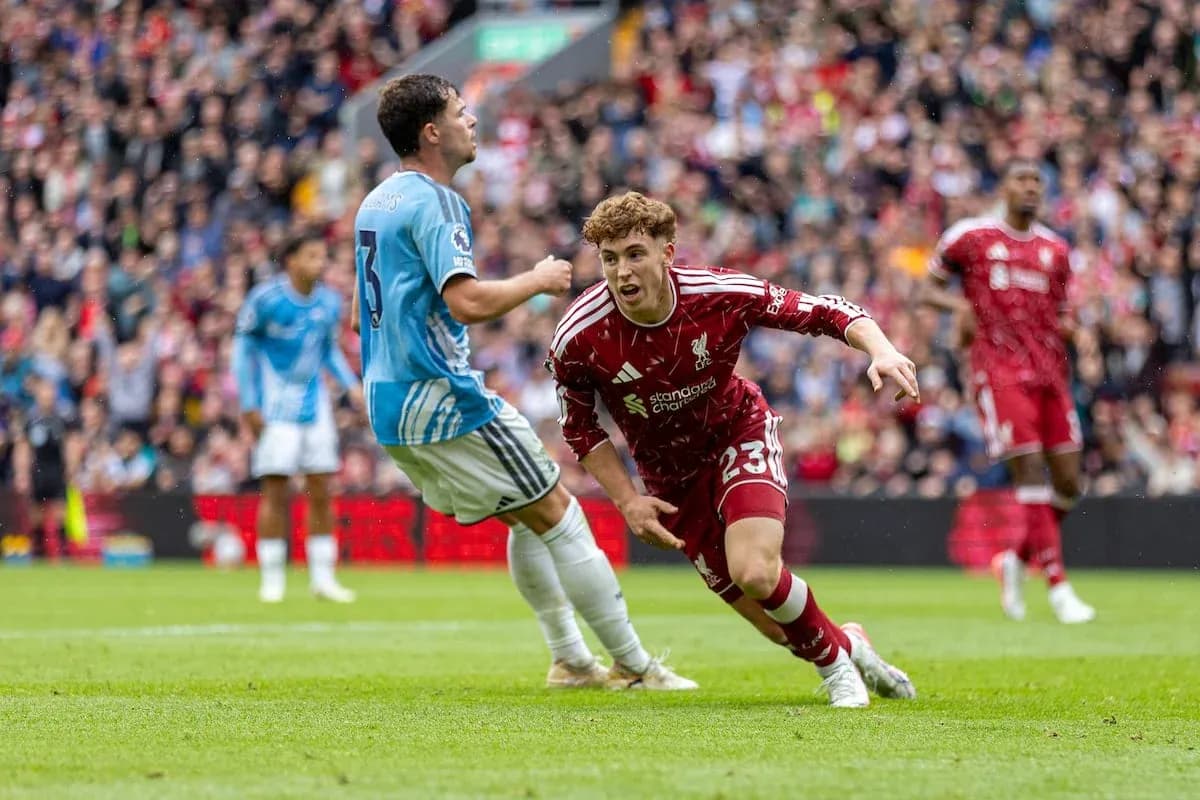
Anfield’s first Premier League afternoon of the 2026 season ends with a familiar feeling for Liverpool: frustration wrapped in promise. A 2-2 draw with Nottingham Forest leaves Andoni Iraola’s side on 2 points from 2 matches, 13th in the table with a goal difference of 0 after scoring 4 and conceding 4 overall. Forest, under Oliver Glasner, depart with a hard-earned point, sitting 15th with 1 point, 2 goals scored and 3 conceded overall for a goal difference of -1.
This was a meeting between two evolving projects whose seasonal identities are already emerging. Liverpool’s numbers are starkly symmetrical: at home they have scored 2 and conceded 2; on their travels they have scored 2 and conceded 2 as well. Forest, by contrast, are split: at home they have yet to score and have conceded 1, while away they have scored 2 and conceded 2. Both sides are still searching for their first win, and the tactical stories of this match explain why.
Tactical voids and selection choices
Liverpool’s squad list told its own tale. A cluster of absentees – S. Bajcetic (hamstring), C. Bradley (knee), F. Chiesa (back), H. Ekitike (Achilles), H. Elliott (coach’s decision), J. Gomez (injury) and G. Leoni (knee) – narrowed Iraola’s defensive and wide options. The consequence was a very pure version of his 4-2-3-1: Alisson behind a back four of J. Frimpong, J. Jacquet, V. van Dijk and M. Kerkez, with D. Szoboszlai and A. Mac Allister as the double pivot.
Ahead of them, the trio of C. Gakpo, F. Wirtz and V. Munoz supported A. Isak. It is an attacking structure that leans heavily on technical overloads between the lines and aggressive full-back positioning. With no natural conservative full-back on the pitch and no Chiesa-style wide runner, the responsibility for balance fell on Mac Allister’s positioning and Van Dijk’s command of depth.
Forest’s absences were fewer but significant in profile: I. Sangare (calf) removed a destroyer from the base of midfield, while N. Savona (knee) further thinned Glasner’s options in central areas. The 3-4-2-1 they deployed – M. Sels in goal behind Cunha, N. Milenkovic and Murillo; a midfield line of O. Aina, X. Schlager, J. McAtee and N. Williams; with M. Gibbs-White and D. Ndoye operating off Igor Jesus – was built to compress central zones and spring forward through Gibbs-White’s creativity and Ndoye’s direct running.
Disciplinary trends from the season added another layer. Liverpool, heading into this game, had spread their yellow cards fairly evenly, but with a noticeable cluster between 16-30 minutes, 46-60 minutes and 76-90 minutes, each period accounting for 28.57% of their cautions. Forest, meanwhile, were at their most combustible between 46-60 minutes, where 50.00% of their yellows had arrived. Those patterns foreshadowed a contest where the middle third of the match would be both tactically and emotionally volatile.
Key matchups: hunter vs shield, engine vs enforcer
In attack, Liverpool’s “hunter” came not from the classic No. 9 but from the line of three behind. Cody Gakpo entered the day as one of the Premier League’s early standouts: 2 appearances, 2 starts, 161 minutes, 1 goal and 1 assist, with 5 key passes and a rating of 7.25. His blend of ball-carrying and final-third decision-making made him the primary question Forest’s back three had to answer.
Opposite him, Forest’s shield was a collective: Milenkovic’s aerial presence, Murillo’s front-foot aggression and Cunha’s covering speed. With Forest conceding 1.0 goal per game at home but 2.0 away, their defensive profile suggested that when they leave their own ground they are more exposed to vertical passes and rotations around the half-spaces – precisely where Gakpo and Wirtz like to operate.
The duel between Gakpo and Milenkovic symbolised the afternoon. Gakpo’s 51 passes and 5 key passes overall this season show a player comfortable drifting inside to create, forcing Milenkovic to decide whether to follow into midfield or hand him to X. Schlager and J. McAtee. Every time Milenkovic stepped out, space opened for Isak to attack the channels between centre-backs.
The “engine room” was even more intriguing. For Liverpool, the creative hub was a triangle: Mac Allister and Szoboszlai building from deep, with Wirtz connecting to the front. Wirtz’s season numbers – 85 passes at 81% accuracy, 2 key passes, 4 successful tackles and 1 assist – paint him as a two-way 10, capable of both pressing and threading the final ball.
For Forest, the enforcer and orchestrator rolled into one was Gibbs-White. With 57 passes at 82% accuracy, 1 goal, 1 assist and 8 successful dribbles from 8 attempts, he arrived at Anfield as one of the division’s most influential attackers. His ability to receive between Liverpool’s lines, roll pressure and release Ndoye or Igor Jesus forced Mac Allister and Szoboszlai to constantly decide whether to step up or protect the back four.
On the flanks, O. Aina’s dual role was critical. He leads the league’s card charts with 2 yellows, a sign of both his aggression and the strain he is under. Tasked with containing Munoz and Frimpong on Liverpool’s right, Aina had to judge when to step out to press and when to tuck in alongside Williams to form a back five. Any mistiming invited overloads and cut-backs, exactly the situations from which Liverpool’s 2.0 home goals-per-game average has sprung.
Statistical prognosis and tactical verdict
From a numbers perspective, Liverpool’s attacking baseline is clear: 2.0 goals scored per match at home and 2.0 overall, with no failures to score so far. Their penalty record is immaculate: 1 penalty awarded, 1 scored, none missed, underlining a clinical edge when chances are clear. Forest’s away attack is sharper than their home form suggests, with 2 goals scored on their travels and an away average of 2.0 goals for and 2.0 against, but they have yet to keep a clean sheet anywhere.
Defensively, both sides are fragile. Liverpool concede 2.0 goals per match at Anfield and 2.0 overall, while Forest allow 1.0 at home and 2.0 away, 1.5 overall. Neither side has recorded a clean sheet; both have seen their structures punctured by individual quality and transitional chaos. That shared vulnerability made a multi-goal draw feel almost inevitable.
The card distributions reinforce a picture of games that open up as fatigue and emotion rise. Liverpool’s late-game yellow share of 28.57% between 76-90 minutes hints at a side that becomes stretched as they chase results, leaving defenders like Frimpong and Kerkez – each already booked this season – exposed in wide isolation. Forest’s concentration of 50.00% of their yellows between 46-60 minutes suggests they struggle to reassert control after half-time, a period where Liverpool’s high press and tempo spikes can be most punishing.
Overlaying the tactical patterns on the statistics, the 2-2 outcome feels like the logical intersection of intent and instability. Liverpool’s 4-2-3-1 generated enough fluidity through Gakpo, Wirtz, Munoz and Isak to sustain their 2.0 goals-per-game home standard, but the absence of a natural holding specialist and the aggressive positioning of full-backs left Van Dijk and Jacquet exposed to Forest’s direct running.
Forest’s 3-4-2-1, anchored by Schlager and animated by Gibbs-White and Ndoye, carried the same away punch that delivered 2 goals on their travels earlier in the season, but their inability to close down the half-spaces and their lack of clean sheets ensured Liverpool would always find a route back.
Following this result, both managers will see confirmation of their early-season truths. Iraola has an attack that can hurt anyone – supported by top-scorer contributions from Gakpo, Munoz and Isak – but a defensive platform that still concedes at the same rate it scores. Glasner has an away structure capable of unsettling big sides, yet one that bleeds chances and leans heavily on Sels and last-ditch defending.
The draw at Anfield, then, is less an anomaly than a preview of the campaigns to come: Liverpool as high-event protagonists, Forest as dangerous spoilers, and both still searching for the solidity that turns entertaining stalemates into decisive wins.