.svg&w=384&q=75 "Naijagoal logo")

Netherlands vs Japan: World Cup 2026 Draw Highlights Tactical Battle
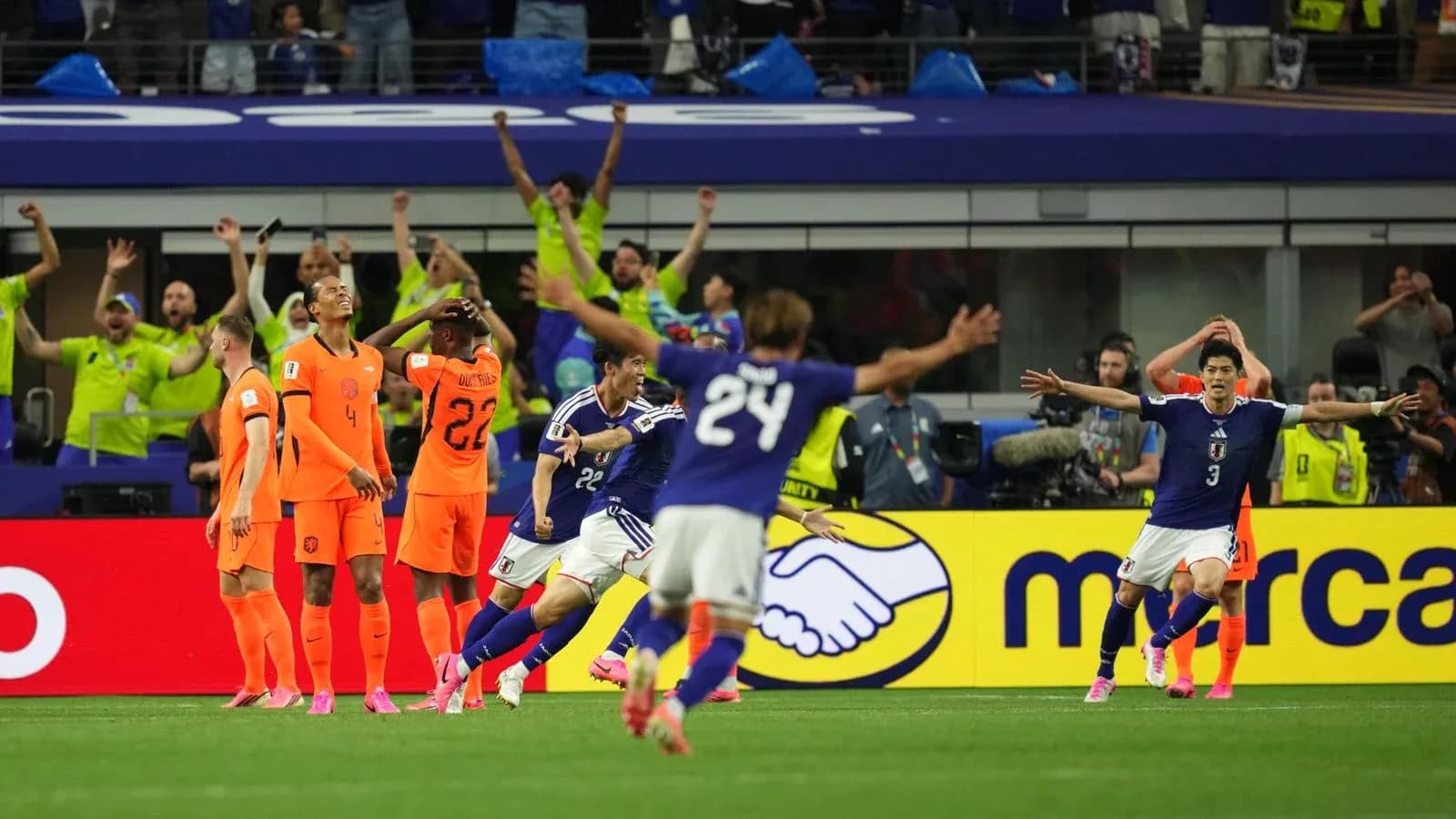
In the cavernous bowl of AT&T Stadium, Netherlands and Japan opened their World Cup 2026 story with a 2-2 draw that felt less like a settled verdict and more like the prologue to a tactical saga. Following this result, both sides sit on 1 point, level on goals for and against at 2-2 overall, their campaigns defined by promise and fragility in equal measure.
I. The Big Picture – Two Identities Laid Bare
Ronald Koeman’s Netherlands arrived as the nominal home side and leaned into their heritage: a 4-3-3, ball-dominant, and structurally orthodox. The numbers back the attacking intent. Heading into this game, all of their World Cup minutes had come at home, and they produced 2 home goals from 1 home fixture, with a home average of 2.0 goals for and 2.0 goals against. No clean sheets, no failures to score – this is a team built for exchange, not control.
Japan, listed as away, offered a modern, flexible 3-4-2-1 under Hajime Moriyasu. On their travels they had played 1 match, scoring 2 and conceding 2, with an away average of 2.0 goals for and 2.0 goals against. Like the Dutch, they have yet to keep a clean sheet or be shut out. The symmetry in the data mirrors what unfolded on the pitch: two sides willing to trade blows.
The standings snapshot underlines the fine margins. Netherlands, with 2 goals for and 2 against overall, sit on a goal difference of 0; Japan mirror that same 2-2, GD 0 profile. Both are unbeaten, both have drawn their only match, both already hint at knockout potential without yet proving defensive reliability.
II. Tactical Voids and Discipline – Where Control Slipped
Injuries and absentees are not flagged in the data, so this was close to full-strength for both. The more revealing gap is psychological: game management and discipline, especially for the Netherlands.
Their card profile is telling. Overall, Netherlands have already collected 3 yellow cards, all clustered late:
- 61-75 minutes: 1 yellow (33.33%)
- 76-90 minutes: 1 yellow (33.33%)
- 91-105 minutes: 1 yellow (33.33%)
That is a clear late-game surge in bookings, suggesting a side that grows ragged as the tempo spikes and legs tire. On the individual level, C. Summerville and M. Depay both carry yellow cards, with Summerville’s aggression intertwined with his attacking output and Depay’s booking arriving in just 20 minutes of action. For a tournament side, that kind of late indiscipline is a red flag: it hints at games that become stretched and emotionally charged instead of being closed out with calm possession.
Japan, by contrast, emerge from this fixture with a clean disciplinary slate. No yellow cards, no reds in their World Cup data so far. For a back three that must constantly step into wide spaces and duels, that restraint is quietly significant. It speaks to timing in the tackle and a system drilled to defend by shape rather than last-ditch challenges.
III. Key Matchups – Hunter vs Shield, Engine Room vs Press
Hunter vs Shield
The most obvious Dutch weapon is on the left: Summerville. As one of the early top scorers, he delivered 1 goal from 1 shot, 1 on target, in 70 minutes, backed by 29 passes at 86% accuracy and 7 duels contested, 5 of them won. He is not just an outlet; he is a ball-secure dribbler (1 attempt, 1 success) who can carry the team up the pitch and punish isolated defenders.
Japan’s “shield” is not a single player but the triangle of H. Ito, S. Taniguchi and T. Watanabe in that 3-4-2-1. Their task was to manage the wide overloads created by D. Dumfries and M. van de Ven stepping high, while tracking the diagonal runs of C. Gakpo and D. Malen. The fact that Netherlands still reached 2 goals at home underlines how difficult that assignment was. Yet Japan’s back three did enough to prevent a Dutch avalanche, holding the Oranje to that 2.0 home goals-for average and ensuring the game never tilted into a rout.
On the other side, Japan’s attacking trident – T. Kubo, D. Maeda, A. Ueda – posed a different problem: constant movement between the lines. Kubo, already among the top assist providers with 1 assist and 16 passes at 75% accuracy, drifted into half-spaces behind F. de Jong and T. Reijnders. That forced V. van Dijk and J. P. van Hecke into uncomfortable decisions: step out and leave space behind, or hold the line and allow Kubo to turn.
Engine Room – Gravenberch vs Kamada
The midfield duel was the game’s quiet hinge. For Netherlands, R. Gravenberch has emerged as a central creative hub. In this match he produced 2 assists, from 25 passes at 88% accuracy, plus 2 key passes and 3 dribble attempts with 2 successes. He is the “engine with a scalpel,” capable of breaking lines with both carrying and passing. His rating of 7.2 reflects that blend of control and incision.
Japan’s response came through D. Kamada and the wider band of K. Nakamura and K. Sano. Kamada’s role in the 3-4-2-1 is to connect the first and second lines of the press, stepping onto de Jong and trying to disrupt Dutch rhythm. While the raw numbers do not spell out his defensive interventions, Japan’s ability to force a 2-2 draw away from home against a side that failed to keep a clean sheet and yet rarely lost their passing structure suggests Kamada’s positioning was key in limiting Gravenberch’s influence between the lines.
The bench options also shaped the tactical narrative. Memphis Depay, with 7 passes at 100% accuracy and 1 key pass in just 20 minutes, showed he can alter the tempo and add a different type of threat – one that drops between the lines rather than attacking the last shoulder. For Japan, Koki Ogawa’s cameo was equally significant: in 15 minutes he delivered 1 assist from his only key pass and 1 shot, underlining Moriyasu’s capacity to change games late with direct, penalty-box forwards.
IV. Statistical Prognosis – What This Draw Really Says
With no xG data provided, we lean on structure and scoring patterns. Both teams sit on 2.0 goals for and 2.0 against per match, both have 0 clean sheets overall, and neither has failed to score. That combination points to open, high-variance football rather than controlled, low-event contests.
For Netherlands, the prognosis is double-edged. Their 4-3-3 has already produced 2 home goals and elevated individual performers like Summerville and Gravenberch into the tournament’s early attacking leaders. But the lack of defensive solidity – 2 home goals conceded, no clean sheet, and a clear late-game yellow-card spike – suggests that stronger opponents will find space, especially in transitions when full-backs push high.
Japan, on their travels, can be quietly encouraged. To go away, score 2, and keep the game within their tactical plan against a side with Netherlands’ attacking pedigree is a statement. Their away average of 2.0 goals for and 2.0 against underlines that they are not here to merely absorb pressure. With Kubo and Ogawa already on the assist charts, and a back three that avoided cards under stress, they look built for knockout football where fine margins and discipline decide everything.
Following this result, the group remains delicately poised. Netherlands have shown they can hurt anyone; Japan have shown they can live with anyone. The next chapter in this World Cup story will be written not by changing identities, but by refining them: can the Dutch tame their late-game chaos, and can Japan turn their structural resilience into the kind of defensive record that turns 2-2 epics into 2-1 wins?