.svg&w=384&q=75 "Naijagoal logo")
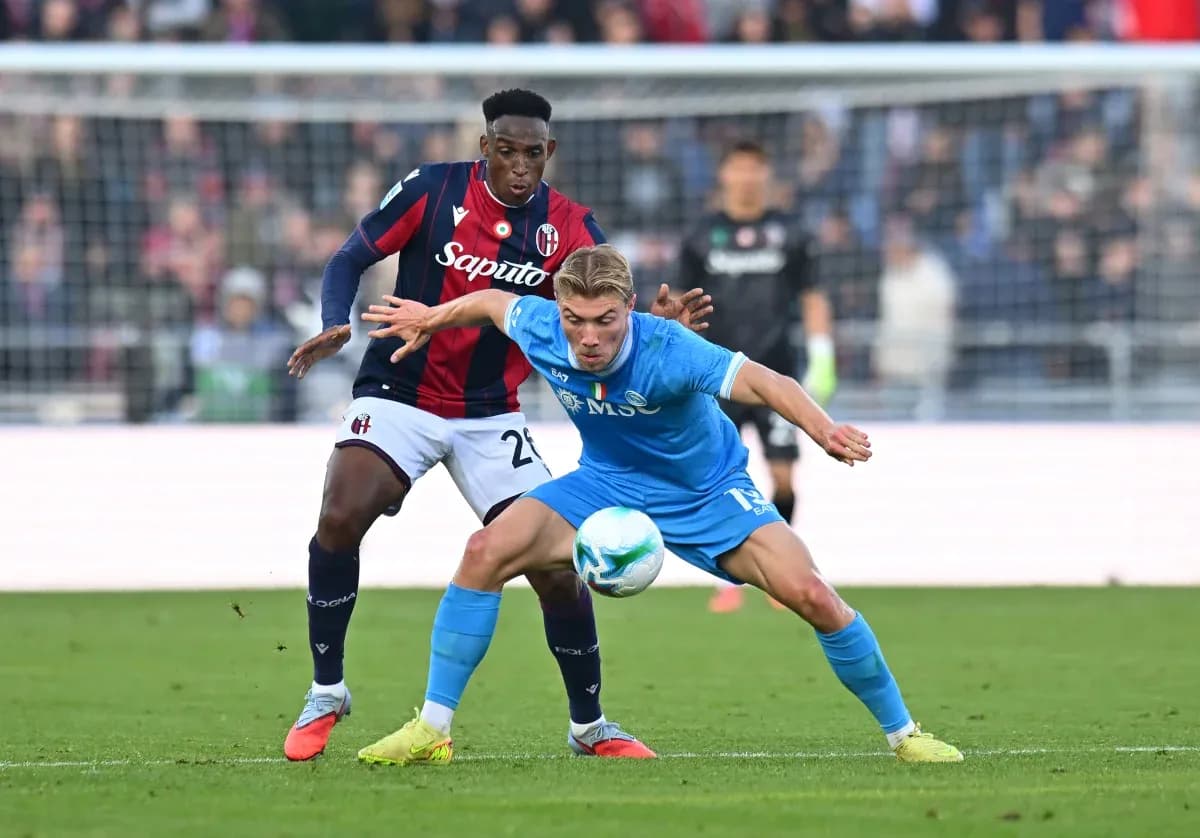
Napoli vs Bologna Tactical Analysis: Key Moments and Insights
Napoli’s 3-4-2-1 against Bologna’s 4-3-3 at Stadio Diego Armando Maradona produced a tactically sharp away win, with the visitors exploiting transition moments and penalty-box efficiency to edge a 3-2 result. The scoreline tracked the underlying data: Bologna generated higher xG (1.32 to Napoli’s 0.75) despite fewer shots, reflecting clearer chances, while Napoli’s territorial control and volume (52% possession, 14 shots, 7 corners) could not offset structural defensive issues and a below-par goalkeeping performance.
Executive Summary
Napoli’s back three and double “10” structure aimed to dominate central zones and wide overloads, but Bologna’s compact 4-3-3 block, vertical outlets, and smart full-back use repeatedly attacked the spaces behind Napoli’s wing-backs. Bologna’s front line, led by Federico Bernardeschi, Riccardo Orsolini and S. Castro, punished early defensive disorganisation to go 2-0 up, then absorbed pressure as Napoli rallied to 2-2 through Giovanni Di Lorenzo and Alisson Santos. Vincenzo Italiano’s bench then decisively tilted the game, with J. Rowe’s late winner exploiting tiring legs and poor rest defence in Napoli’s back line.
Scoring Sequence & Disciplinary Log
Goals (chronological, all minutes literal):
- 10' Federico Bernardeschi (Bologna) — assisted by J. Miranda
- 34' Riccardo Orsolini (Bologna) — Penalty (no assist)
- 45' Giovanni Di Lorenzo (Napoli) — (no assist)
- 48' Alisson Santos (Napoli) — assisted by R. Hojlund
- 90' J. Rowe (Bologna) — (no assist)
These five goals match the final 2-3 scoreline (Napoli 2, Bologna 3).
Cards (chronological, exact reasons):
- 38' Joao Mario (Bologna) — Foul
- 47' Federico Bernardeschi (Bologna) — Foul
- 58' Eivind Helland (Bologna) — Foul
- 69' Jhon LucumÍ (Bologna) — Foul
- 84' Matteo Politano (Napoli) — Foul
Totals: Napoli: 1 yellow, Bologna: 4 yellows, Total: 5.
Key non-scoring events included a VAR intervention at 33', when a potential penalty incident involving Juan Miranda (Bologna) was checked and “Penalty confirmed”, directly preceding Orsolini’s conversion at 34'. Substitutions followed the game’s tactical arc: N. Zortea (IN) came on for Joao Mario (OUT) at 64', J. Rowe (IN) came on for F. Bernardeschi (OUT) at 73', then Napoli’s push saw E. Elmas (IN) for Giovane (OUT) and B. Gilmour (IN) for S. Lobotka (OUT) at 76'. Later, N. Moro (IN) for T. Pobega (OUT), S. Sohm (IN) for L. Ferguson (OUT), and T. Heggem (IN) for E. Fauske Helland (OUT) between 81' and 82' refreshed Bologna’s midfield and back line. For Napoli, L. Spinazzola (IN) replaced M. Politano (OUT) at 85', and P. Mazzocchi (IN) came on for M. Gutierrez (OUT) at 87', just before Rowe’s decisive strike.
Tactical Breakdown & Personnel
Antonio Conte’s 3-4-2-1 built from V. Milinkovic-Savic as the lone goalkeeper behind a back three of A. Buongiorno (left), A. Rrahmani (central) and Giovanni Di Lorenzo (right). The wing-back roles were asymmetric: M. Gutierrez on the left played deeper and narrower, while M. Politano on the right pushed high, often forming a front four with Giovane, Alisson Santos and R. Hojlund. S. Lobotka and S. McTominay formed the central pair, tasked with both ball progression and counter-pressing.
Napoli’s possession structure worked numerically: 484 passes, 425 accurate (88%), with 52% of the ball. They created 14 shots (11 inside the box) and 7 corners, indicative of sustained pressure and territorial dominance, especially between minutes 40 and 70. However, the quality of those chances remained modest, reflected in the low xG of 0.75. Much of the shooting came from crowded central areas or half-chances after second balls, rather than clean cut-throughs of Bologna’s block.
Defensively, Napoli’s issues began with rest defence. With Politano high and wide, and both Giovane and Alisson Santos seeking pockets between the lines, transitions left Buongiorno and Di Lorenzo exposed against Bologna’s wide forwards. The opening goal at 10' came from Bologna attacking Napoli’s right: J. Miranda advanced from left-back, found Bernardeschi, and the forward exploited the channel between Di Lorenzo and Rrahmani to finish. The second, following the VAR-confirmed penalty at 33', underlined Napoli’s vulnerability when defending the box; the back three failed to control movements in front of Milinkovic-Savic, leading to Orsolini’s spot-kick.
Milinkovic-Savic’s numbers underline a difficult night: only 1 save, with goals prevented at -0.82. Conceding three from xG 1.32 suggests that at least one of the goals was more saveable than the model baseline, compounding structural defensive problems. Napoli’s Defensive Index in this match was significantly below their possession control; they allowed Bologna to turn limited entries into high-value shots.
After the break, Napoli’s attacking adjustments were effective. Di Lorenzo’s 45' goal, arriving just before half-time, came from him stepping aggressively into the right half-space, illustrating how Conte’s side used the outside centre-backs to overload. At 48', R. Hojlund dropped off the last line to link play and then slipped Alisson Santos through for 2-2, a textbook exploitation of Bologna’s temporarily disorganised defensive line after a turnover.
Vincenzo Italiano’s Bologna, in a 4-3-3, were more economical. Their 458 passes (386 accurate, 84%) and 48% possession reflected a willingness to concede some territory, but they maximised their attacks: 10 shots, only 5 inside the box, yet xG 1.32 and 3 goals scored. The midfield trio of T. Pobega, R. Freuler and L. Ferguson focused on screening central lanes and jumping on triggers when Napoli played into McTominay or Lobotka with their backs to goal. When they won the ball, the first pass was often vertical to Castro or into the feet of Bernardeschi or Orsolini.
The discipline profile shows Bologna walking a fine line: 12 fouls and 4 yellow cards, all for “Foul”, as Joao Mario, Bernardeschi, Eivind Helland and Jhon LucumÍ repeatedly broke up Napoli’s rhythm. Politano’s booking at 84' was symptomatic of Napoli’s frustration as their attacks stalled and transitions became riskier.
The bench impact was decisive. Zortea’s introduction stabilised Bologna’s right, while Moro and Sohm added legs and pressing in midfield. Most crucially, J. Rowe, replacing Bernardeschi, brought fresh pace against a tiring Napoli back three. His 90' winner, unassisted, came from exploiting space as Napoli pushed their wing-backs and outside centre-backs high; with rest defence again compromised, Bologna’s late transition found Rowe isolated against a stretched line, and Milinkovic-Savic could not bail his side out.
The Statistical Verdict
From a data perspective, Bologna’s win aligns with chance quality more than volume. Napoli’s 14 shots to Bologna’s 10, and 7 corners to 1, suggest territorial control, but the xG gap (1.32 vs 0.75) and identical negative goals prevented values (-0.82 for both goalkeepers) highlight that Bologna created and finished better opportunities. M. Pessina’s 3 saves for Bologna were more numerous and, given the xG, broadly adequate; Milinkovic-Savic’s single save, against three conceded, underscores a poor shot-stopping return relative to expectation.
Napoli’s passing accuracy and possession were consistent with a side in reasonable overall form with the ball, but their Defensive Index in this match lagged: transitions, penalty-box defending, and goalkeeping all underperformed. Bologna, by contrast, translated a slightly lower possession share and fewer shots into a higher xG and three goals, reflecting a tactical plan built on compactness, selective pressing, and incisive counter-attacks. The disciplinary imbalance (Napoli 1 yellow, Bologna 4) did not derail Italiano’s side; instead, their controlled aggression and impactful substitutions allowed them to manage phases without the ball and strike decisively at the death.