.svg&w=384&q=75 "Naijagoal logo")
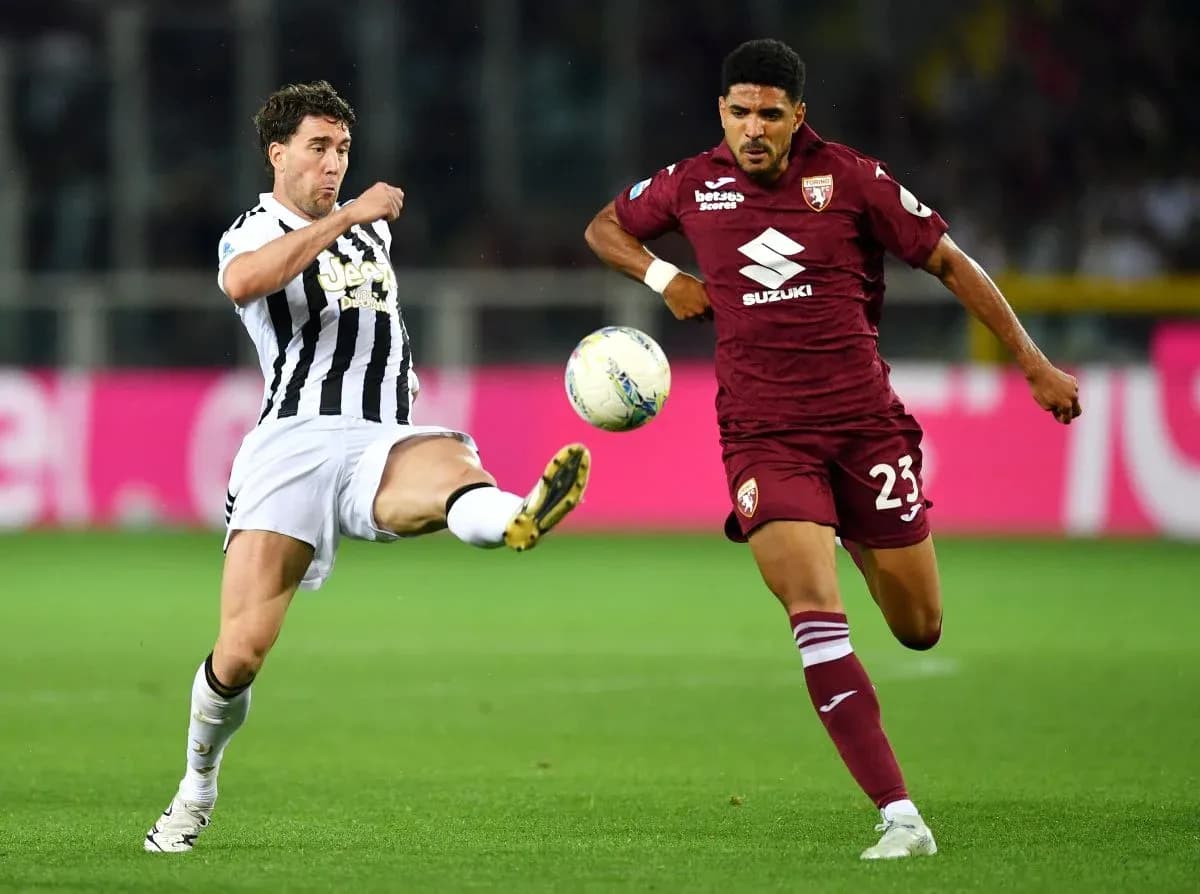

Derby della Mole: Torino and Juventus Draw 2–2 in Chaotic Finale
The Derby della Mole closed its Serie A season in fittingly chaotic fashion at the Stadio Olimpico Grande Torino. In round 38, Torino and Juventus traded punches for 90 minutes, the hosts roaring back from a 0–1 half‑time deficit to draw 2–2, a result that neatly mirrored their contrasting seasonal identities: Torino’s volatility and Juventus’ control.
Heading into this game, the table framed the narrative. Torino finished 12th on 45 points, their goal difference of -19 coming from 44 scored and 63 conceded overall. Juventus, by contrast, secured 6th with 69 points and a goal difference of 27, built on 61 goals for and just 34 against. It was mid‑table turbulence against Europa‑bound stability, played out in a derby that refused to obey the script.
I. The Big Picture – Shapes, context, and season DNA
Leonardo Colucci doubled down on Torino’s three‑at‑the‑back identity with a 3‑4‑1‑2. A. Paleari sat behind a back three of S. Coco, A. Ismajli and E. Ebosse. The wing‑line of M. Pedersen and R. Obrador flanked central pair E. Ilkhan and G. Gineitis, with N. Vlasic floating as the link behind a physical front two of G. Simeone and D. Zapata.
This was consistent with Torino’s season: they used a three‑centre‑back base in most matches, with the 3‑5‑2 their most common formation (16 times), followed by the 3‑4‑1‑2 (9 times). At home, they averaged 1.4 goals scored and 1.5 conceded, a fragile balance that often tipped into chaos. The -19 overall goal difference underlines how frequently their structure was stretched.
Luciano Spalletti’s Juventus arrived in their now familiar 3‑4‑2‑1. M. Perin was protected by a trio of P. Kalulu, F. Gatti and L. Kelly. The midfield square of W. McKennie, M. Locatelli, K. Thuram and A. Cambiaso sat behind dual creators F. Conceicao and J. Boga, both servicing D. Vlahovic as the lone reference point.
Juventus’ season numbers tell the story of a side built on control and defensive discipline. Overall, they averaged 1.6 goals scored and only 0.9 conceded. On their travels they still produced 1.4 goals per game while allowing just 0.9. Sixteen clean sheets in total underline how rarely opponents found a way through.
II. Tactical Voids – Absences and disciplinary shadows
Both coaches had to navigate important absences. Torino were without Z. Aboukhlal and F. Anjorin through muscle and hip injuries respectively, while L. Marianucci missed out with a knee problem. Perhaps most significantly, G. Maripan was suspended due to yellow cards, removing an experienced organiser from the back line. His absence helped explain Colucci’s choice of Coco, Ismajli and Ebosse as a relatively mobile but less battle‑hardened trio.
Juventus were missing Bremer for the same disciplinary reason. Losing their dominant central defender forced Spalletti to trust F. Gatti as the axis of the back three, with Kalulu and Kelly providing recovery speed but less aerial dominance than the usual pairing.
Season‑long card profiles added another layer to the derby’s risk profile. Torino’s yellow cards were heavily back‑loaded: 21.13% came between 76–90 minutes and another 21.13% in 91–105, pointing to a team that tends to lose composure late on. Their only red card of the league campaign arrived in the 46–60 minute window, suggesting that the early second half is often emotionally volatile.
Juventus, by contrast, distributed their yellows more evenly, with a notable spike between 61–75 minutes (23.08%). Their two league red cards were split between 31–45 and 76–90, hinting that their aggression occasionally boiled over around half‑time and in the closing stages. With Andrea Cambiaso already carrying one red this season and Manuel Locatelli on nine yellows, the Bianconeri engine room walked a familiar disciplinary tightrope.
III. Key Matchups – Hunter vs Shield, Engine Room
Hunter vs Shield was defined by G. Simeone against Juventus’ away defence. Simeone’s season was one of relentless work: 11 goals overall from 32 appearances, 59 shots with 28 on target, and 23 key passes. He thrives on chaos, second balls and aggressive runs across the near post. That profile collided with a Juventus rearguard that, on their travels, conceded only 18 goals in 19 matches – 0.9 per game – and produced 8 away clean sheets.
Without Bremer, the responsibility to track Simeone’s movement fell primarily on F. Gatti and L. Kelly. Gatti’s season numbers – particularly his role as a central stopper – suited the aerial duels with Simeone and Zapata, but the absence of Bremer’s anticipation made Juventus more vulnerable to quick combinations around the box. The 2–2 full‑time scoreline suggested that Torino successfully exploited those marginal drops in defensive height and timing.
In midfield, the “Engine Room” battle pitted Juventus’ passing hub against Torino’s graft. M. Locatelli orchestrated the visitors’ rhythm with 2,805 passes overall at 88% accuracy, 47 key passes and 102 tackles. He blocked 23 shots and made 39 interceptions, a complete holding midfielder who both builds and breaks. Next to him, McKennie’s verticality (5 goals, 5 assists, 48 key passes and 40 tackles) and Cambiaso’s wide intelligence (3 goals, 4 assists, 56 key passes) gave Juventus a three‑lane supply line into the final third.
Torino countered with the industry of Ilkhan and Gineitis and the connective tissue of Vlasic between the lines. Their task was less about out‑passing Juventus and more about disrupting Locatelli’s tempo, forcing play wide and then springing Simeone and Zapata into the channels. Given Juventus’ season‑long comfort in possession, any success Torino had in turning the match into a transition battle was always going to tilt the derby in their favour.
IV. Statistical Prognosis – What the numbers say about the 2–2
Following this result, the numbers still lean towards Juventus as the more stable side over the campaign. Their overall goal difference of 27 (61 scored, 34 conceded) and 19 wins from 38 underline a team whose xG profile would almost certainly reflect sustained superiority in both boxes. Torino’s -19 goal difference (44 for, 63 against), 17 defeats and only 12 wins paint them as a side often chasing games and living on emotional surges.
Yet in a single match – and especially a derby – those macro trends compress. Torino’s home average of 1.4 goals scored met Juventus’ away average of 1.4; the 2–2 draw sits slightly above the combined expectation but within a plausible xG narrative of a stretched, open contest. Juventus’ defensive solidity bent more than usual, but their attacking structure still found enough solutions to score twice away.
In tactical terms, the derby became a story of how Torino’s aggressive 3‑4‑1‑2 could, for one evening, distort the shape of one of Serie A’s most controlled sides. Simeone’s season‑long relentlessness, Vlasic’s between‑the‑lines craft and the wing‑back energy of Pedersen and Obrador combined to exploit the Bremer‑shaped hole in Juventus’ back line.
For Juventus, the underlying architecture remains reassuring: a 3‑4‑2‑1 that consistently generates chances through Kenan Yildiz’s creativity (10 goals, 6 assists, 76 key passes overall), McKennie’s late runs and Conceicao’s 5‑assist dribbling threat, all anchored by Locatelli’s metronome. Even when the clean sheet slips, the structure usually ensures they stay in the game.
In the end, the 2–2 at the Olimpico Grande Torino felt like a statistical outlier wrapped in a perfectly fitting narrative: Torino’s flawed volatility dragging Juventus out of their comfort zone, and Juventus’ superior season profile just about rescuing a point in a derby that refused to settle quietly.