.svg&w=384&q=75 "Naijagoal logo")

Morocco Dominates Canada in World Cup 1/8 Final
Canada’s 4-4-2 against Morocco’s 4-2-3-1 at NRG Stadium produced a match where structural ideas were clear on both sides, but execution diverged sharply. Morocco’s 3-0 win in this World Cup 1/8 final was built on superior control between the lines, efficient pressing triggers, and a far more coherent use of possession.
Canada’s shape under Jesse Marsch was orthodox: Maxime Crépeau in goal behind a back four of Richie Laryea, Luc De Fougerolles, Moise Bombito and Alistair Johnston. The midfield band of four — Ali Ahmed left, Stephen Eustaquio and Niko Sigur inside, Tajon Buchanan right — was tasked with compressing the centre and then breaking quickly into space for the front two, Jonathan David and Tani Oluwaseyi. On paper this offered verticality and counter-attacking threat; in practice, Canada were repeatedly stretched and forced into reactive defending.
Morocco’s 4-2-3-1 under Mohamed Ouahbi was the tactical reference point. Yassine Bounou sat behind a technically secure back line of Noussair Mazraoui, Redouane Halhal, Issa Diop and Achraf Hakimi. The double pivot of Ayyoub Bouaddi and Neil El Aynaoui provided circulation and protection, while the attacking trio of Bilal El Khannouss (left), Azzedine Ounahi (central) and Brahim Díaz (right) floated behind Ismael Saibari as the nominal striker. This structure allowed Morocco to dominate the middle third and dictate tempo.
Possession figures underline that control: Morocco completed 472 passes to Canada’s 357, with a cleaner 82% accuracy compared to Canada’s 76%.
That passing edge was not sterile; it was used to pull Canada’s flat 4-4-2 out of shape. Ounahi constantly received between Canada’s lines, with Bouaddi and El Aynaoui creating triangles around Eustaquio and Sigur. As Canada’s central midfield slid to close the ball, Díaz and El Khannouss moved into the half-spaces, pinning full-backs and preventing compactness horizontally.
Canada’s main response was intensity rather than structure. The foul count — 24 for Canada against 14 for Morocco — and four yellow cards for Canadian players illustrate a side often arriving late into duels. Jonathan David and Tani Oluwaseyi were asked to screen Morocco’s double pivot, but once the first line was bypassed, Canada’s midfield had to sprint back towards its own goal, leading to mistimed challenges and a disjointed block.
The shot profile is revealing. Canada produced 11 total shots to Morocco’s 5, with 3 on goal for Canada and 4 for Morocco. Yet the expected goals were almost level — 0.86 for Canada, 0.78 for Morocco — and the scoreline 0-3. That contrast points to Morocco’s superior shot quality and Canada’s inability to protect critical zones. Morocco needed only five attempts to score three times, a sign of how clean the chances were once their combinations broke through.
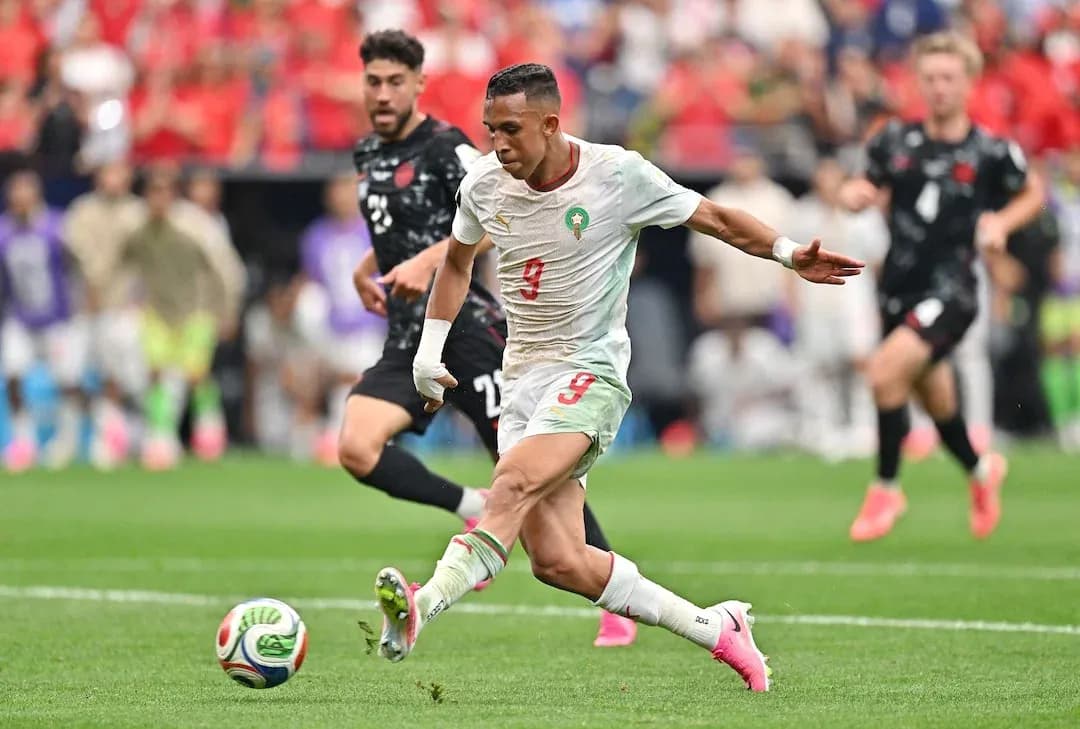
Morocco’s first goal at 50' came from precisely this structural superiority. With Canada’s lines compressed but narrow, Hakimi advanced from right-back and combined down the flank before finding Ounahi. The assist from Hakimi and the finish by Ounahi reflected Morocco’s recurring pattern: full-back high and wide, attacking midfielder arriving in the channel between centre-back and full-back. Canada’s right side, with Laryea and Johnston, struggled to coordinate pressure on the ball-carrier while tracking runs inside.
The second goal at 82', again from Ounahi, underlined Morocco’s dominance in the half-spaces. This time the supply came from Brahim Díaz, who drifted infield from the right. Canada’s double pivot failed to close Díaz’s shooting and passing lane, while the back four remained pinned by Morocco’s front line. Díaz had time to select Ounahi, who once more arrived in the soft space between Canada’s midfield and defence. The repetition of the same weakness — central/inside-right pockets unprotected — was a tactical failure rather than an individual error.
The third goal at 90+8' by Soufiane Rahimi, assisted again by Díaz, was the natural outcome of a Canada side stretched by game state. Chasing the match late, Canada pushed numbers forward, but without the structure to counter-press effectively. Turnovers left the back line exposed, and Morocco’s substitutes attacked open grass. Díaz’s second assist reflected Morocco’s bench impact and their ability to maintain technical quality even after multiple changes.
In goal, Maxime Crépeau (Canada) faced only four shots on target yet conceded three, with 1 save and 0.66 goals prevented. That combination indicates that the chances Morocco generated were of high quality and often arrived from close range or with limited defensive pressure. At the other end, Yassine Bounou (Morocco) made 3 saves, matching Canada’s shots on goal. His interventions, combined with Morocco’s compact mid-block, ensured that Canada’s 0.86 xG never translated into a breakthrough.
Canada’s attacking plan produced volume but not precision. Seven of their 11 shots came from inside the box, but Morocco’s central defenders and double pivot generally kept those attempts under pressure or from suboptimal angles. The 3 blocked shots for Canada show Morocco’s willingness to step out and contest attempts early, whereas Canada failed to block a single Moroccan shot, another sign of slower defensive reactions and poorer spacing around the ball.
Set pieces were one of the few areas where Canada held a structural advantage. They earned 11 corners to Morocco’s 1, an indicator of territorial pressure and crossing volume, especially as the game state worsened. Yet the inability to convert that dead-ball platform into chances of higher xG speaks to delivery quality and organisation in the box. Morocco defended their area with clear roles and strong first-contact dominance, neutralising what could have been a Canadian route back into the match.
Discipline also shaped the tactical tone. Both teams received four yellow cards, but Canada’s were clustered around defensive strain — Richie Laryea, Jonathan David, Luc De Fougerolles and substitute Cyle Larin all booked as they tried to halt Moroccan progress. Morocco’s cautions to Halhal, Hakimi, El Khannouss and Ounahi came largely from assertive pressing and duels higher up the pitch, a by-product of an aggressive but controlled defensive scheme rather than systemic emergency defending.
Overall, Morocco’s 55% possession was not just a statistic but a reflection of structural superiority: stable build-up through Bouaddi and El Aynaoui, creative exploitation of the half-spaces by Ounahi and Díaz, and full-backs who provided width without sacrificing defensive balance. Canada’s 4-4-2 offered sporadic threat and set-piece volume, but the lack of compactness between lines, the high foul count, and the failure to protect central zones turned an ostensibly even shot and xG profile into a tactically emphatic 0-3 defeat.