.svg&w=384&q=75 "Naijagoal logo")

Mexico vs England: Tactical Analysis of World Cup 16
Mexico’s 3-2 defeat to England at Estadio Azteca in this World Cup Round of 16 tie was defined less by chance creation than by how each side manipulated space and tempo. Mexico imposed a territorial siege – 67% possession, 20 shots, 12 corners – but England’s compact 4-2-3-1, ruthless transitions and set-piece clarity allowed them to survive a long second-half siege even after going down to ten men.
Javier Aguirre’s 4-3-3 for Mexico was textbook: Raúl Rangel in goal behind a back four of Jorge Sánchez, César Montes, Johan Vásquez and Jesús Gallardo; a midfield trio of Gilberto Mora as the nominal right-sided No.8, Erik Lira as the pivot and Luis Romo to the left; Roberto Alvarado and Julián Quiñones flanking Raúl Jiménez. On paper this offered width and crossing volume; in practice it produced deep territorial control but too many low-quality final actions relative to the volume of attacks.
Thomas Tuchel’s England lined up in a 4-2-3-1 with Jordan Pickford in goal, a back four of Jarell Quansah, Ezri Konsa, Marc Guéhi and Nico O’Reilly, Declan Rice and Elliot Anderson as the double pivot, Bukayo Saka and Anthony Gordon wide, Jude Bellingham as the 10 and Harry Kane up front. The plan was clear: concede the ball, compress the central lane, and break with the Bellingham–Saka–Gordon trio into the spaces behind Mexico’s full-backs.
First Half
England’s early aggression was signalled by Declan Rice’s yellow card for “Roughing” in the 1st minute, a deliberate marker that the midfield duel would be physical. Out of possession, England’s 4-4-1-1 block hinged on Bellingham dropping alongside Kane to screen Lira. Saka and Gordon tucked inside to deny central progression, inviting Mexico to build via their full-backs and then springing once passes went into wide areas.
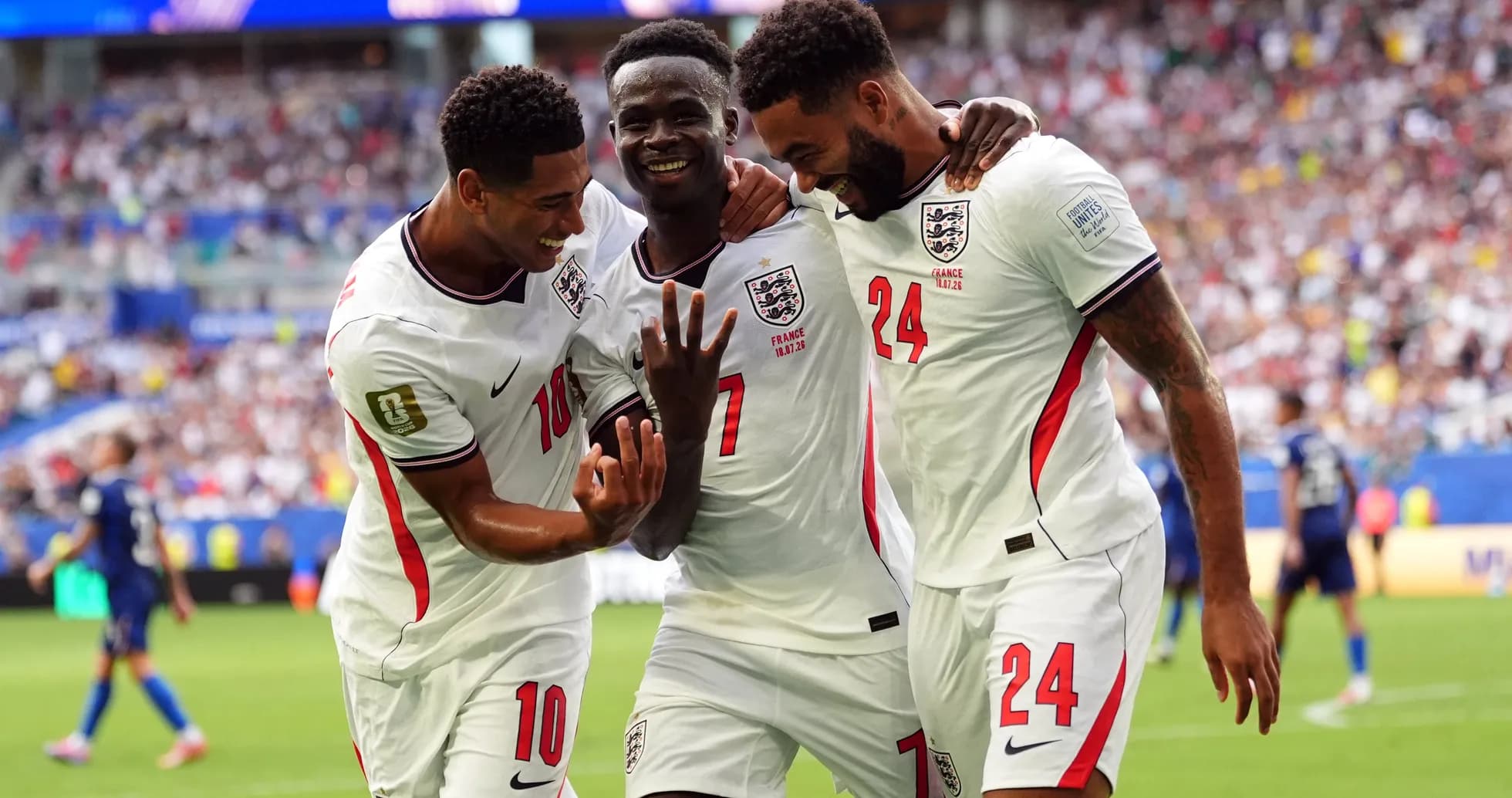
This trap produced the decisive first-half phase. Twice in three minutes, England broke the Mexican structure: at 36', Bellingham arrived from the second line to finish a move created by Saka’s right-sided incision; at 38', he struck again, this time fed by Kane. Both goals reflected England’s vertical superiority: Rice and Anderson winning first or second balls, immediate forward passes into Bellingham, and wide players attacking the half-spaces against a Mexican back line stretched horizontally by their own full-backs’ ambition.
Mexico’s response was more emotional than structural. They continued to dominate the ball, and at 42' Julián Quiñones halved the deficit, capitalising on sustained pressure rather than a clear tactical shift. Yet the underlying pattern remained: Mexico circulating through Lira, Mora and Romo, but England comfortable defending their box, limiting the hosts to 5 shots on goal from 20 attempts, with 7 blocked. England’s narrow block forced Mexico into crowded central zones or hopeful crosses, which suited Konsa and Guéhi.
Second Half
The second half opened with Aguirre’s first adjustment at 46': Edson Álvarez (IN) came on for César Montes (OUT). Functionally, this pushed Mexico towards a more aggressive, hybrid shape. Álvarez could step into midfield, allowing Lira to play higher and Romo to drift wider, increasing the number of players between England’s lines. However, it also left the back line more exposed in transition.
The game’s complexion changed at 54' when Jarell Quansah was sent off for a “Serious foul”. Down to ten, Tuchel reconfigured England into a deeper, more conservative block. At 57', John Stones (IN) replaced Bukayo Saka (OUT), moving to a back five in defensive phases: Quansah’s absence was covered by Stones, while Gordon and Bellingham were tasked with enormous defensive workloads, often dropping into a 5-3-1 shape.
Paradoxically, England extended their lead in this period. At 60', Kane converted a penalty to make it 3-1, a reward for England’s efficiency: they produced only 6 shots all match, but 5 were on goal and they carried 1.55 xG, matching Mexico’s 1.87 xG despite far fewer attempts. The penalty underlined England’s method: few attacks, but when they did break, they attacked with numbers and purpose.
Aguirre reacted immediately, chasing the game and the extra man. At 61', Santiago Giménez (IN) replaced Gilberto Mora (OUT), and Brian Gutiérrez (IN) came on for Luis Romo (OUT). This tilted Mexico towards a more attacking 4-2-4/4-2-3-1 hybrid: Lira and Álvarez as a double pivot, Alvarado and Quiñones (before his later withdrawal) wide, with Jiménez and Giménez as a front pair. The idea was to pin England’s back line with two central strikers while flooding the half-spaces with late runs.
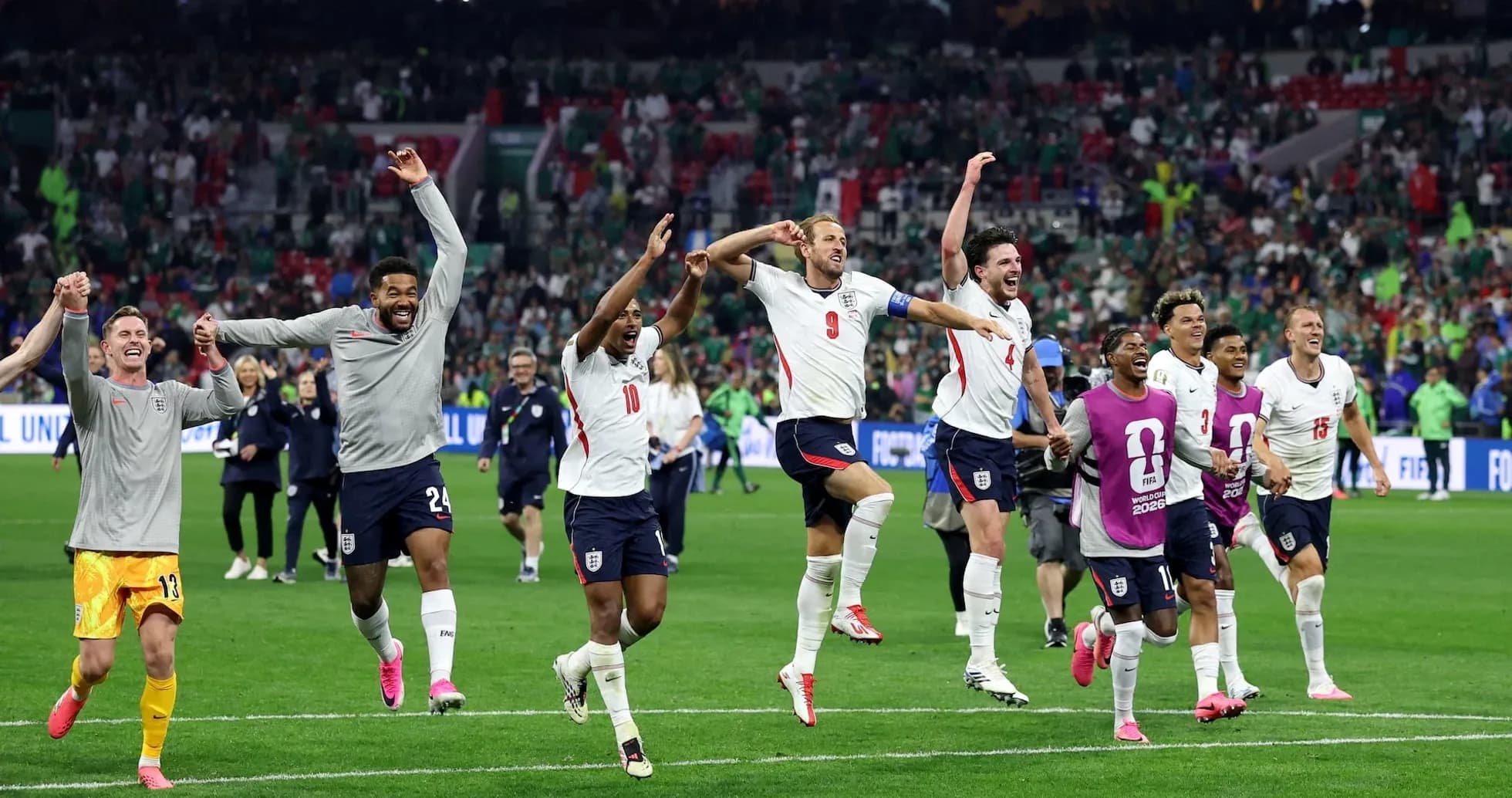
The pressure told at 69', when Raúl Jiménez converted a penalty to bring it back to 3-2. From that point, the match became a siege. Mexico’s 12 corners and 67% possession translated into waves of crosses and second balls, but England’s defensive organisation held. Guéhi’s yellow card for “Unsportsmanlike conduct” at 68', Nico O’Reilly’s for the same reason at 72', and later Jordan Henderson’s card at 90+8' reflected a side constantly on the edge, breaking rhythm and using game management to disrupt Mexico’s tempo.
On the Mexican side, Jorge Sánchez’s booking at 71' for “Unsportsmanlike conduct” and Johan Vásquez’s at 90+8' showed the frustration of a team committing numbers forward and then struggling to control transitions and emotions. Substitutions at 79' and 81' – Álvaro Fidalgo (IN) for Jorge Sánchez (OUT) and Guillermo Martínez (IN) for Julián Quiñones (OUT) – further emphasised attacking intent, with Fidalgo offering an extra passer between lines and Martínez adding aerial presence.
Despite the territorial dominance, Mexico’s shot profile betrayed structural issues. Of their 20 attempts, only 5 were on goal, with 7 blocked – a sign that England’s block was compact and well-timed in its pressure on the ball. Mexico’s 455 passes with 420 accurate (92%) show outstanding circulation, but much of it was in front of England’s block or into wide areas where crosses could be contested. The 1.87 xG suggests they eventually generated decent chances, but not at a rate commensurate with their volume of possession and territory.
England, by contrast, completed 244 passes with 195 accurate (80%), playing a much more vertical, low-possession game. Their 6 total shots, 5 on goal, and identical 5 “Goalkeeper Saves” for Mexico underline the clarity of their attacking moments: when they reached the final third, they tended to produce clear efforts rather than speculative ones.
In goal, Raúl Rangel (Mexico) made 2 saves, with goals prevented at -0.15, indicating he conceded slightly more than the post-shot quality of England’s attempts might predict. Jordan Pickford (England) produced 3 saves with the same -0.15 goals prevented, but crucially, he was protected by a structure that limited Mexico’s clean looks at goal despite the shot volume. England’s defensive index on the night – low shots conceded on target (5) relative to territory ceded – was high, driven by collective organisation rather than goalkeeping heroics.
Tactically, the match distilled into a contrast: Mexico’s high-possession, full-back-driven 4-3-3 morphing into an aggressive multi-forward shape, against England’s flexible 4-2-3-1 that became a resilient low block after the red card. Mexico’s overall form with the ball was strong, but their inability to turn dominance into clear chances – and their vulnerability to England’s early transitions – ultimately decided a finely poised knockout tie.