.svg&w=384&q=75 "Naijagoal logo")

Manchester United's Tactical Masterclass in 3-0 Victory at Brighton
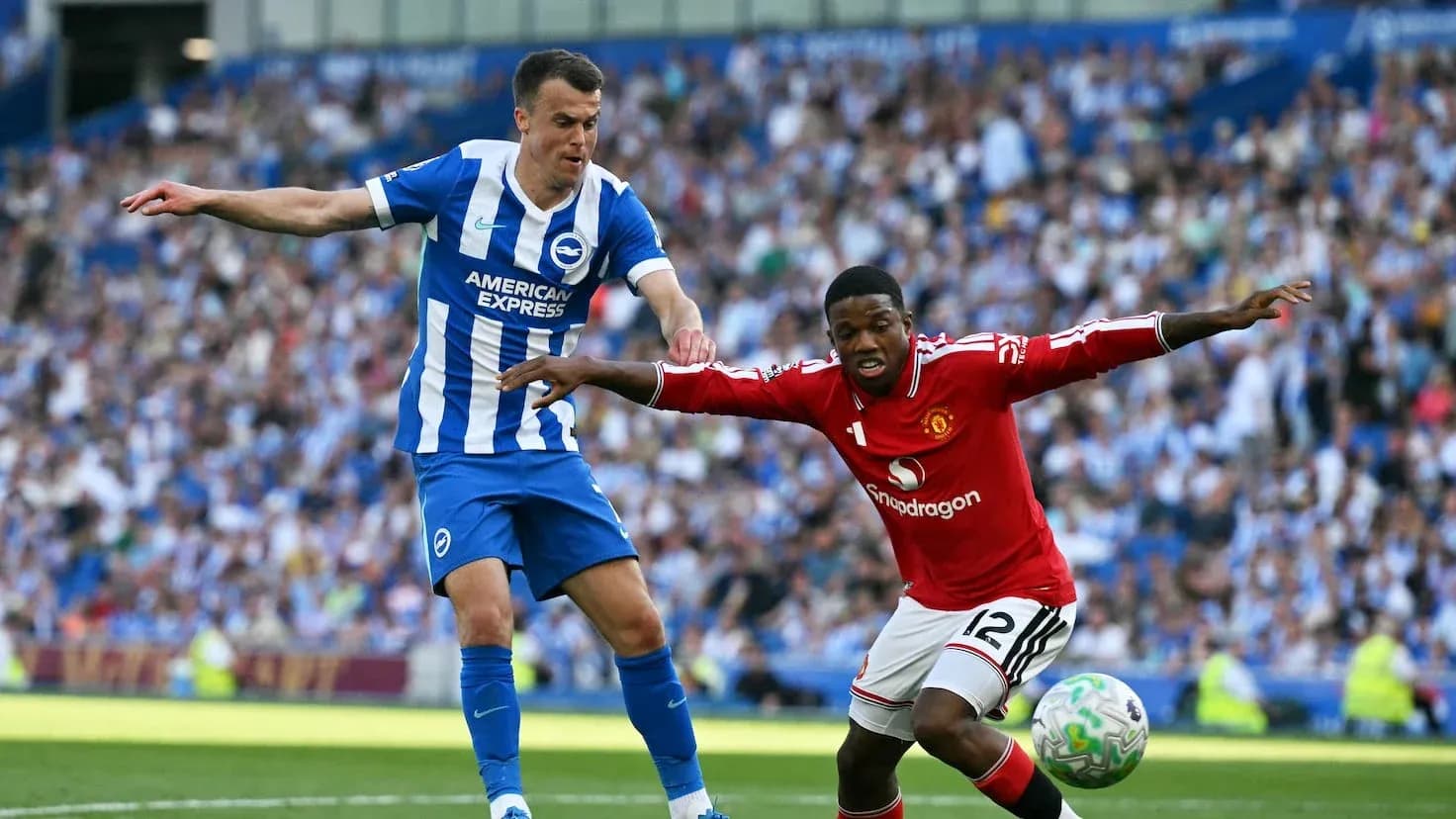
Manchester United’s 3-0 win at Amex Stadium was built on a clear tactical superiority in both boxes, despite Brighton edging possession 51–49. Michael Carrick’s side maximised a compact 4-2-3-1 structure, striking with precision in transition and set positional attacks, while Fabian Hurzeler’s Brighton reproduced their usual ball circulation but lacked incision and penalty-box presence.
Brighton's Structure
Brighton’s 4-2-3-1 was oriented around controlled build-up from Bart Verbruggen (Brighton) and the back four. Lewis Dunk and Jan Paul van Hecke split wide, with M. Wieffer often sliding in to form a situational back three in the first phase. Full-backs F. Kadioglu and M. De Cuyper (before his withdrawal) pushed high to pin Manchester United’s wide players, while the double pivot of P. Gross and J. Milner tried to dictate tempo and find the No.10 D. Gomez between the lines. On paper, the structure gave Brighton access to the half-spaces, but in practice United’s compact mid-block suffocated central progression.
United's Tactics
Carrick’s 4-2-3-1 had Kobbie Mainoo and M. Mount as a disciplined double pivot in front of Harry Maguire and Lisandro Martinez. The wingers A. Diallo and P. Dorgu narrowed aggressively without the ball, closing Brighton’s interior lanes and steering play towards the touchlines. B. Mbeumo led the press, curving his runs to screen passes into Gross and Milner. This meant Brighton’s 51% possession was often sterile, producing 13 total shots but only 2 on goal, with 5 efforts blocked by United’s compact block and aggressive last-ditch defending.
Goals Summary
The first goal on 33 minutes encapsulated United’s plan. After another Brighton spell in front of United’s block, a turnover allowed quick vertical progression into space. With Brighton’s full-backs high, the visitors attacked the vacated channels, and P. Dorgu arrived from the left to finish, assisted by B. Fernandes. The pattern repeated before half-time: in the 44th minute A. Diallo released B. Mbeumo, whose run attacked the space behind an advanced Brighton line for 0-2. By half-time United had only 11 total shots across the game but already converted two of their seven on target, illustrating their clinical edge against Brighton’s stretched rest defence.
Defensive Analysis
Brighton’s defensive structure was less stable. Their high full-backs and an aggressive counter-press left Verbruggen exposed whenever the first press was broken. Manchester United’s xG of 1.82 versus Brighton’s 0.81 underlines that the visitors consistently generated higher-quality chances from fewer attacks. United’s third goal on 48 minutes, again from a central combination between P. Dorgu (this time the provider) and B. Fernandes, punished Brighton’s attempt to step higher early in the second half. The VAR check at 50 minutes, confirming the earlier goal, only reinforced how United were repeatedly accessing the most dangerous central spaces just outside and inside the box.
United's Build-Up Play
With the ball, United were flexible. Mainoo and Mount alternated dropping to aid build-up, allowing Luke Shaw to advance and form a three-man chain with Fernandes and Dorgu on the left. On the right, N. Mazraoui supported Diallo, creating rotations that pulled Brighton’s wide midfielders back and disrupted their pressing triggers. United’s 447 passes, with 369 accurate (83%), show a side comfortable both in controlled phases and in quick transitions. They did not need to dominate the ball; instead, they focused on progressing cleanly through the thirds when the opportunity arose.
Brighton's Possession Stats
In contrast, Brighton’s 463 passes with 397 accurate (86%) reflect their territorial control but also their lack of vertical bite. Too many sequences remained in front of United’s block, and when they did reach the final third, the occupation of the box was poor. D. Welbeck, nominally the central forward, was often isolated against Maguire and Martinez, and the second-line arrivals from D. Gomez and J. Hinshelwood (later in the game) were rarely timed to attack crosses or cut-backs. The absence of corner kicks (0 for Brighton versus 3 for United) is a telling indicator of how little Brighton were able to pin United back and force last-ditch defending.
Coaching Adjustments
The coaching adjustments in the second half reflected the tactical narrative. Hurzeler’s triple substitution flurry around the hour — Y. Minteh (IN) for M. De Cuyper (OUT) at 46', then S. March (IN) for D. Gomez (OUT), C. Baleba (IN) for J. Milner (OUT) and C. Kostoulas (IN) for D. Welbeck (OUT) all at 59' — aimed to inject pace and directness. The idea was to push Minteh and March high and wide, with Kostoulas as a more mobile focal point and Baleba offering ball-carrying from deeper zones. Structurally, Brighton tilted towards a more aggressive, almost 4-1-4-1/4-3-3 hybrid, but United’s defensive compactness and game-state management at 0-3 meant the hosts’ xG remained modest and clear chances scarce.
United's Substitutions
Carrick’s substitutions were more about energy preservation and control than changing shape. S. Lacey (IN) for P. Dorgu (OUT) at 62', then J. Zirkzee (IN) for B. Mbeumo (OUT), L. Yoro (IN) for N. Mazraoui (OUT) and T. Fletcher (IN) for M. Mount (OUT) all at 74', and finally T. Malacia (IN) for L. Shaw (OUT) at 82', allowed United to maintain intensity in the press and solidity in the back line without compromising the basic 4-2-3-1 framework. With a three-goal cushion, United dropped slightly deeper, focusing on denying central access rather than pressing high.
Goalkeeping Performances
In goal, Bart Verbruggen (Brighton) made 5 saves and, with goals prevented at 0.32, actually limited further damage given the quality of chances United created. His shot-stopping underlined that the 3-0 scoreline could have been heavier. At the other end, S. Lammens (Manchester United) needed only 2 saves behind a well-protected defensive unit, a reflection of how effectively United restricted Brighton to low-quality efforts and blocked shots.
Discipline and Duels
Discipline and duels also favoured the visitors in terms of control. Brighton committed 11 fouls to United’s 8, a product of chasing the game and late counter-pressing attempts once transitions were lost. The only card of the match came in first-half added time: at 45+3', Kobbie Mainoo (Manchester United) — Foul. Even this incident fit within the broader tactical story: United were willing to break up Brighton’s rare promising counters with controlled, tactical infringements rather than allow the hosts to attack an unbalanced structure.
Statistical Summary
Statistically, the verdict reinforces the tactical impression. United, with lower possession, produced more shots on target (7 to 2), higher xG (1.82 to 0.81) and forced more saves from the opposition goalkeeper. Brighton’s superior pass volume and accuracy did not translate into box entries or set-piece pressure, as evidenced by their zero corners and limited shots on goal. United’s defensive organisation, compact mid-block, and ruthless exploitation of transition moments turned a relatively even territorial contest into a comfortable 0-3 away win, underlining a clear gap in penalty-box quality and game management between the two sides on the day.