.svg&w=384&q=75 "Naijagoal logo")

Ivory Coast vs Ecuador: World Cup 2026 Group Stage Highlights
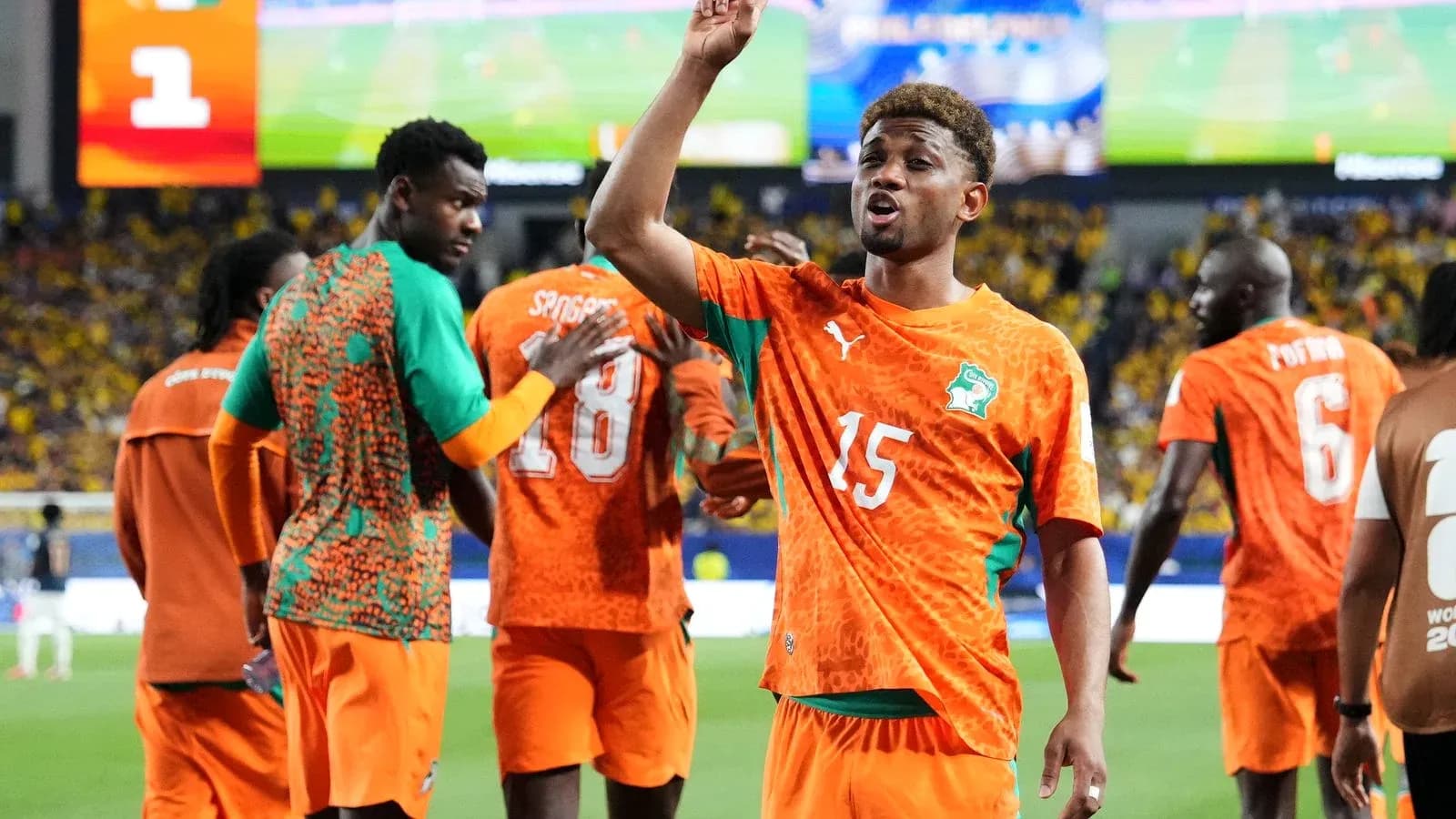
Under the lights of Lincoln Financial Field in Philadelphia, Ivory Coast and Ecuador opened their World Cup 2026 campaigns with a contest that felt more like a knockout tie than a Group Stage - 1 fixture. By full time, Ivory Coast had carved out a 1-0 victory, a result that immediately reshaped Group E: following this result they sit 2nd with 3 points and a goal difference of +1 (1 scored, 0 conceded), while Ecuador drop into early jeopardy, 3rd with 0 points and a goal difference of -1 (0 scored, 1 conceded).
I. The Big Picture: Two 4-4-2s, Two Different Identities
Both teams arrived with a clear structural idea: matching 4-4-2s, but with very different personalities.
Emerse Fae’s Ivory Coast leaned into balance and control. At home in this World Cup setting, they have now played 1 match, won 1, drawn 0, lost 0, with 1 goal for and 0 against. The home average of 1.0 goals scored and 0.0 conceded underlines a side comfortable grinding out narrow wins. Their biggest home result so far is exactly this 1-0, a template that may define their group campaign.
Sebastian Beccacece’s Ecuador, on their travels, also lined up in a 4-4-2 but looked more transitional and risk-reward oriented. Overall this campaign they have played 1 match, losing it 1-0 away. In total they have 0 goals for and 1 against, with an overall average of 0.0 goals scored and 1.0 conceded. The away profile is stark: 1 away match, 0 wins, 0 draws, 1 defeat, no goals scored, and no clean sheet.
The starting XIs told the story of intent. Ivory Coast’s back four of G. Konan, E. Agbadou, W. Singo and G. Doue screened Y. Fofana in goal, with a muscular midfield band of B. Toure, S. Fofana, F. Kessie and Y. Diomande. Up front, N. Pepe and E. Wahi offered a blend of depth runs and one-v-one threat.
Ecuador’s back line – P. Hincapie, W. Pacho, J. Ordonez and A. Franco in front of H. Galindez – was built to defend space as much as the box. The midfield quartet of A. Minda, P. Vite, M. Caicedo and J. Yeboah sat behind a mobile front two of G. Plata and E. Valencia.
II. Tactical Voids and Discipline: Where the Edges Appeared
There were no official absentees listed, so the tactical voids were more about in-game roles than missing personnel. For Ivory Coast, the key question was how aggressively the full-backs could advance without exposing the centre-backs. With no natural holding specialist alone in front of the defence, F. Kessie and S. Fofana had to share the screening work.
Discipline already hints at how both sides walk the line. Heading into this game, Ivory Coast’s yellow-card profile was front-loaded: 1 booking in the 16-30 minute window (33.33% of their total yellows) and 2 between 31-45 (66.67%). That late first-half spike suggests a team willing to foul to break rhythm as opponents build momentum before the interval.
Ecuador, by contrast, had a single yellow in the 61-75 window, a 100.00% concentration of their bookings in that period. It points to frustration and tactical fouls when chasing the game in the second half rather than early aggression.
Individually, S. Fofana embodies Ivory Coast’s edge. In his opening match he committed 1 foul and took a yellow, yet still managed 36 passes at 88% accuracy, 1 key pass, 1 blocked shot and 2 interceptions. He is both rhythm-setter and disruptor, and his card record shows he will walk close to the line to protect transitions.
For Ecuador, J. Porozo’s profile is telling. Off the bench, he logged 28 minutes, committed 2 fouls and collected 1 yellow card. His 12 passes at 100% accuracy underline composure on the ball, but his duels (2 total, 0 won) and disciplinary line show a defender who can be dragged into reactive defending when the block is stretched.
III. Key Matchups: Hunter vs Shield, Engine Room vs Enforcer
The most intriguing attacking axis for Ivory Coast is no longer just N. Pepe or E. Wahi; it is the introduction of A. Diallo from the bench. As a top scorer in this early phase, he has 1 goal in 1 appearance, with 34 minutes played. His efficiency is striking: 2 shots, both on target, 17 passes with 82% accuracy, 1 key pass, and 5 successful dribbles from 6 attempts. He won 6 of 8 duels, a profile of a wide attacker who can both break lines and hold the ball under pressure.
Against Ecuador’s defensive shield, that is a problem. Overall, Ecuador have conceded 1 goal in total, all away, with an away average of 1.0 goals against. They have yet to keep a clean sheet, and their biggest away loss is already this 1-0. If Beccacece continues to lean on a high or mid block, Diallo’s ability to receive under pressure, turn, and attack the half-spaces between full-back and centre-back will be decisive.
In the engine room, the duel between F. Kessie and M. Caicedo is the true metronome battle. Kessie’s presence allows S. Fofana to surge and shoot – he has already attempted 4 shots, 1 on target – while still maintaining structure. Caicedo, positioned as Ecuador’s central anchor, must both screen Diallo’s inside drifts and initiate transitions to G. Plata and E. Valencia.
On the flanks, G. Konan and G. Doue will be asked to pin back Ecuador’s wide midfielders. J. Yeboah and A. Minda are direct runners; if Ivory Coast’s full-backs overcommit, Ecuador’s front four can suddenly turn a cautious 4-4-2 into a wave of four vertical threats.
IV. Statistical Prognosis: Margins, xG Logic and Defensive Solidity
Even without explicit xG numbers, the statistical patterns are clear. Ivory Coast have built their early World Cup identity on defensive control: in total, 1 match, 1 clean sheet, 0.0 goals conceded on average, and no penalties conceded or missed. They have never failed to score so far (failed to score total: 0), which suggests a floor of at least minimal attacking output.
Ecuador’s profile is the mirror image: in total, they have failed to score in their only match, and their clean sheet total stands at 0. The away averages – 0.0 scored, 1.0 conceded – describe a side whose expected goals against is likely to hover around the single-goal mark per match, with their own xG depending heavily on transitions and set pieces.
Following this result, the tactical verdict is that Ivory Coast’s 4-4-2 is already more stable and repeatable. Their capacity to introduce A. Diallo as a high-impact substitute, layered onto the structure provided by Kessie and S. Fofana, gives them both control and a late-game cutting edge.
Ecuador, meanwhile, must refine the balance between their aggressive, vertical instincts and the need for defensive compactness. If they continue to chase games into the 61-75 window, where their yellow-card spike already appears, their xG against will likely rise as they leave space for runners like Diallo, Pepe and Wahi.
In a group that may be decided on fine margins and goal difference, Ivory Coast’s early blend of clean-sheet solidity and efficient finishing positions them as a quietly dangerous contender, while Ecuador face the immediate tactical challenge of turning their structure from reactive to proactive before the knockout door begins to close.