.svg&w=384&q=75 "Naijagoal logo")

Iran and New Zealand Battle to 2-2 Draw in Tactical World Cup Opener
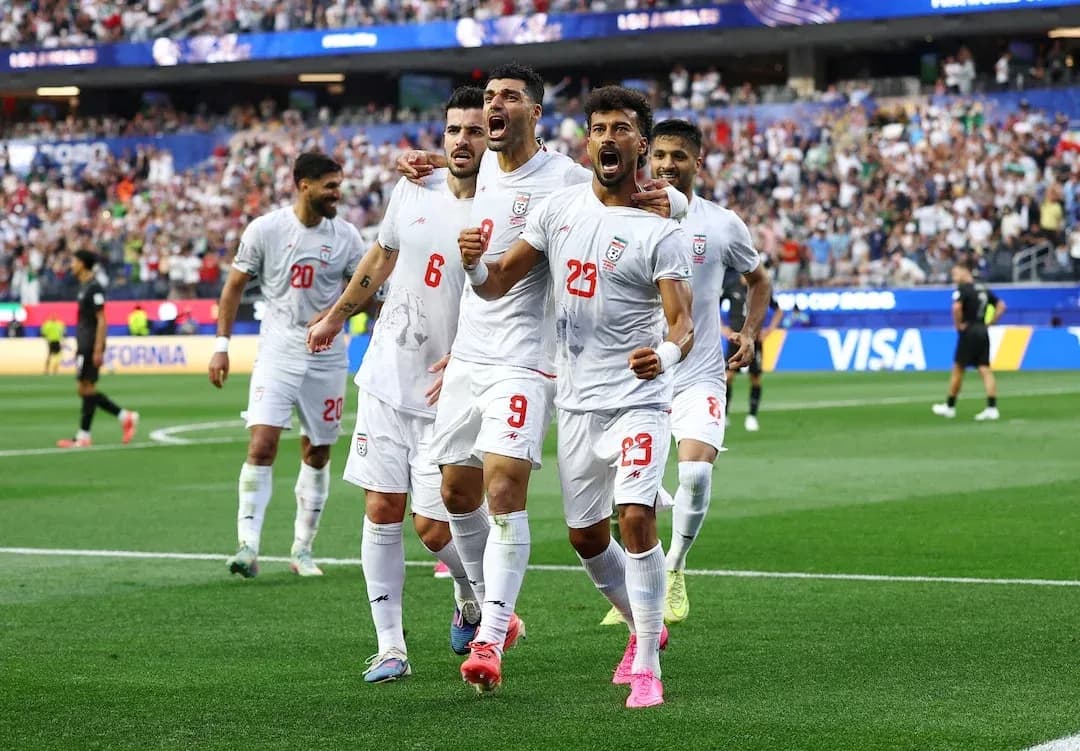
Iran and New Zealand shared a 2-2 draw at SoFi Stadium in a World Cup group-stage opener that was tactically rich and swung repeatedly in momentum. Iran’s 4-4-2 under Amir Ghalenoei faced D. Bazeley’s 4-2-3-1 for New Zealand, and the underlying numbers framed the stalemate: New Zealand edged possession 52% to 48% and generated 1.24 xG to Iran’s 1.5, while both sides finished with two goals and a broadly balanced shot profile.
First Half
The match opened with New Zealand’s structure immediately visible. The 4-2-3-1 placed Chris Wood as a classic reference nine, with Elijah Just, Sarpreet Singh and Callum McCowatt forming a narrow, rotating line of three behind him. Joe Bell and Marko Stamenic sat as a double pivot, tasked with both screening transitions and progressing play. That setup produced an early reward at 7', when Just scored from a move involving Wood, whose assist underlined his role as a target and connector rather than just a finisher.
Iran’s 4-4-2 had Shahriar Moghanlou and Mehdi Taremi starting as a front pair ahead of a compact midfield four. Saman Ghoddos and Mohammad Mohebi offered technical quality between the lines, while Saeid Ezatolahi anchored the central zone. Initially, Iran struggled to control New Zealand’s overloads in the half-spaces, particularly where Singh drifted inside. However, their response was to push the full-backs higher and compress the game horizontally, with Ramin Rezaeian advancing aggressively down the right.
That adjustment paid off on 32', when Rezaeian struck Iran’s equaliser. It was emblematic of Iran’s wing-oriented approach: the right-back stepping into advanced areas from a nominal back four, supported by a narrow right midfielder and one forward dropping to combine. By half-time, Iran had taken more shots (17 total to New Zealand’s 14) and matched New Zealand’s 10 efforts inside the box, reflecting how their positional play gradually pinned the New Zealand back line deeper.
Second Half
The second half became a chess match of in-game tweaks. At 46', Amir Ghalenoei made his first move: Aria Yousefi (OUT) was replaced as Mehdi Ghayedi (IN) came on, a clear attempt to inject more direct dribbling and verticality from wide areas. This shifted Iran’s attacking shape closer to a 4-2-3-1 in possession, with one of the strikers drifting wider and Ghayedi offering 1v1 threat.
On 53', another Iranian substitution altered the forward line: Shahriar Moghanlou (OUT) made way as Ali Alipour (IN) came on. This change aimed to add depth runs and pressing energy against New Zealand’s build-up. Yet New Zealand responded almost immediately, reasserting their attacking clarity. At 54', Elijah Just again combined with Chris Wood, Just scoring his second and Wood providing his second assist. Tactically, it highlighted New Zealand’s commitment to using Wood as a focal point to draw centre-backs out, freeing Just to attack the gaps.
Iran’s reaction was swift and structurally coherent. On 64', Mohammad Mohebi finished a move assisted by Rezaeian, whose advanced positioning remained a key feature. This goal encapsulated Iran’s right-sided overloads: full-back plus wide midfielder plus a dropping striker creating crossing or cut-back lanes. The 2-2 scoreline aligned closely with Iran’s 1.5 xG, indicating that their repeated entries into the box eventually produced chances of decent quality.
The bench continued to shape the tactical narrative. At 65', Saman Ghoddos (OUT) was replaced as Ehsan Hajsafi (IN) came on, a move that tilted Iran slightly more towards stability and control in midfield, with Hajsafi offering defensive nous and left-footed balance. New Zealand responded on 68' with a triple structural refresh: Liberato Cacace (OUT) was replaced as Benjamin Old (IN) came on, Callum McCowatt (OUT) made way as Ryan Thomas (IN) came on, and at 78' Tim Payne (OUT) was replaced as Callan Elliot (IN) came on. These changes suggested a desire to protect the flanks, manage fatigue in the pressing line, and retain enough vertical threat through fresh legs in wide and full-back areas.
Iran’s most aggressive late attacking adjustment came on 80', when Mehdi Taremi (OUT) was replaced as Amirhossein Hosseinzadeh (IN) came on. Removing a leading striker for a more mobile forward/attacking midfielder profile indicated a shift towards fluid interchanges rather than a fixed penalty-box presence, trying to unsettle New Zealand’s central defenders with movement rather than aerial duels.
Discipline remained largely under control, with only one card issued. At 89', Ehsan Hajsafi (Iran) received a yellow card — Tripping. This isolated incident did not materially alter the tactical landscape but underlined Iran’s increasing urgency in duels as they pushed for a late winner.
In added time, New Zealand made two final substitutions at 90+2': Sarpreet Singh (OUT) was replaced as Jesse Randall (IN) came on, and Marko Stamenic (OUT) was replaced as Tyler Bindon (IN) came on. Introducing Randall offered fresh pace for transitions, while Bindon’s arrival hinted at shoring up central areas and defending the draw.
Statistical Overview
From a statistical perspective, New Zealand’s 446 total passes, 377 accurate (85%), compared with Iran’s 405 passes, 312 accurate (77%), confirmed that New Zealand had a slight edge in ball circulation and pass security. Their 8 shots on goal versus Iran’s 4 also showed a marginal advantage in testing the goalkeeper, even though both sides ended with identical goals scored and very similar xG outputs.
Defensively, Iran’s block of four plus Ezatolahi gradually contained New Zealand’s initial fluidity, while New Zealand’s double pivot and back four absorbed Iran’s 10 shots inside the box with notable resilience. The 2-2 result at SoFi Stadium ultimately reflected two teams whose tactical plans were clear, whose in-game adjustments were proactive, and whose statistical profiles converged on a fair, finely balanced draw.