.svg&w=384&q=75 "Naijagoal logo")

Germany Dominates Curaçao 7-1 in World Cup Opener
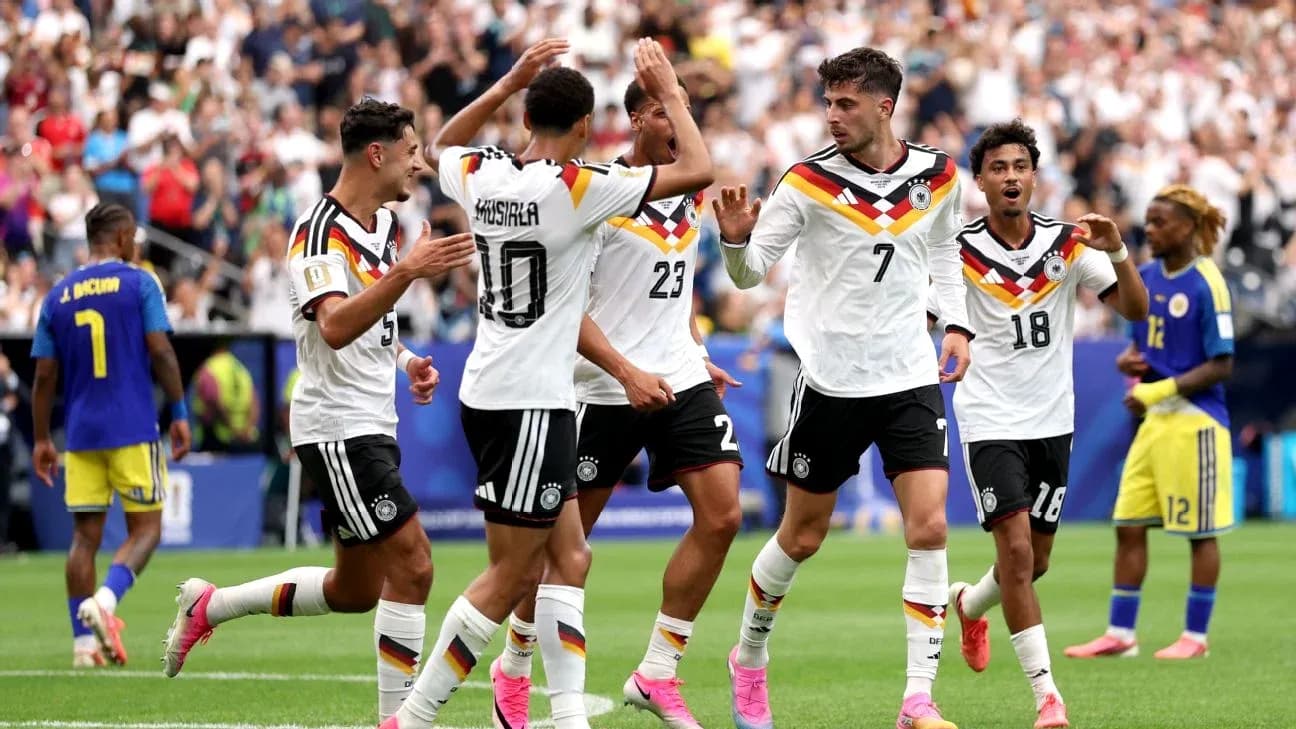
In the closed bowl of NRG Stadium in Houston, Germany opened their 2026 World Cup with a statement that echoed far beyond Group E. A 7–1 dismantling of Curaçao did more than secure three points; it revealed a side already humming to Julian Nagelsmann’s tactical tune, while exposing the structural limits of a courageous but overmatched Curaçao.
Heading into this game, the numbers were reset to zero. Following this result, the standings are brutally clear. Germany sit 1st in Group E on 3 points, with a goal difference of +6 after scoring 7 and conceding 1 overall. Curaçao are 4th, also after 1 match, with 0 points and a goal difference of -6 from 1 goal for and 7 against. The statistical profiles mirror that gulf: Germany’s goalsFor average overall is 7.0 and their goalsAgainst average overall is 1.0, while Curaçao’s averages on their travels are inverted in the worst way – 1.0 scored away and 7.0 conceded away.
I. The Big Picture – Germany’s new shape, old ruthlessness
Nagelsmann’s Germany lined up in a 4-2-3-1 that looked familiar on paper but modern in execution. M. Neuer anchored behind a back four of J. Kimmich, J. Tah, N. Schlotterbeck and N. Brown. Ahead of them, the double pivot of F. Nmecha and A. Pavlovic provided both circulation and counter-pressing, freeing an aggressive band of three: L. Sané wide, J. Musiala between the lines, F. Wirtz drifting in from the left. K. Havertz led the line as a hybrid 9, dropping to connect and surging beyond the last defender.
The statistical imprint is already stark. Overall, Germany have played 1 match, won 1, with no draws or defeats. At home they have played 1, won 1, scoring 7 and conceding 1. Their biggest win at home is, inevitably, this 7–1. They have yet to keep a clean sheet, but they have also yet to fail to score; their penalty record is pristine so far, with 1 penalty in total, 1 scored, 0 missed.
Curaçao, under Dick Advocaat, set up in a 4-3-1-2 that sought to compress central spaces and spring forward through T. Chong behind the front pair of J. Locadia and S. Hansen. E. Room started in goal, shielded by a back four of S. Floranus, R. Bazoer, A. Obispo and D. Fonville. The midfield trio of L. Comenencia, L. Bacuna and J. Bacuna was tasked with both screening and progression. On their travels, Curaçao have played 1 match, lost 1, scoring 1 and conceding 7; no wins, no draws, and no clean sheets.
II. Tactical Voids – Absences and discipline
There were no recorded suspensions or injury absences in the data, so both coaches essentially had full decks to shuffle. The discipline logs for the World Cup campaign so far are blank for both sides: Germany’s cards distribution is null across all time ranges, and Curaçao’s is the same. That absence of bookings in the statistics underlines how unencumbered Germany were in controlling tempo and how rarely Curaçao were able to turn the match into the kind of physical, stop-start contest that might have suited them.
III. Key Matchups – Hunter vs Shield, Engine Room vs Resistance
Hunter vs Shield was brutally one-sided. K. Havertz arrived in Houston as Germany’s most clinical presence and leaves the opening match as one of the tournament’s early headline forwards. In total this campaign he has 2 goals from 2 shots, both on target, plus 1 penalty scored and 0 missed. His 41 passes at 92% accuracy and 1 key pass show how he blurred the line between finisher and facilitator.
Set against him was a Curaçao defence that, overall, has conceded 7 goals on their travels with an average of 7.0 goalsAgainst away. The central pairing of R. Bazoer and A. Obispo were repeatedly dragged into uncomfortable zones by Havertz’s roaming and the constant half-space incursions of Musiala and Wirtz. The numbers for Curaçao’s defensive record so far tell the story: in total this campaign they have played 1, lost 1, with 7 against and no clean sheet.
Around Havertz, Germany’s secondary weapons were devastating. J. Musiala, operating as the nominal 10, delivered 1 goal from his only shot on target, with 2 key passes and 5 dribble attempts, 4 of them successful. He won 9 of 14 duels, constantly turning between Curaçao’s lines and forcing the Bacuna brothers to chase shadows rather than dictate. On the left, F. Wirtz’s subtle movements opened corridors for N. Brown, who emerged as a surprise two-way star: 1 goal, 1 assist, 36 passes at 88% accuracy and 3 key passes from left-back, plus 2 tackles and 1 interception.
On the right, J. Kimmich was the metronome and, by the numbers, one of the competition’s early top creators. Across his 83 minutes he produced 73 passes at 89% accuracy, 5 key passes and 2 assists. His advanced positioning effectively turned Germany’s 4-2-3-1 into a 3-2-5 in possession, pinning Curaçao’s narrow midfield back and forcing their full-backs into impossible decisions.
For Curaçao, the Engine Room battle was always going to be uphill. L. Bacuna and J. Bacuna had to screen, press and play, all while Germany’s double pivot and rotating 10s overloaded central zones. T. Chong, stationed as the 10 in a 4-3-1-2, was often reduced to transition raids rather than sustained influence. The away side’s offensive numbers are modest but not negligible: 1 goal overall, with an average of 1.0 goalsFor away. The problem is that their attacks came in isolated flashes, never in waves.
IV. The Bench as a Weapon – Undav and depth
If the starting XI announced Germany’s intent, the bench confirmed their depth. D. Undav, who [IN] replaced one of the forwards from the starting structure, compressed an entire striker’s performance into 26 minutes. In total this campaign he has 1 goal, 2 assists, 1 shot on target from 1 attempt, and 11 passes at 72% accuracy. Three key passes in such a short spell underline how Nagelsmann can change the flavour of his attack without losing efficiency. Undav already leads the World Cup assist charts, and his presence gives Germany a different kind of penalty-box menace compared to Havertz’s all-court game.
Germany’s defensive depth is similar. With A. Rüdiger, M. Thiaw, W. Anton and D. Raum all available from the bench, Nagelsmann can tailor his back line to future opponents with more aerial threat or pace in behind than Curaçao could muster.
V. Statistical Prognosis – What this result really says
Following this result, Germany’s statistical profile is almost absurdly dominant: 1 match, 1 win, 7 goals for, 1 against, a goal difference of +6. Their goalsFor average overall is 7.0, and their goalsAgainst average overall is 1.0. They have converted their only penalty, have never failed to score, and their biggest win at home is already 7–1. While xG data is not provided, the shot and chance creation metrics for individuals like Havertz, Musiala, Kimmich, Brown and Undav suggest that the scoreline was no mere finishing spike; the chance volume was relentless.
Curaçao’s numbers are harsh but honest: 1 match, 1 defeat, 1 goal scored, 7 conceded, a goal difference of -6. Their goalsFor average on their travels is 1.0, but their goalsAgainst average away is 7.0, and they have no clean sheets in total. For a debutant or outsider, this was always going to be a steep learning curve. The task now is to stabilise the defensive structure of the 4-3-1-2, perhaps by tightening the spacing between the back four and midfield three, and by giving more protection to the full-backs who were repeatedly isolated in Houston.
In narrative terms, this was Germany announcing themselves as early World Cup heavyweights, their 4-2-3-1 already fully weaponised, their stars in form and their depth impactful. For Curaçao, it is a brutal introduction but not a final verdict. The data says they can score; the tactical challenge now is to ensure that when they do, the match is still alive.