.svg&w=384&q=75 "Naijagoal logo")

France's Tactical Masterclass Against Senegal: A 3-1 Victory
France’s 3-1 win over Senegal at MetLife Stadium was a methodical demonstration of control through structure and efficiency rather than sheer volume. Both sides lined up in a 4-2-3-1, but France’s superior occupation of central zones, cleaner progression and sharper execution in the final third ultimately told, especially in a second half where they converted a balanced game into a clear scoreboard advantage.
France’s Formation
France’s 4-2-3-1 was built on a stable back four of Jules Koundé, Dayot Upamecano, William Saliba and Theo Hernández, with Aurélien Tchouaméni and Adrien Rabiot as the double pivot. In possession, this often morphed into a 3-2-5: Hernández pushed aggressively on the left, Koundé stayed a little deeper on the right to form a back three with the centre-backs, while Michael Olise and Ousmane Dembélé held wide or half-space positions around Kylian Mbappé, with Désiré Doué tucking in from the left. That structure underpinned France’s 53% possession and 575 total passes, of which 505 were accurate (88%), reflecting a controlled, high-precision circulation.
Key Attacking Theme
The key attacking theme for France was the manipulation of Senegal’s double pivot (Idrissa Gana Gueye and Pape Gueye from the start) and the channels either side of Kalidou Koulibaly. With Senegal also in a 4-2-3-1, their midfield line could be pinned by France’s three advanced midfielders, allowing Tchouaméni and Rabiot to receive facing forward. Once between the lines, they could then feed Mbappé’s diagonal runs into the left half-space or combine with Olise and Dembélé in tight triangles.
Statistics
The statistics underline how effectively France turned territory into threat. They generated 11 total shots, with 8 shots on goal and 7 from inside the box, supported by an xG of 1.79. That shot profile indicates that most of their attempts came from high-value central areas, consistent with the way they collapsed Senegal’s back line towards their own box. The 2 blocked shots suggest Senegal’s centre-backs did get contact on some efforts, but not enough to reduce France’s overall danger.
Mbappé’s Performance
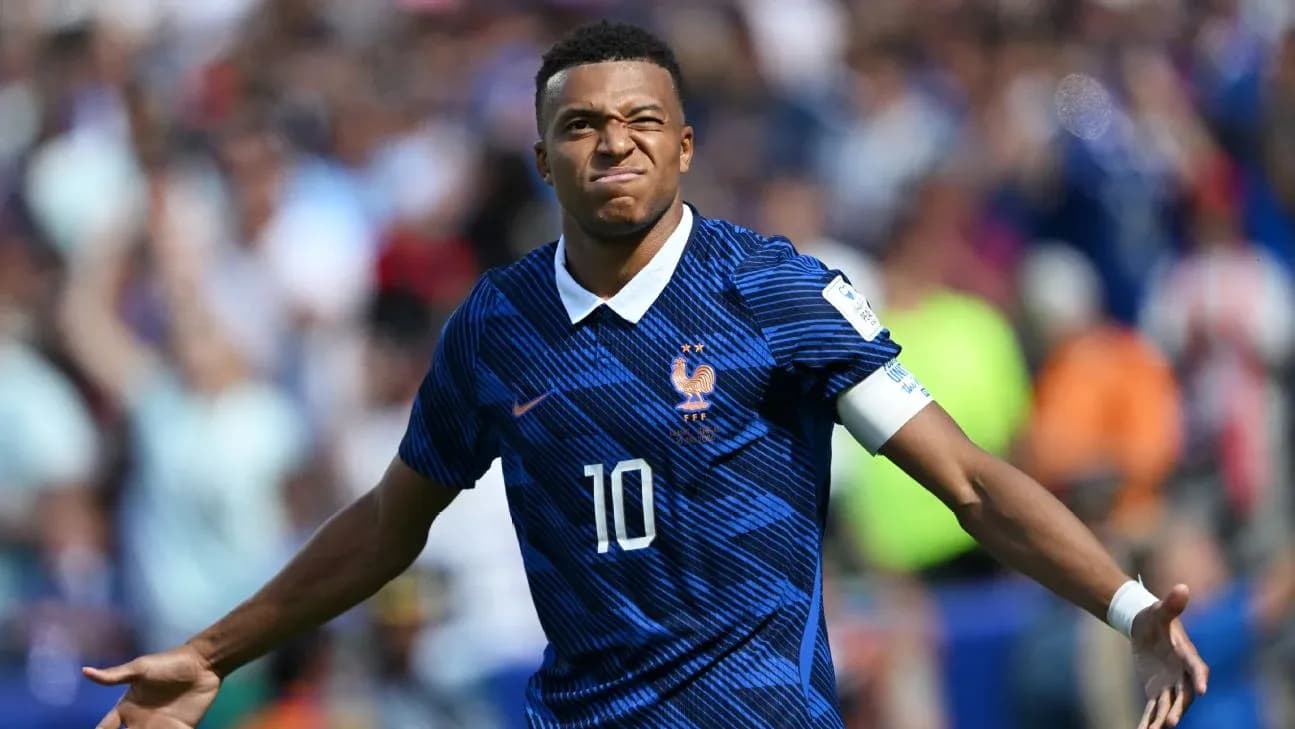
Mbappé’s brace was the natural outcome of this structure. The first goal at 66' came after a period where France had increasingly isolated Senegal’s full-backs; Michael Olise’s assist highlights the right-sided combination play that dragged the defence across before Mbappé attacked the gap. The second, deep in added time at 90+6', came when Senegal were stretched, chasing the game after substitutions had altered their shape. By then, Bradley Barcola’s introduction for Dembélé at 80' had refreshed France’s left flank, and his own goal at 82' — assisted by Rabiot — was emblematic of France’s capacity to exploit tired legs with direct running and late box entries from wide.
Defensive Strategy
Out of possession, France’s defensive plan was compact rather than hyper-aggressive. With only 5 fouls committed, they defended more through positioning and counter-pressing triggers than through repeated challenges. The double pivot shielded central spaces, allowing the back four to hold a relatively high line without being dragged out. Senegal managed just 6 total shots, 2 on goal and 4 inside the box, for an xG of 0.53. That combination suggests that while they did occasionally reach promising areas, they were largely forced into lower-probability situations or rushed finishes.
Maignan’s Goalkeeping
In goal, Mike Maignan (France) was required to make 2 saves. Given Senegal’s low shot volume and modest xG, this reflects a defensive system that limited clear looks rather than a goalkeeping exhibition. Notably, France’s goals prevented figure of -0.94 indicates Maignan conceded slightly more relative to expected than an average keeper might, but with only one goal against and a strong defensive block in front of him, the structural integrity of the team masked any marginal underperformance in pure shot-stopping terms.
Senegal’s Attacking Potential
On the other side, Senegal’s 4-2-3-1 had clear attacking potential on paper, with Sadio Mané, Ismaïla Sarr, Lamine Camara and Nicolas Jackson offering verticality and one-v-one threat. However, their 502 passes (430 accurate, 86%) were often horizontal or in safer zones, reflecting difficulty in progressing cleanly through France’s mid-block. When they did advance, it was more often via direct balls into Jackson or wide switches towards Sarr and Mané than through sustained central combinations.
Mendy’s Workload
Edouard Mendy (Senegal) was significantly busier, making 5 saves. That workload, combined with France’s 8 shots on goal, illustrates how frequently France were able to reach finishing positions despite not utterly dominating possession. Senegal’s own defensive metrics — 9 fouls, 1 blocked shot, 4 corners conceded — show a side that had to defend deeper and more reactively, especially after falling behind.
Senegal’s Substitutions
Tactically, Senegal’s substitutions around the 75–83' mark — introducing Ibrahim Mbaye, Habib Diarra, Ahmadou Bamba Dieng, Iliman Ndiaye and later Pathé Ismaël Ciss — were aimed at injecting energy and direct running. Mbaye’s goal at 90+5', assisted by Ndiaye, shows that this adjustment did add late-game punch, exploiting a more open contest as France managed the lead. Yet by that stage, France’s three-goal cushion, built on superior chance creation and clinical finishing, had effectively decided the match.
Overall Verdict
Overall, the statistical verdict matches the tactical story: France’s higher xG (1.79 to 0.53), better shot quality, and more precise passing network within a well-drilled 4-2-3-1 under Didier Deschamps created a platform for Mbappé and the supporting cast to decide the game. Senegal, under Bouna Thiaw Pape, showed structure and flashes of threat, but their 2 shots on goal and reliance on a late consolation underscore how effectively France controlled both territory and risk.