.svg&w=384&q=75 "Naijagoal logo")
Cremonese vs Pisa: A Crucial Relegation Battle
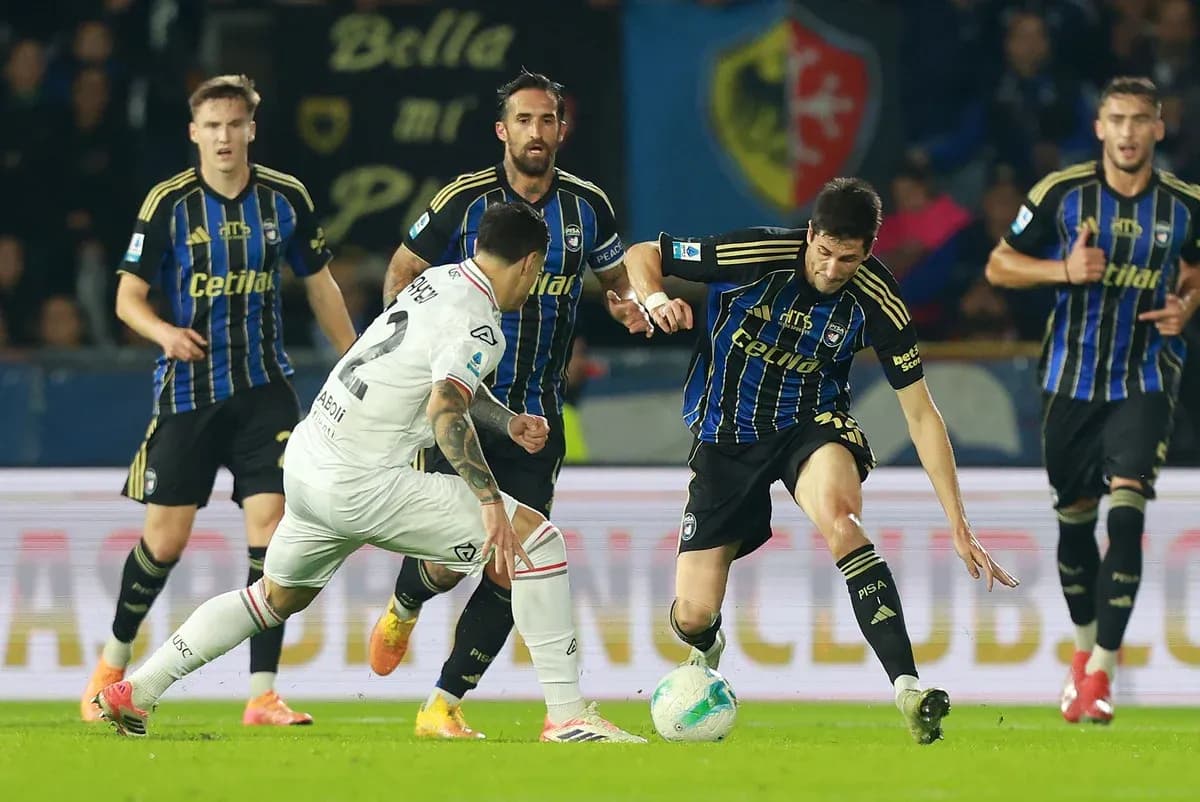
Stadio Giovanni Zini had the feel of a relegation battleground rather than a routine May fixture, and the final scoreline – Cremonese 3, Pisa 0 – told the story of a home side that finally aligned its season-long struggle into ninety minutes of clarity.
I. The Big Picture – a basement clash with real weight
Following this result in Serie A’s Regular Season - 36, the table still paints a harsh picture for both. Cremonese sit 18th on 31 points, Pisa 20th on 18, both locked in the “Relegation - Serie B” zone. Yet the context matters: heading into this game, Cremonese’s overall record of 7 wins, 10 draws and 19 defeats from 36 matches, with 30 goals for and 53 against (a goal difference of -23), suggested a team more stubborn than spectacular. Pisa, by contrast, arrived as the league’s most fragile unit: just 2 wins in 36, 25 goals for and 66 conceded, a goal difference of -41 that has defined their season.
At home, Cremonese had been cautious and often blunt – 3 wins, 7 draws, 8 defeats with 17 goals scored and 25 conceded, averaging 0.9 goals for and 1.4 against per home game. Pisa’s away profile was the mirror of vulnerability: 0 wins, 8 draws, 10 losses, with 16 goals scored and 43 conceded on their travels, an away average of 0.9 scored but a brutal 2.4 shipped per match. This was the statistical fault line the game would inevitably open.
II. Tactical Voids – absences and the discipline backdrop
Marco Giampaolo’s selection was shaped by a cluster of absentees. Cremonese were without F. Baschirotto (thigh injury), R. Floriani (muscle injury), F. Moumbagna (muscle injury) and M. Payero (knock). None appear in the available squad list, but collectively their absence trimmed depth in the defensive and midfield rotations, nudging Giampaolo towards a more orthodox, stable 4-4-2 rather than a bolder three-at-the-back shape that has been his most-used structure this season (the 3-5-2 has been deployed 24 times overall, far more than the 5 matches with 4-4-2).
On the other bench, Oscar Hiljemark had his own gaps to bridge. Pisa travelled without F. Coppola (muscle injury), D. Denoon (ankle injury), C. Stengs (inactive) and M. Tramoni (muscle injury). Again, these players are not in the listed matchday squad, but their absence explains a thinner bench for structural tweaks, especially in attacking creativity.
Discipline has been a quiet but powerful narrative for both sides. Cremonese’s season-long yellow card timing shows a pronounced late-game spike: 27.27% of their yellows arrive between 76-90 minutes, a phase where fatigue and desperation collide. Pisa mirror that pattern with 25.33% of their yellows also in the 76-90 window. Red cards add another layer: Cremonese’s G. Pezzella has already seen one red this season, while Pisa’s Idrissa Touré also carries a dismissal on his record. This is not a fixture of cool heads.
III. Key Matchups – Hunter vs Shield, Engine Room wars
The tactical script began with the formations. Cremonese’s 4-4-2 was clear and classical: E. Audero behind a back four of F. Terracciano, M. Bianchetti, S. Luperto and G. Pezzella; a midfield band of T. Barbieri, A. Grassi, Y. Maleh and J. Vandeputte; with F. Bonazzoli and J. Vardy paired up front.
Pisa lined up in a 3-4-2-1: A. Semper in goal; a back three of S. Canestrelli, A. Caracciolo and R. Bozhinov; a four-man midfield line of I. Toure, E. Akinsanmiro, F. Loyola and M. Leris; and an attacking trident of S. Moreo, I. Vural and F. Stojilkovic.
Hunter vs Shield
The clearest “Hunter vs Shield” duel centred on F. Bonazzoli against Pisa’s defensive core. Bonazzoli has been Cremonese’s primary finisher this season: 9 goals and 1 assist in Serie A, from 33 appearances and 54 shots, 30 of them on target. His penalty record is perfect – 2 scored from 2 – echoing Cremonese’s overall penalty profile of 3 taken, 3 scored and 0 missed (100.00% conversion). He is not just a poacher; 803 completed passes with 13 key passes and 27 tackles underline a forward who stays involved in the build-up and the first line of pressing.
His main obstacle was Pisa’s central pillar, A. Caracciolo. The defender has lived a season of constant fire-fighting: 34 appearances, 71 tackles, 24 successful blocks and 45 interceptions, plus 260 duels with 139 won. Yet his aggression has a cost – 9 yellow cards – and in a team conceding 66 goals overall, his “shield” role has often been about damage limitation rather than control. In this match, with Cremonese’s front two stretching the three-man Pisa back line horizontally, Caracciolo’s usual strengths in aerial duels and last-ditch blocks were exposed by constant movement and support from wide areas.
Engine Room – Vandeputte and Grassi vs Toure and Aebischer’s shadow
The midfield battle was framed by J. Vandeputte and A. Grassi on one side, and I. Toure plus the broader Pisa engine room on the other. Vandeputte arrives as one of Serie A’s more quietly effective creators: 5 assists and 1 goal from 30 appearances, backed by 887 passes and an outstanding 53 key passes. His 21 dribble attempts with 7 successes and a willingness to tackle (37 tackles, 2 blocked shots, 18 interceptions) make him a true two-way wide midfielder.
Behind him, A. Grassi provided positional discipline and vertical passing, allowing Vandeputte to drift inside between Pisa’s lines. Pisa’s nominal counterweight in the middle, I. Toure, is a combative presence – 42 tackles, 8 blocked shots, 24 interceptions and 402 duels with 219 won – but his passing accuracy of 65% betrays a more chaotic profile. His own disciplinary record (4 yellows, 1 red) added risk in a game where Cremonese were keen to draw contact and free-kicks in advanced zones.
In the wider Pisa squad context, M. Aebischer’s season numbers (62 tackles, 6 blocks, 34 interceptions, 31 key passes) show how much Hiljemark usually relies on structured midfielders to stabilise games. Starting instead with Akinsanmiro and Loyola, Pisa leaned into energy and legs rather than control, and Cremonese’s more seasoned pairing exploited that.
IV. Statistical Prognosis – xG logic and defensive solidity
Even without explicit xG values, the season data sketches a clear expected pattern that this 3-0 result faithfully followed. Heading into this game, Cremonese’s overall attacking profile – 0.8 goals per match, with a ceiling of 3 goals both home and away in their biggest wins – suggested that if they could ever open up Pisa’s brittle defence early, a multi-goal home performance was plausible. Pisa’s away numbers, conceding 43 on their travels at 2.4 per away game, almost guaranteed that sustained pressure would yield chances.
Cremonese’s defensive structure, conceding 1.5 goals per match overall and keeping 10 clean sheets in total (6 at home, 4 away), has never been elite but is clearly functional when they control territory. Against a Pisa side that has failed to score in 20 of 36 league matches and averages just 0.7 goals per game overall, the probability of a home clean sheet was always high once the hosts took the lead.
The disciplinary trend – with both sides prone to late yellows and Pisa carrying multiple red-card risks across the season – also tilted the expected game state in Cremonese’s favour once they were ahead. A team that must chase, yet has structural and emotional fragility, is the ideal opponent for a side like Cremonese that thrives more on game management than relentless creativity.
In narrative terms, this 3-0 is less an upset and more a statistical correction: a home side whose numbers hinted at competence finally met an away defence whose season-long collapse was always likely to be punished. Bonazzoli’s presence as a reliable finisher, Vandeputte’s supply line from midfield, and a back four anchored by Bianchetti and Luperto provided just enough solidity to turn probability into reality.
Following this result, both remain in deep trouble in the standings, but the tactical and statistical story is clear: Cremonese, with their defined roles and sharper edge in both boxes, look like a team that at least understands how to survive a fight. Pisa, even in a 3-4-2-1 designed for compactness, still resemble a side whose numbers – and now this scoreline – tell of a season spent permanently on the back foot.